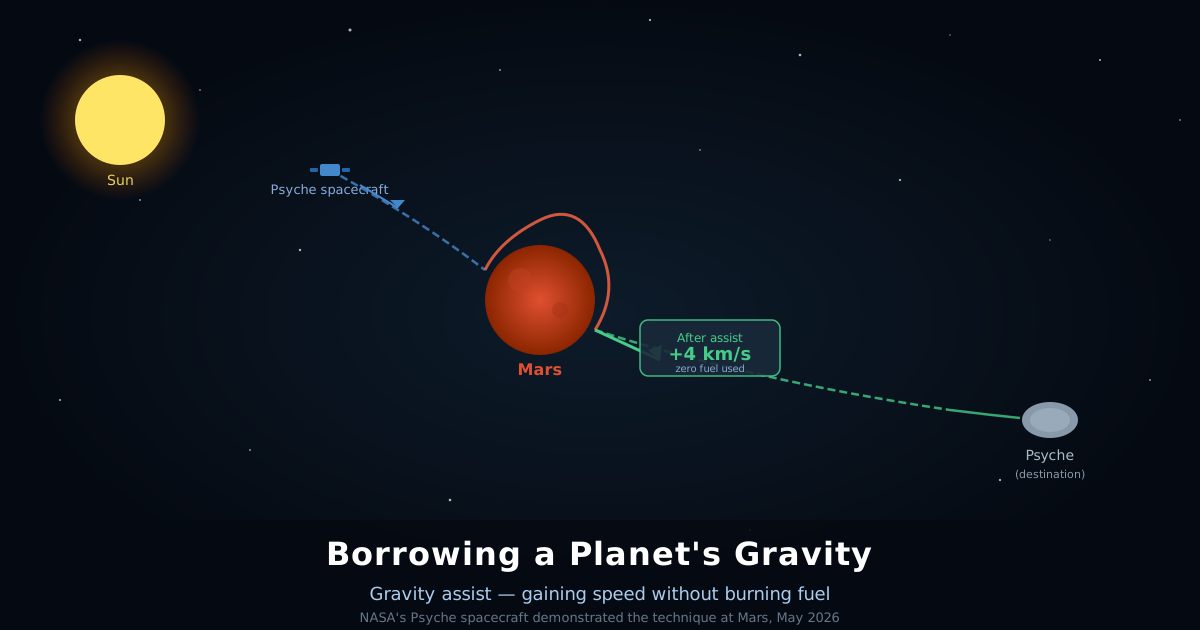
On May 15, 2026, NASA’s Psyche spacecraft skimmed past Mars at roughly 7 km/s, just 4,500 km above the surface.
Mars was never the destination. It was a pit stop — a carefully chosen one. Psyche’s real target is a metal asteroid also named Psyche, sitting about 400 million km away in the belt between Mars and Jupiter. That close encounter with the Red Planet wasn’t a detour. It was the engine.
The spacecraft picked up speed without burning any fuel. Instead, it borrowed Mars’s gravity and orbital momentum.
That technique is called a gravity assist, or swingby.
What Does “Borrowing Gravity” Actually Mean?
Every kilogram of fuel a rocket carries comes at a steep cost — not just because fuel is heavy, but because carrying more fuel requires even more fuel to lift that fuel. This compounding problem is captured in the Tsiolkovsky rocket equation, and it essentially means that accelerating in space is extraordinarily expensive.
So whenever a spacecraft needs to travel far, mission designers try to let planets do as much of the work as possible. Gravity assist turns that idea into a practical maneuver.
The mechanics feel counterintuitive at first. A spacecraft swings toward a planet, curves around it, and flies away faster than it arrived. How?
The key is that planets aren’t sitting still. They orbit the Sun, moving at tens of kilometers per second. When a spacecraft approaches a planet, it gets pulled in and accelerates. As it arcs around and departs, it’s essentially been flung outward in the direction of the planet’s motion — carrying a little of that orbital momentum with it.
Energy is conserved. The planet loses a tiny amount of orbital energy equal to what the spacecraft gained. But a planet’s mass is trillions of times greater than a spacecraft’s, so that loss is negligible beyond all measure.
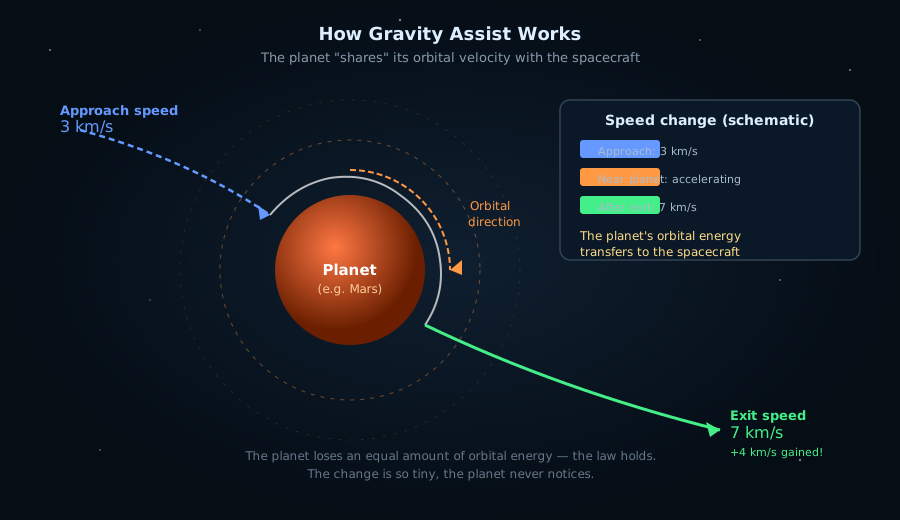
What the Numbers Look Like
Psyche gained about 4 km/s from the Mars flyby. To put that in perspective: 4 km/s means covering the straight-line distance from New York to Los Angeles in under a minute. It’s more than 1,000 times faster than a car on a highway.
To generate that same delta-v with onboard propulsion, Psyche would have needed a drastically heavier fuel load — meaning a bigger, more expensive spacecraft, a bigger rocket, and a bigger launch bill. What the mission actually paid was years of meticulous trajectory design and the operational cost of timing the Mars encounter just right.
That’s why gravity assist is sometimes called a “free ride.” It isn’t truly free — the energy comes from the planet’s orbit — but since the planet doesn’t notice the difference, it’s about as close to free as physics allows.
Flyby distance matters enormously. Too far, and the gravitational pull is too weak to do much. Too close, and you risk atmospheric drag or, in the worst case, capture. That 4,500 km altitude wasn’t a rough estimate. It was the product of painstaking calculation.
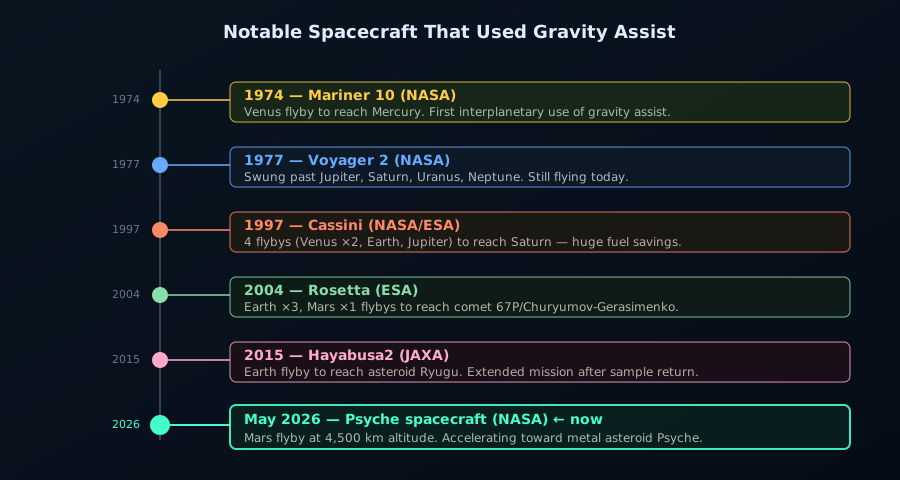
Fifty Years of the Technique — From Mariner 10 to Voyager and Beyond
The first spacecraft to use gravity assist for an interplanetary journey was Mariner 10, in 1974.
It swung past Venus to redirect itself toward Mercury — a trajectory that would have been nearly impossible with propulsion alone. For the engineers who designed it, watching the numbers confirm the theory in real time must have been something.
Then came the real showcase. Voyager 2, launched in 1977, used a rare planetary alignment to pull off what mission planners called the Grand Tour: consecutive flybys of Jupiter, Saturn, Uranus, and Neptune. Gravity assist made the entire sequence possible. Voyager 2 is still traveling today, one of the few human-made objects to have crossed into interstellar space.
ESA’s Rosetta, launched in 2004, is another instructive case. It needed three Earth flybys and one Mars flyby just to reach comet 67P/Churyumov-Gerasimenko — a slow-moving object so hard to match orbits with that Rosetta had to work its way there gradually, using every planetary encounter it could find.
Japan’s Hayabusa2 used an Earth flyby to reach asteroid Ryugu, returned a sample to Earth, and then departed for yet another asteroid on an extended mission — with gravity assist principles guiding each leg of the journey.
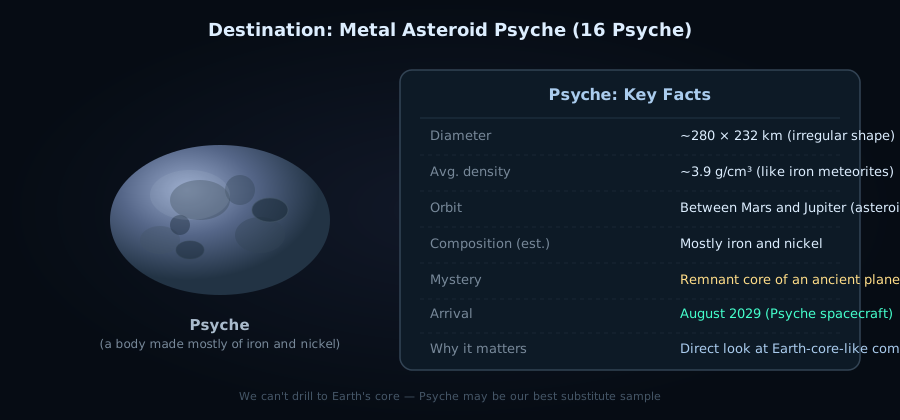
The Destination: A World Made of Metal
So why is Psyche making this complicated trip in the first place? Because its destination is one of the strangest objects in the solar system.
Asteroid Psyche is roughly 280 km across. It isn’t rock, and it isn’t ice. Its bulk appears to be iron and nickel — the same stuff that makes up Earth’s core.
Here’s the thing: no human has ever seen Earth’s core directly. Drilling to a depth of 6,400 km is not something we know how to do, and it probably won’t be feasible for a very long time.
Asteroid Psyche may be the closest substitute we’re ever likely to get. The leading hypothesis is that it was once the core of a forming planet — a protoplanet repeatedly battered by collisions that stripped away all its rocky outer layers, leaving just the metallic interior exposed. If that’s right, studying Psyche is as close as we can get to examining what sits at the center of our own planet.
The Psyche spacecraft is scheduled to arrive in August 2029. Once in orbit, it will map the surface, measure the magnetic field, and analyze the chemical composition in detail. Whatever it finds will sharpen — or overturn — our models of how rocky planets are built from the inside out.
Trajectory Design as a Craft
Gravity assist only works when the planet is actually there — in the right place, at the right time. Planets move. If your spacecraft arrives and the planet has already passed, you’ve missed your window.
That’s why launch windows for these missions are so narrow. For Psyche, October 2023 was the optimal departure. A delay of a few weeks would have scrambled the Mars encounter entirely.
Teams spend years designing the trajectory, then build the spacecraft around those constraints, then wait for the specific hour when conditions align. It’s an enormous amount of computation converging on a very small window of time. Space exploration, it turns out, is largely a story about logistics.
When Psyche made its Mars pass on May 15, it validated years of that planning in a few hours of flight.
Gravity Assist Can Also Slow You Down
There’s a flip side worth knowing. Gravity assist isn’t only for acceleration. Approach a planet from the opposite angle — passing in front of its direction of travel rather than behind it — and the interaction saps speed instead of adding it.
ESA and JAXA’s BepiColombo mission to Mercury is doing exactly this right now. Mercury sits close to the Sun, deep in its gravity well, which means arriving spacecraft come in fast. Rather than burning enormous amounts of fuel to brake, BepiColombo is bleeding off speed through a series of planetary flybys, carefully shedding velocity across multiple encounters with Venus and Mercury itself.
In space, whether you want to go faster or slower, the most efficient path often runs through someone else’s gravity field.
In August 2029, when Psyche finally pulls into orbit around a world made of iron, we may learn something new about the center of our own planet. By then, Mars will have long since forgotten its role in the story, quietly continuing its orbit as it always has.
Humanity keeps reaching a little farther — not by brute force, but by knowing when to let gravity do the work.