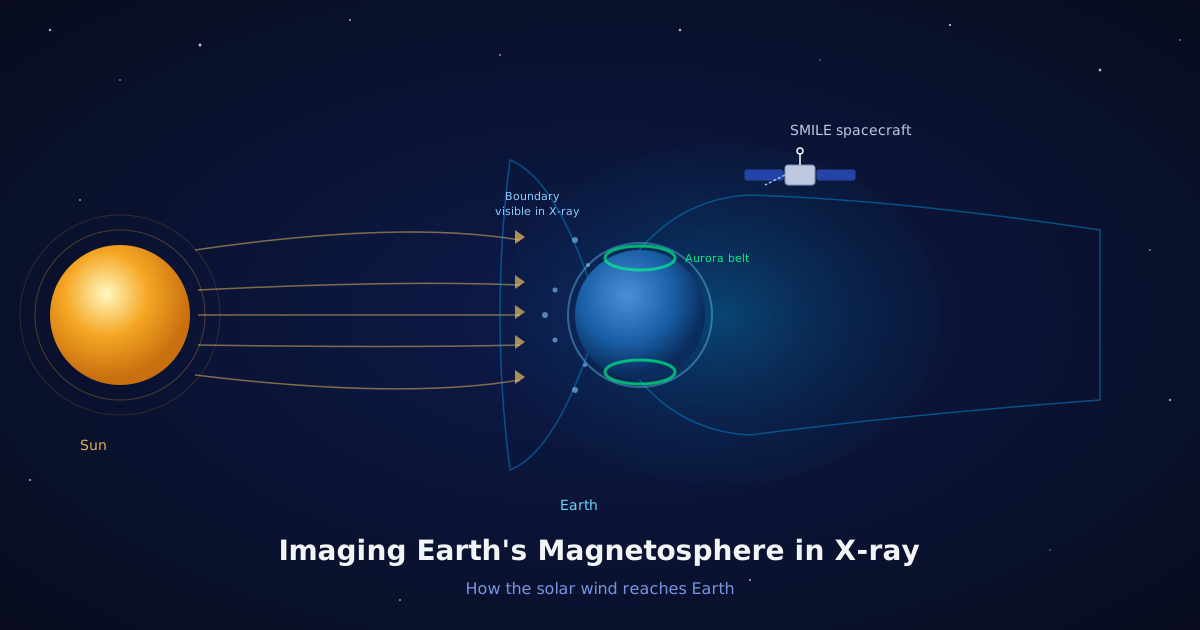
A storm of particles from the Sun is heading toward Earth. Four hundred kilometers every second — an invisible torrent of charged particles racing through space.
The moment that stream collides with Earth’s magnetic field — flaring with X-ray light as it crashes into the boundary — is something humanity has never actually seen as moving images. On May 19, 2026, that’s supposed to change for the first time.
What the Solar Wind Is Actually Doing
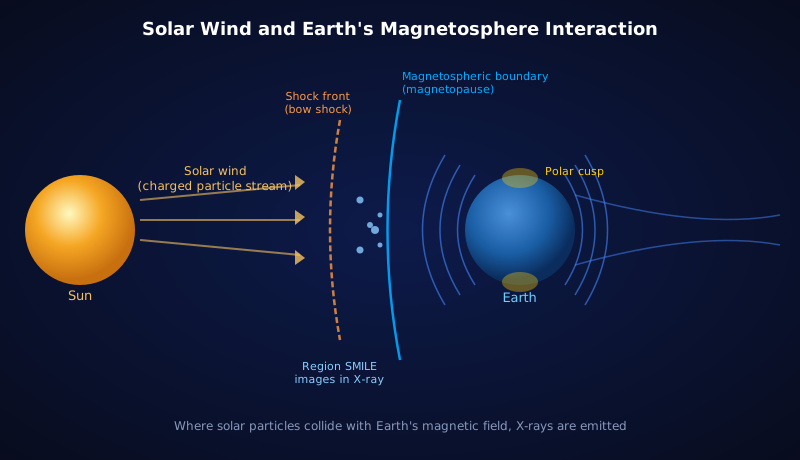
The Sun constantly sheds particles. This outflow of protons and electrons is called the solar wind, and even on calm days it moves at 300 to 500 km/s. When a solar flare or coronal mass ejection (CME) erupts, both the speed and density spike dramatically.
So what happens when this storm hits Earth directly?
The honest answer is: nothing, at least not at ground level. Earth has a magnetic field that continuously deflects charged particles. The bubble-like region that field creates — the magnetosphere — acts as an invisible shield protecting life on Earth.
But the shield isn’t perfect. At the boundary where the solar wind slams into it, energy gets exchanged. Magnetic field lines reconnect, particles stream in, and auroras light up. Researchers still don’t fully understand how that mechanism works.
The Problem of Never Having Looked
Honestly, this is a bit surprising. Humans have walked on the Moon, driven rovers on Mars, and sent a spacecraft all the way to Pluto. Yet we have never captured, in real-time video, the dynamics of the very shield protecting our planet.
The reason is how difficult it is to observe.
The magnetosphere is a vast structure wrapping around the entire Earth. On the dayside, the boundary surface — the magnetopause — sits roughly 60,000 to 100,000 km from Earth’s center. Satellites scattered across that enormous volume can only make point measurements. We’ve accumulated plenty of data saying “the magnetic field here looks like this,” but capturing the whole picture as a single image has been out of reach.
A change of approach was needed.
The key insight: use X-rays. At the magnetospheric boundary, charged particles in the solar wind collide with gas drifting around Earth (the geocorona) and emit X-rays. If you can photograph that glow from a distance, you can record the shape and movement of the magnetosphere as actual imagery. The challenge is finding the right vantage point.
SMILE’s Mission
SMILE — Solar wind Magnetosphere Ionosphere Link Explorer — is a spacecraft developed jointly by ESA (the European Space Agency) and the Chinese Academy of Sciences (CAS).
It’s scheduled to launch on May 19, 2026, aboard a Vega-C rocket (delayed from its original date).
The orbital design is clever. SMILE will be placed in a highly elliptical orbit — an egg-shaped path that climbs to 121,000 km above the North Pole and dips to just 5,000 km above the South Pole, with an inclination of 73 degrees.
From the high point (apogee) above the North Pole, SMILE gets a prime seat overlooking the magnetosphere. The math works out to up to 40 hours of continuous imaging per orbit. What could only ever be a snapshot from previous satellites can finally become a movie.

Four Instruments Working at Once
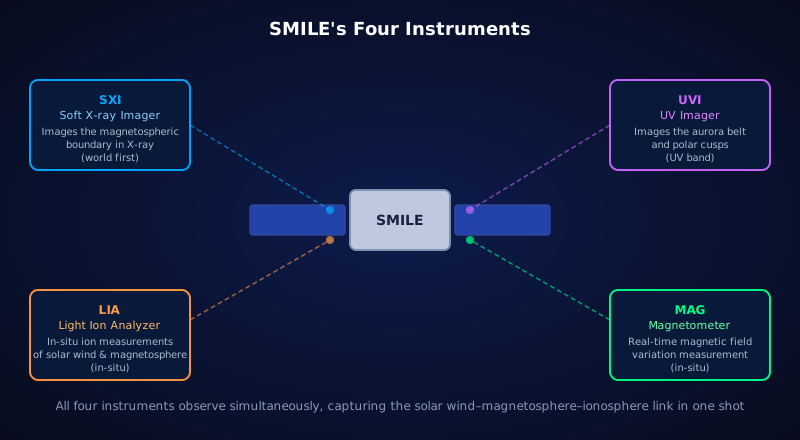
SMILE carries four different instruments. Each one offers a different kind of “eye,” and together they build up a complete picture.
SXI (Soft X-ray Imager) is the headline instrument. It will image the magnetospheric boundary and the polar cusps — the gaps where solar wind particles can funnel directly into Earth’s magnetic field — in X-ray light. This is the first attempt of its kind anywhere.
UVI (UV Imager) photographs the auroral zone in ultraviolet. Tracking the shape and movement of auroras lets scientists follow exactly where and how much energy is being poured into the magnetosphere.
LIA (Light Ion Analyzer) and MAG (Magnetometer) are the in-situ measurement tools. Wherever SMILE happens to be flying, they continuously measure the ion composition of the local solar wind and magnetosphere, and record magnetic field fluctuations in real time.
The key is doing imagery (SXI + UVI) and in-situ measurements (LIA + MAG) simultaneously. Imagery alone tells you what is happening but not why. Simultaneous observations let you pin down cause and effect in a single pass.
Three Questions SMILE Is Trying to Answer
The mission team has framed three fundamental questions it wants to address.
1. What are the basic modes of the dayside magnetosphere–solar wind interaction?
On the dayside, where the solar wind contacts the magnetosphere, field lines from each side reconnect in a process called magnetic reconnection. How that process repeats — what patterns it follows, what triggers each cycle — is something we lack systematic data on. SMILE’s continuous video could finally map out the periodicity and conditions.
2. What drives the substorm cycle?
A substorm is when Earth’s magnetosphere temporarily destabilizes, unleashing a large-scale aurora. It looks sudden, but SMILE aims to capture what happens before and after, revealing both the trigger and the recovery mechanism.
3. How do major geomagnetic storms get started?
The large-scale “geomagnetic storms” driven by CMEs can knock out GPS, disrupt communications satellites, and stress power grids. The early stages of how these storms develop remain invisible. SMILE’s imagery will directly observe that process for the first time.
The Space Weather Forecast Problem
What researchers want from SMILE isn’t just an updated understanding. Improving the accuracy of space weather forecasting is the other major goal.
Even when we know a solar storm is coming, today’s forecasts are barely more precise than “something big might hit.” The magnetosphere’s response — and exactly when that impact reaches Earth’s surface — isn’t visible enough to allow for much more specificity.
If SMILE can systematically record how the magnetosphere moves and responds, those forecast models can be updated. In practical terms, it opens up the possibility of predictions like: “This geomagnetic storm will start affecting GPS in X hours.”
The initial three-year mission probably won’t yield complete answers. But at minimum, we’ll finally have imagery of something that has never been seen before — and that, I think, is a bigger deal than it might sound.
A European–Chinese Partnership
One thing worth noting about this mission is the partnership itself: ESA and the Chinese Academy of Sciences. In recent years, space cooperation between Europe and China has navigated some politically delicate territory.
SMILE was selected back in 2015. Development has stretched over more than a decade, through shifting international dynamics — and the project has kept moving. Space science is a domain where cooperation tends to persist beyond political friction, maybe because both sides have too much invested to walk away. Or maybe that’s wishful thinking.
Launch is set for May 19, 2026. Over a three-year mission, the way we see the magnetosphere could look quite different on the other side. We might even understand why auroras appear where they do — not just that they look beautiful, but the actual why.
Space weather turns out to be a surprisingly local story.
Sources
- ESA: SMILE Mission Overview
- ESA: Smile set to launch on 19 May
- Wikipedia: SMILE (spacecraft)