For decades, the planet closest to the Sun has been an afterthought.
Mercury sits about 58 million kilometers from the Sun — roughly 0.39 times Earth’s distance. NASA’s Mariner 10 made the first close flyby in 1974, and it wasn’t until 2011 that MESSENGER became the first spacecraft to orbit Mercury. Mars, meanwhile, has been visited by mission after mission. Mercury kept getting bumped to the back of the queue.
The reason is straightforward: getting to a planet that close to the Sun is genuinely hard. Slowing down near such a powerful gravitational source requires a spacecraft heading inward to actually decelerate against its initial velocity. You can carry enough fuel to do it directly, or you can use planetary gravity assists to bleed off speed gradually — either way, it takes time.
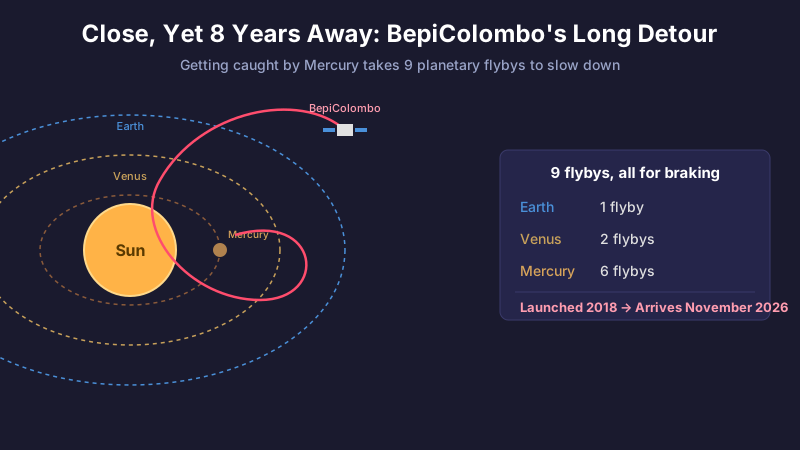
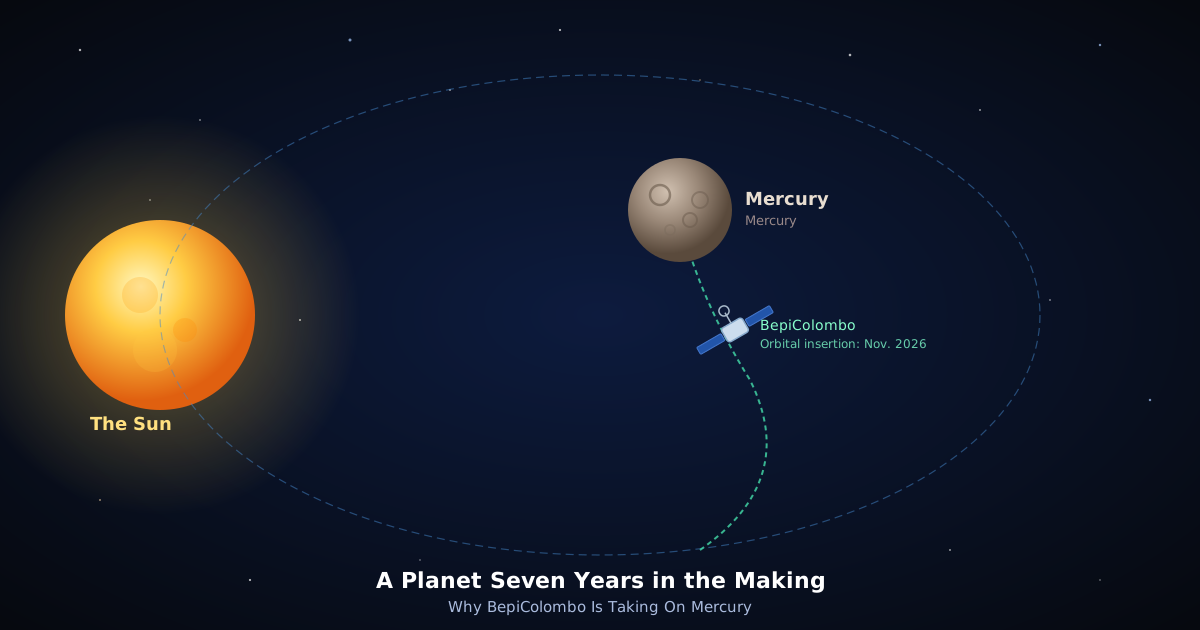
BepiColombo, the joint European–Japanese mission, went with the gravity assist approach. Launched in 2018, the spacecraft will finally enter Mercury’s orbit in November 2026 — eight years after leaving Earth.
Why Does It Take Over Seven Years?
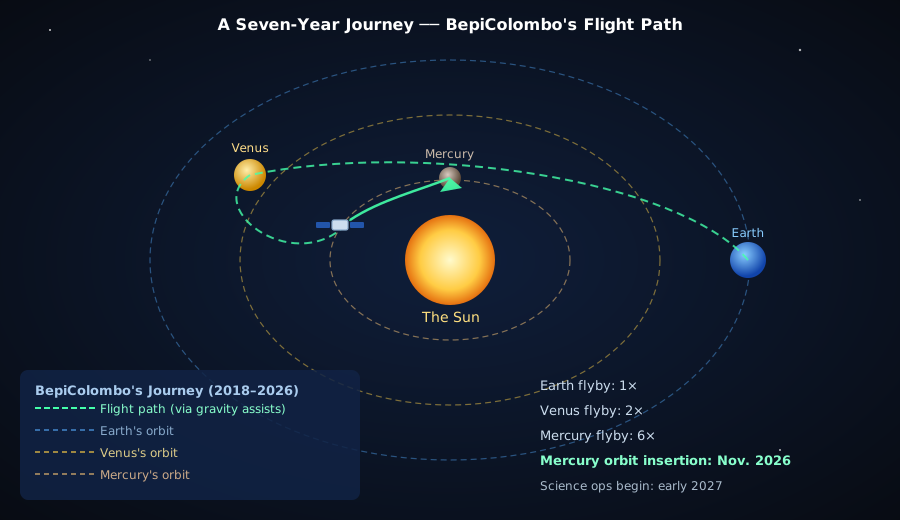
You may have heard the saying that reaching Mercury takes more fuel than leaving the solar system entirely. It sounds like an exaggeration, but it isn’t.
When a spacecraft heads toward the outer planets — Jupiter, Saturn — it just needs a small boost to ride an outward trajectory. Going inward is trickier. Earth orbits the Sun at about 30 km/s, and a spacecraft leaving Earth carries that same velocity. To fall into a closer orbit around the Sun, it actually needs to slow down, which counterintuitively requires a significant energy investment.
BepiColombo’s solution was the gravity assist, or swingby — using the gravitational pull of planets to gradually reshape its orbit and shed speed on the way to Mercury.
- Earth flyby: 1 pass (April 2020)
- Venus flybys: 2 passes (October 2020, August 2021)
- Mercury flybys: 6 passes (2021–2025)
Six Mercury flybys, each one scrubbing off a little more velocity, before the spacecraft finally slips into orbit in November 2026. The closer it gets to the Sun, the hotter things become — BepiColombo is designed to withstand temperatures up to 350°C.
There was also a timing hiccup. The original plan called for arrival in 2025, but the ion engine (which uses electricity rather than chemical propellants for thrust) produced slightly less output than expected, pushing the timeline back by about a year. The spacecraft isn’t broken — just slower. Scientific expectations remain unchanged.
So What Makes Mercury So Mysterious?
Mercury doesn’t get a lot of headlines. It has the reputation of a small, crater-pocked rock — not exactly the most glamorous destination in the solar system.
But the more you look, the stranger it gets.
An impossibly large core
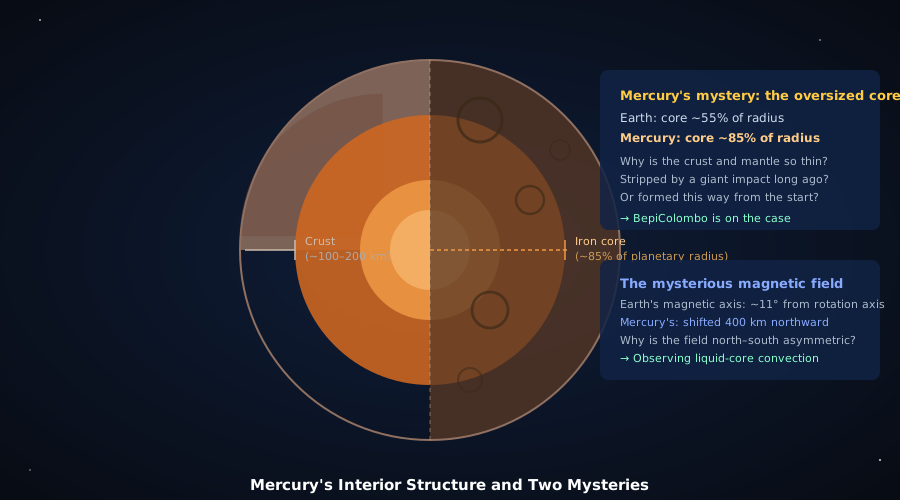
Mercury’s iron core takes up roughly 85% of the planet’s radius. For comparison, Earth’s core accounts for about 55%. Why is the crust and mantle so thin? The leading hypothesis is a giant impact: something enormous slammed into Mercury long ago and blasted away the outer layers. But that’s never been confirmed. The planet may simply have formed this way.
A magnetic field that doesn’t add up
Among rocky planets, only Earth and Mercury have their own global magnetic fields — Mars and Venus lack them. But Mercury’s field is strangely lopsided. The magnetic axis isn’t centered on the planet; it’s offset about 400 km north of center. A magnetic field with genuine north–south asymmetry. No one knows why. The liquid-iron dynamo in the core seems to be running unevenly, but the details remain a mystery.
These questions demand sustained observation from orbit, and that’s what BepiColombo is built to provide. Mariner 10 only zipped past three times. MESSENGER was constrained by its orbital geometry and couldn’t adequately survey the southern hemisphere. BepiColombo will be the first mission to put two spacecraft in Mercury orbit simultaneously, observing from different altitudes.
A Two-Spacecraft Team
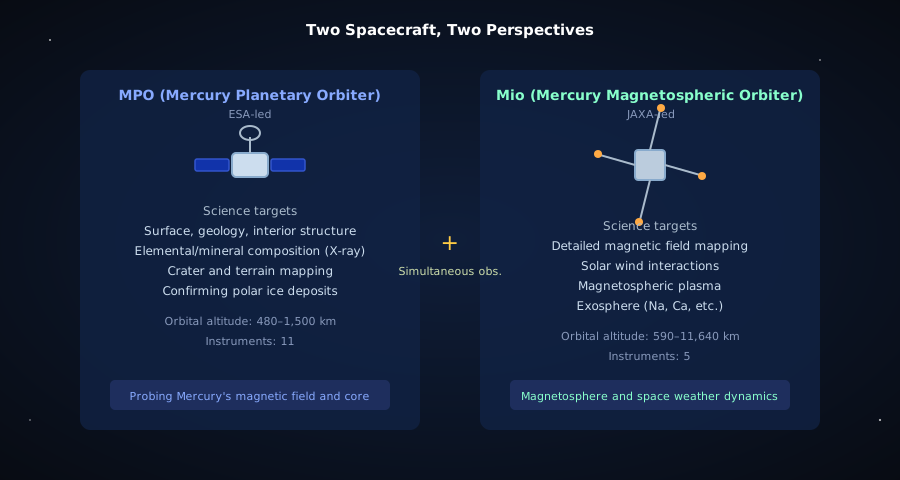
BepiColombo is not one spacecraft — it’s two, stacked together for the cruise to Mercury. Once in orbit, they separate and operate independently on different trajectories.
MPO (Mercury Planetary Orbiter) — ESA-led
MPO takes the low orbit and focuses on Mercury’s surface and interior. Its 11 instruments include an X-ray telescope that will map the elemental composition of the surface in unprecedented detail — silicon, magnesium, iron, calcium. Mapping another planet’s surface in X-rays has never been done before.
Mio (Mercury Magnetospheric Orbiter) — JAXA-led
Also called MMO, Mio sweeps through a wide elliptical orbit at higher altitude, studying Mercury’s magnetic field and the surrounding space environment. Mercury has almost no atmosphere, so the solar wind hammers directly toward the surface. By watching how that wind interacts with Mercury’s magnetosphere, Mio may help explain why the planet has a magnetic field at all — and why it’s so asymmetric. The contrast with Earth’s own magnetosphere should be illuminating.
Having two spacecraft at different altitudes observing simultaneously gives this mission a three-dimensional picture of Mercury that no single orbiter could achieve. That dual-spacecraft design is BepiColombo’s defining feature.
How Can a Scorching Planet Have Ice?
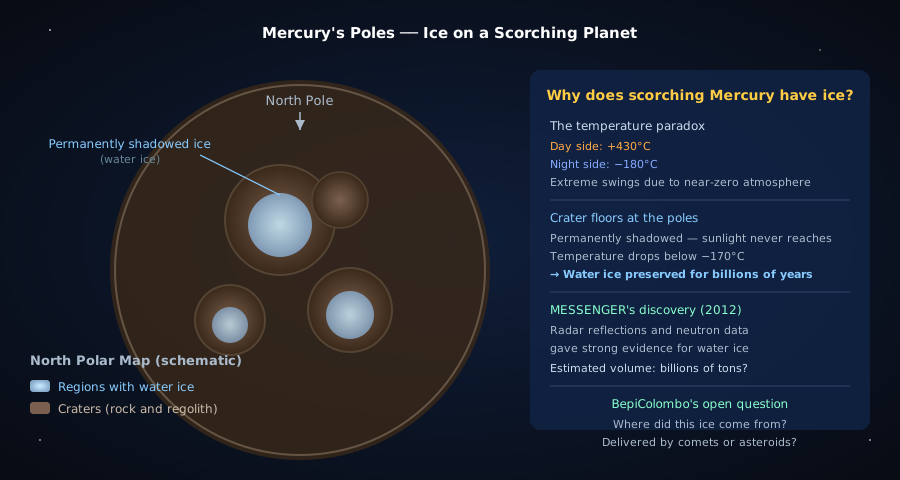
One of Mercury’s more counterintuitive secrets: there’s water ice sitting at both poles.
That sounds impossible. The sunlit side of Mercury hits 430°C. But Mercury has almost no atmosphere to redistribute heat, which means shadowed areas stay permanently cold. Deep inside polar craters that never see sunlight, temperatures drop below −170°C — and there, comets and asteroids appear to have deposited water ice that has been sitting undisturbed for hundreds of millions of years.
MESSENGER collected strong evidence for this using radar reflections and neutron spectroscopy. But “strong evidence” isn’t confirmation. To nail down the composition directly, you need a gamma-ray and neutron spectrometer like the one carried by BepiColombo’s MPO.
If Mercury’s polar ice turns out to be chemically identifiable water, it becomes a data point for a much larger question: how much water did comets bring to the inner solar system? Where did Earth’s oceans actually come from?
After All the Waiting
Full science operations are expected to begin in early 2027, a few months after orbital insertion, once system checks and instrument calibrations are complete. The nominal science mission runs for one Earth year, with a potential extension into a second.
Mercury’s long neglect came down to pure difficulty. The technical hurdles were high, the cost was significant, and it was harder to sell to a general audience than Mars — “searching for life” makes a compelling headline; “understanding why a planet’s magnetic field is off-center” is a tougher pitch.
But understanding Mercury means understanding how rocky planets form, how magnetic fields arise, and whether a planet can survive that close to its star. The innermost planet in our solar system turns out to tell the story of the whole solar system.
The spacecraft has been traveling for seven years. It’s almost there.