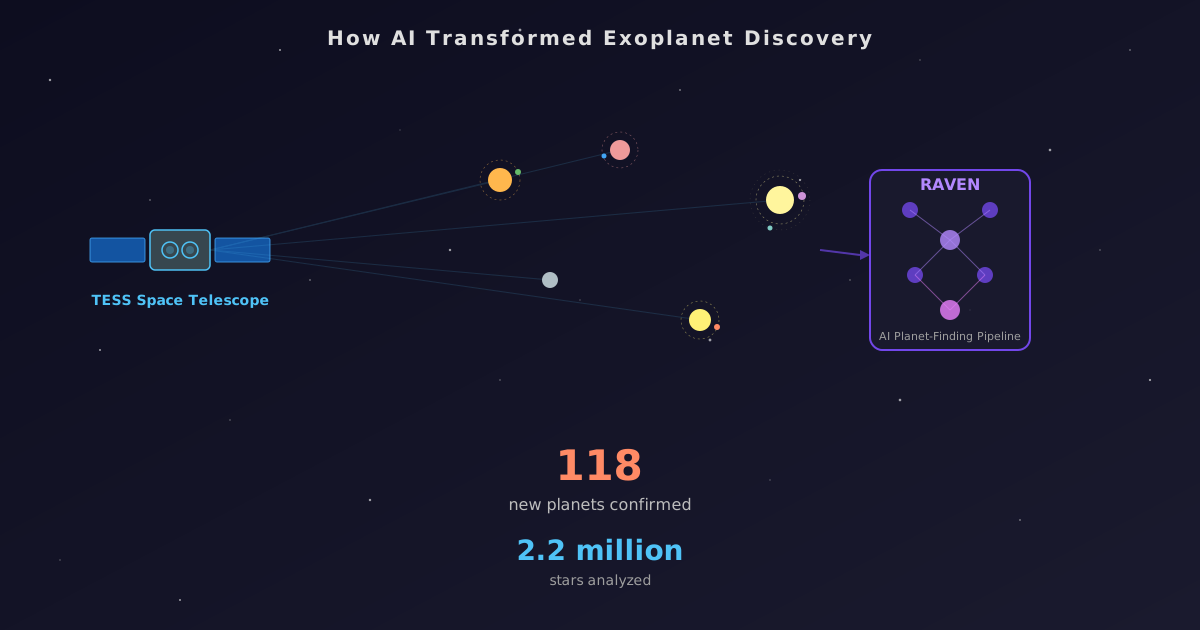
2.2 million. That’s how many stars the AI pipeline RAVEN tore through in a single pass. If human astronomers had tried to check each one by hand, we’d be waiting decades.
The results were hard to believe: 118 planets newly confirmed, plus over 2,000 high-confidence candidates flagged for follow-up. On top of that, the data yielded a striking statistic — roughly 10% of Sun-like stars harbor a planet orbiting closer than 16 days. That number is basically a body blow to the old idea that planets are rare. Suddenly, “how common are planets?” has a hard answer.
How Do We Even Find Exoplanets?
Let’s start with the basics. An exoplanet is any planet orbiting a star other than our Sun. Since Swiss astronomers made the first confirmed detection in 1995, the tally has climbed past 5,000 confirmed worlds.
But “finding” one isn’t as simple as pointing a telescope and snapping a picture. Planets are tiny compared to their host stars, and the star’s glare drowns them out completely. Trying to spot a planet next to its star from light-years away is a bit like trying to see a firefly hovering right next to a floodlight — from a hundred kilometers out. It’s not really a fair fight.
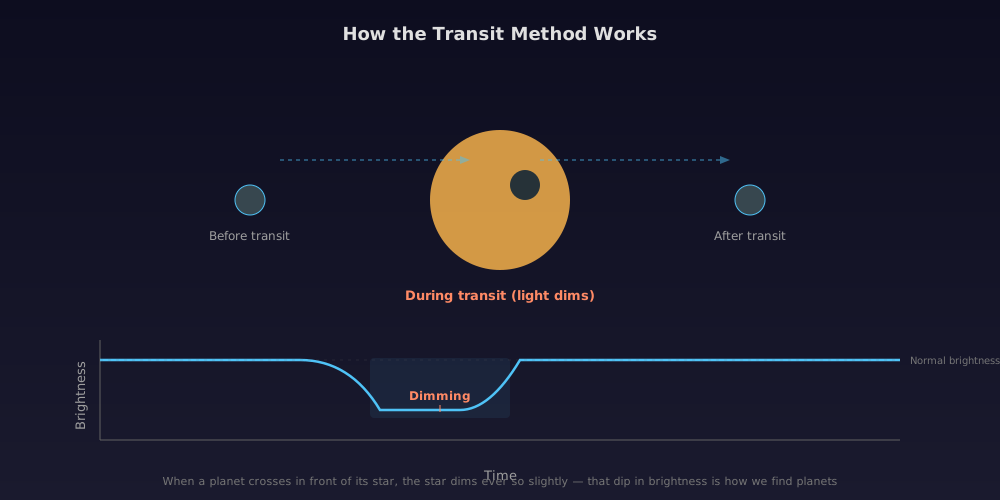
So astronomers rely on indirect methods. The one TESS (Transiting Exoplanet Survey Satellite) uses is called the transit method. When a planet passes in front of its star from our line of sight, it blocks a tiny fraction of the starlight, causing a faint dip in brightness. Detect that dip pattern, and you’ve found a planet candidate.
The dimming is tiny — typically somewhere between 0.01% and 1%. You can’t see it with the naked eye. That’s why you need a precision space telescope and the computing power to process enormous datasets.
TESS — The All-Sky Planet Hunter
NASA launched TESS in April 2018. Equipped with four wide-field cameras, it swept across the sky in sections and covered more than 85% of the entire sky within two years. An extended mission is still ongoing today, revisiting those same regions for deeper coverage.
TESS focuses on stars that are relatively nearby and bright — a deliberate contrast with its predecessor, Kepler (2009–2018), which stared at a small patch of distant, faint stars for years. TESS takes the opposite approach: broad and shallow, but close enough that any planets found can later be studied in detail by the James Webb Space Telescope or other powerful observatories.
The problem is scale. TESS has observed millions of stars. A light curve — a plot of a star’s brightness over time — exists for every single one of them. There is no way for humans to eyeball millions of these curves and catch everything that’s hiding in the data. For years, TESS sat on a mountain of potential discoveries that no one had the bandwidth to fully excavate.
RAVEN Solved the Bottleneck
That’s where RAVEN comes in. Developed by researchers at the University of Warwick in the UK, RAVEN is an automated AI pipeline — a system that takes raw TESS data at one end and spits out confirmed planets at the other.
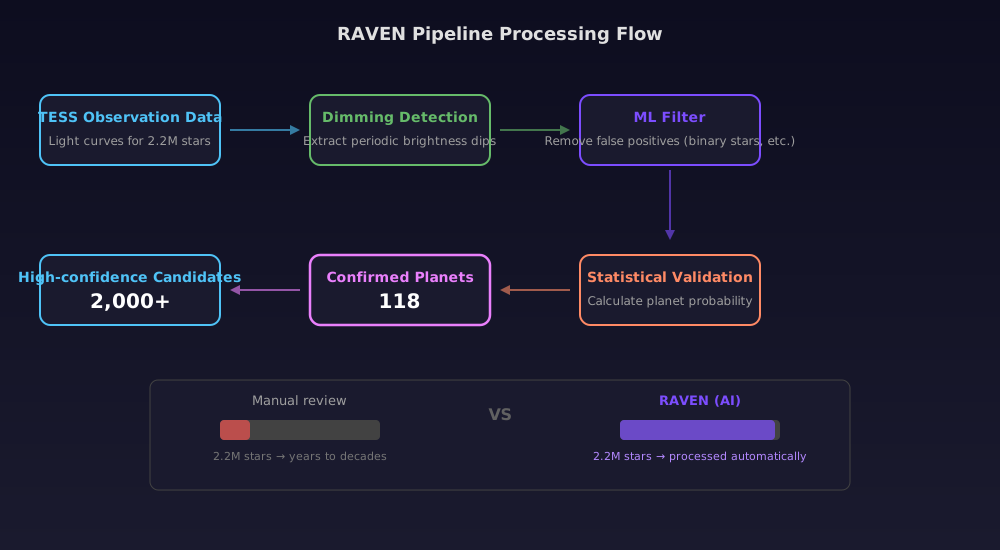
The workflow goes roughly like this. First, RAVEN ingests light curves for all 2.2 million stars in the dataset and scans each one for periodic brightness dips. That part has been possible with conventional software for a while. The real difference comes next.
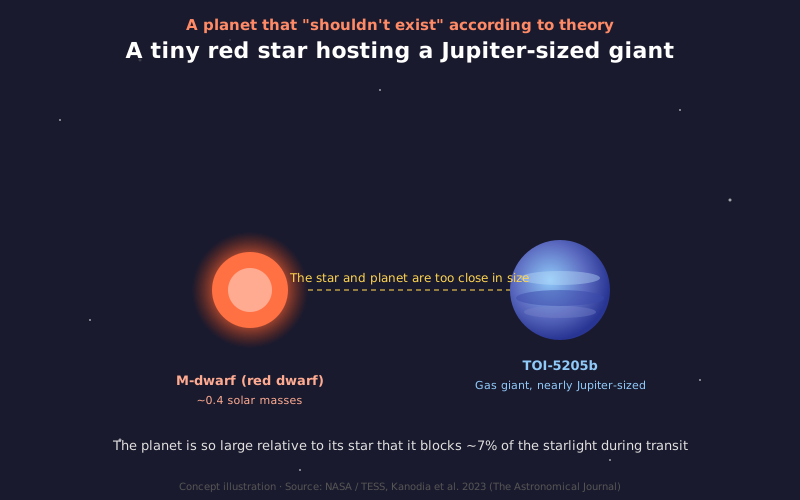
Finding a dip is the easy part. Knowing whether it’s actually a planet is much harder. Binary star systems, for example, produce similar-looking signals when one star eclipses the other — what astronomers call a “false positive.” To weed these out, RAVEN deploys machine learning models trained on vast amounts of simulated data. A neural network evaluates each candidate and decides: planet-like, or not? Finally, statistical validation kicks in, and only those signals with sufficiently high planet probability get promoted to “confirmed.”
The entire pipeline runs automatically. That’s the point.
You might be tempted to file this under “AI did a thing, cool” and move on. But there’s something more interesting going on under the hood.
How the Machine Learned to See
The core of RAVEN is a deep learning model — the kind that treats a light curve a bit like an image, recognizing patterns that say “this looks like a transit” versus “this doesn’t.”
Training that kind of model in astronomy comes with a hard problem: you don’t have enough real examples. Fewer than ten thousand exoplanets have been confirmed so far, and their light curves come from a messy mix of instruments and conditions. That’s not nearly enough data to train a robust classifier.
The Warwick team solved this with simulation. They generated huge volumes of synthetic light curves — with and without planets — using physical models of stellar systems. Realistic noise was baked in so the synthetic data would behave like the real thing. The result was a model that can match or outperform human experts at distinguishing genuine transits from imposters.
The lead researcher on RAVEN, Dr. Marina Lafarga Magro of the University of Warwick, along with developer Dr. Andreas Hadjigeorgiou and their collaborators, published the results in the peer-reviewed journal Monthly Notices of the Royal Astronomical Society. This is not a preprint or a press release — it’s proper, refereed science.
One in Ten Sun-like Stars Has a Neighbor
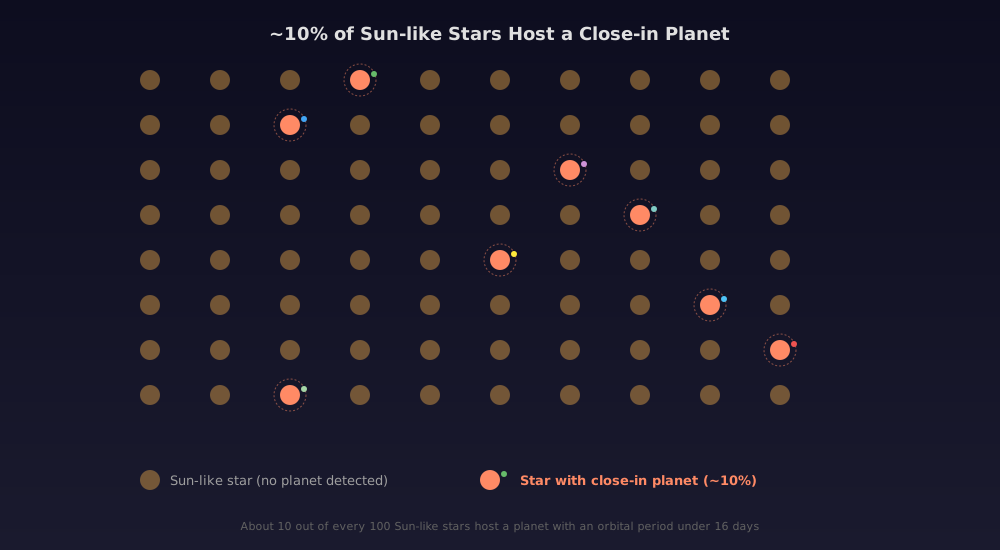
Of all the numbers RAVEN produced, this one hits hardest. Among F-, G-, and K-type stars — the solar-type stars most similar to our own Sun — somewhere between 9% and 10% have at least one planet with an orbital period of 16 days or less.
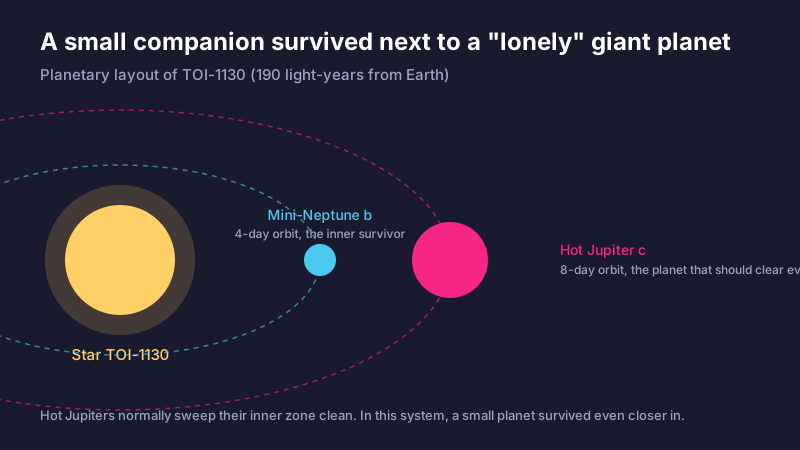
Sixteen days. Earth takes 365. A planet on a 16-day orbit is hugging its star at a distance that would make Mercury feel like the outer suburbs. Surface temperatures on these worlds can reach hundreds of degrees Celsius, which makes them pretty poor candidates for life as we know it.
But that’s not the point. The point is the frequency. Look up at the night sky, pick out ten Sun-like stars, and statistically one of them has a tight little planet zipping around it right now. That’s the universe we live in.
There’s an interesting corollary tucked into the data as well. The “Neptune desert” — a region close to stars where Neptune-sized planets are conspicuously absent — shows up sharply in RAVEN’s results. Only about 0.08% of solar-type stars host a Neptune-size planet in a close-in orbit. Whether that’s because their atmospheres get stripped away by stellar radiation, or because they simply never migrate that close in the first place, remains an open question. RAVEN’s dataset may help narrow down the answer.
A Universe Where Planets Are Normal
It’s worth stepping back. When the first exoplanet was confirmed in 1995, the astronomical community was genuinely shaken. Planets outside our solar system? Really? In the thirty years since, the picture has flipped completely.
The emerging view now is that stars without planets might be the exception. Kepler data already suggested the Milky Way alone could harbor hundreds of billions of planets. RAVEN’s results add another data point to that pile.
Which makes Fermi’s paradox feel heavier. Planets everywhere, and still no confirmed signal of life beyond Earth. The more planets we find, the louder the silence gets.
That said, most of what RAVEN discovered are scorching close-in worlds — not exactly prime real estate for biology. Finding planets in the habitable zone, where liquid water could exist on the surface, at the same scale and statistical depth, is the next challenge. That work will fall to the extended TESS mission and the next generation of space observatories currently in development.
Where AI and Astronomy Go from Here
RAVEN’s success makes one thing clear: AI isn’t an experiment in astronomy anymore. It’s infrastructure. Analyzing 2.2 million stars manually was never realistic, and the data volumes are only going to grow.
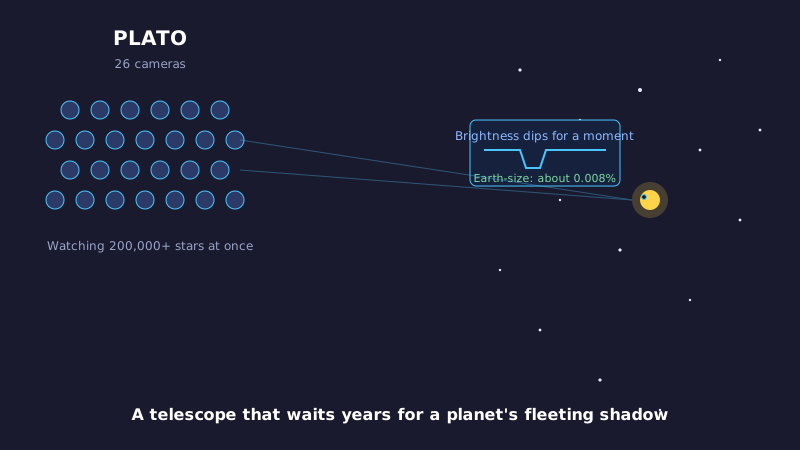
ESA’s PLATO mission, scheduled for launch in 2026, will hunt for planets around nearby Sun-like stars with even greater precision. The Vera Rubin Observatory, fully operational as of 2025, images roughly 20 million objects every night. At that scale, AI isn’t a nice-to-have — it’s the only way the science gets done.
None of this means astronomers are being replaced. RAVEN handles the filtering and candidate identification; the physical interpretation, the follow-up observations, the judgment calls — those still belong to scientists. Think of the AI as an exceptionally sharp-eyed assistant who never sleeps and never gets bored. The science is still human.
One small footnote: the name RAVEN isn’t officially explained in the paper, but in English a raven is a large, intelligent crow. There’s something fitting about it — a clever black bird sweeping across a dark sky, picking out glints of light that everyone else missed.
118 confirmed planets. More than 2,000 candidates still waiting. And a universe where one in ten Sun-like stars quietly keeps a planet close. Planets aren’t remarkable. They’re just what happens when stars form. That’s the ordinary, staggering cosmos we’re living in.