Let me tell you about the day Jupiter shrank — sort of.
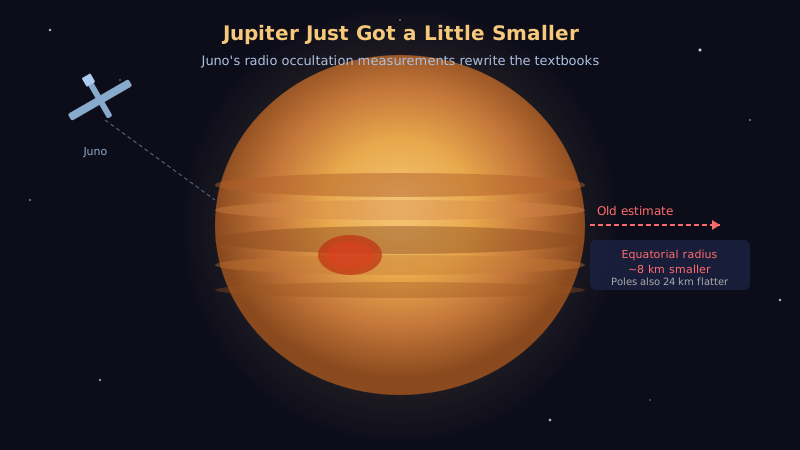
Nothing about Jupiter itself changed, of course. What changed was the number in our textbooks. In February 2026, scientists used data from NASA’s Juno spacecraft to remeasure the planet’s shape. The result didn’t match what we’d believed since the 1970s. The gap was small — but it mattered.
Equatorial radius: about 8 kilometers smaller. Polar radius: about 24 kilometers smaller. On cosmic scales, that’s a rounding error. But when you realize those old figures have been used as a fundamental calibration standard for half a century, the story gets more interesting.
Jupiter’s Radius as a Cosmic Ruler
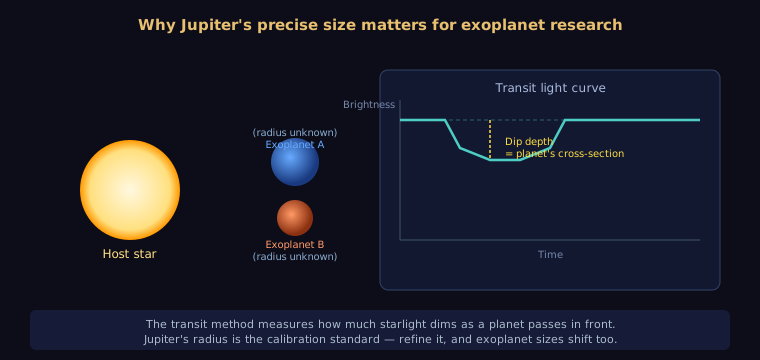
You can’t put a tape measure around a distant planet. Instead, astronomers rely on a technique called the transit method: when a planet crosses in front of its host star, it blocks a sliver of starlight. The dip in brightness is proportional to the planet’s cross-sectional area — which is the square of its radius.
To turn that dip into an actual radius, you need a reference. If a distant planet looks “roughly Jupiter-sized,” you can only calculate its true radius if you know Jupiter’s radius precisely. For decades, Jupiter has been the zero point on the ruler that planetary scientists use to measure the universe.
The trouble is, that ruler was calibrated in the 1970s. Pioneer and Voyager flew past Jupiter and conducted six radio occultation experiments. For the time, the data was cutting-edge. By today’s standards, the sample was thin and the precision limited.
For fifty years, no one questioned those numbers — not because they seemed wrong, but because no one had better data to question them with.
What Juno Brought Back
Juno arrived at Jupiter in 2016 and has been circling the planet ever since. By the time of this study, the spacecraft had completed 13 radio occultation experiments — more than twice the 1970s total.
The principle is elegantly simple. Juno continuously transmits a radio signal toward NASA’s Deep Space Network back on Earth. Just before and just after Juno dips behind Jupiter, that signal grazes the planet’s ionosphere — the electrically charged upper layer of the atmosphere.
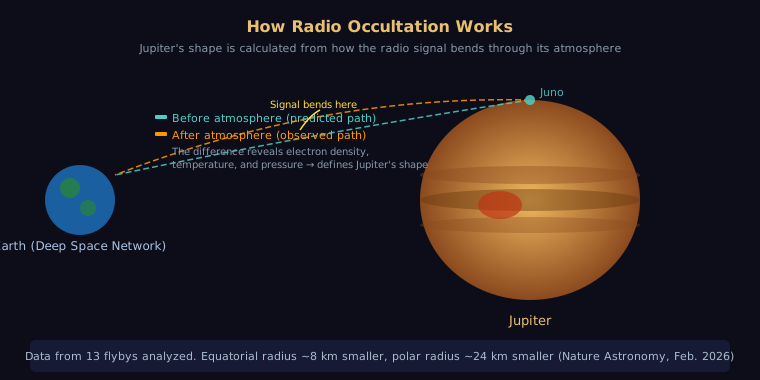
As the signal skims through the atmosphere, its frequency shifts slightly. The pattern of that shift encodes the temperature, pressure, and electron density at each altitude layer. From those profiles, scientists can calculate the exact contour of Jupiter’s outer atmosphere — and thus the planet’s shape. It’s conceptually similar to how GPS satellites correct for atmospheric distortion here on Earth.
Combining all 13 passes, the team found Jupiter’s equatorial radius to be about 8 km smaller and its polar radius about 24 km smaller than the accepted values. The planet is also more oblate — more flattened at the poles — than previously measured. The findings were published in Nature Astronomy on February 2, 2026.
What “Just 8 Kilometers” Actually Means
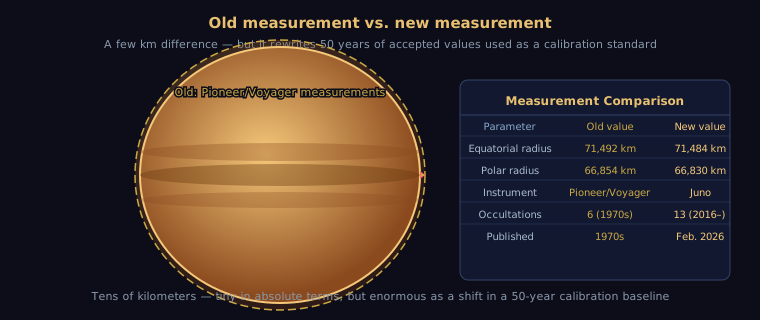
How you feel about an 8 km discrepancy probably depends on your perspective. Jupiter’s equatorial radius is over 71,000 km — 8 km is less than 0.01% of that. Easy to dismiss as a rounding error.
But precision is a different conversation. Think of it like a thermometer: the difference between “exactly 37°C” and “a fraction above 37°C” is medically trivial in one sense and clinically meaningful in another. In planetary science, a more accurate baseline value has effects that reach far beyond the numbers themselves.
Two consequences stand out. First, the radius measurements of exoplanets that were calibrated against Jupiter will shift — subtly, but across thousands of objects. Second, the revised shape gives us a sharper constraint on Jupiter’s internal structure. A planet’s shape is determined by the combination of its internal mass distribution and its rotation rate; a more precise shape measurement feeds directly into models of what lies beneath those cloud bands — how far down the gas extends, where a solid core might begin.
To put numbers on it: more than 5,000 exoplanets have been discovered so far, and a significant fraction of the giant ones — particularly hot Jupiters — were sized using Jupiter as the calibration standard. When the ruler’s zero point shifts by 8 km, every single one of those size estimates gets a tiny correction. Individual corrections are negligible; statistically, across hundreds of planets, the distribution of planetary radii — which sizes are common, which are rare — can shift in ways that affect our interpretation of how planetary systems form.
Honestly, this isn’t a “everything changes overnight” discovery. It’s more like fifty years of accumulated knowledge becoming fractionally sharper. I still find it quietly satisfying to watch.
Why It Took Fifty Years
It’s a fair question: why didn’t anyone remeasure this sooner? The answer is simply that no suitable spacecraft was there to do it. The Galileo probe orbited Jupiter from 1995 to 2003, but its orbit wasn’t designed for radio occultation science. Juno, by contrast, was built from the start with radio science as a core mission objective. Its polar orbit takes it on repeated high-latitude flybys — nearly ideal geometry for occultation experiments.
The research team noted that the result “demonstrates the importance of precision in planetary measurements.” A Stanford collaborator put it plainly: “A more accurate shape for Jupiter will serve as an important calibration reference for researchers who measure Jupiter-like exoplanets using the transit method.”
What Comes Next
Juno’s data collection is ongoing. The mission has been extended, and additional occultation passes could yield further refinements.
Looking further ahead, the same technique can be applied to Saturn. Researchers are already working backward through Cassini’s radio observations from its final plunge into Saturn in 2017. The method Juno validated at Jupiter is now being ported to the next planet over.
Uranus and Neptune are a different story. The last close-up observations of those ice giants came from Voyager 2 — in 1986 and 1989, respectively. A single flyby each, data that’s now pushing 40 years old. There’s no comparison to Juno’s 13 passes. NASA is exploring a Uranus orbiter for the 2030s; if it happens, the outer solar system will finally get a ruler worth trusting.
Space exploration doesn’t advance only through dramatic discoveries. Sometimes it advances by correcting the ruler — by quietly going back to a number that everyone accepted and asking whether it’s actually right. The news that Jupiter is slightly smaller than we thought is, in its own unassuming way, exactly that kind of progress.
The team that measured Jupiter anew after half a century knew what they were doing. They wrote their paper, ran their numbers, and let the data speak.