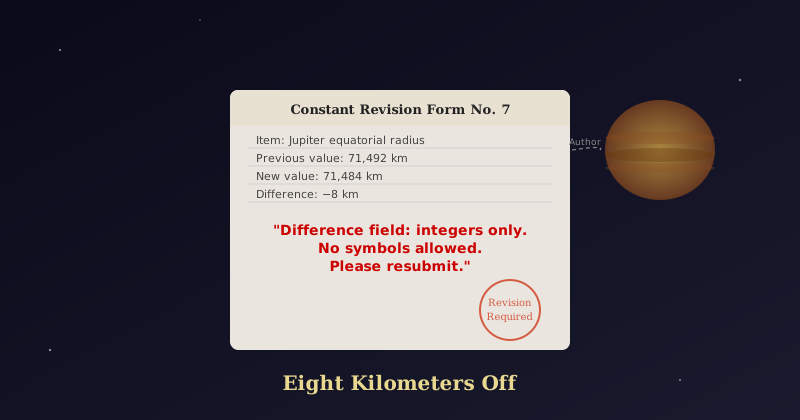
Hashida started filling out the Constant Revision Form — No. 7 — on a Thursday afternoon.
There was only one number to change. Jupiter’s equatorial radius. Old value: 71,492 kilometers. New value: 71,484 kilometers. Difference: 8 kilometers. Just eight. A number that had stood unchanged for fifty years had quietly shifted, courtesy of the Juno spacecraft. Hashida had been on the observation team, watching all thirteen flybys go by.
The form was four pages long.
The first two pages went fine — just fill in the fields. Page three, the “difference” field, stopped her cold. She typed “−8 km.” That was the convention in her field: a plus sign for upward revisions, a minus for reductions. She hit submit. A pop-up appeared.
“Difference field accepts integers only. Symbols, decimal points, and unit designations are not permitted.”
She typed “8” and sent it again. This time a confirmation number came back immediately.
The next day, the review officer, Nakajima, called.
“Hashida-san, the difference field just says ‘8.’ Does that mean a reduction of 8 kilometers, or — is it 8 meters, perhaps?”
“Kilometers. I put the unit in the separate field.”
“Right, yes. It’s just that anyone reading only the difference field might be confused. Ideally we’d want something like ‘−8’ there.”
“But the system said no symbols.”
“That’s the specification, yes. In practice, though, the convention is to add a note in the supplementary handwritten section.”
After she hung up, Hashida found the supplementary section on page four. It was there, all right. Handwritten, it said. She printed the form, picked up a mechanical pencil, and wrote: Reduction. Approx. 8 km.
Three days later, the papers came back. There was a note in red ink: “‘Approx.’ is not acceptable. Confirmed values only.”
Hashida took a slow breath. Let’s talk about measurement. The number 8 had emerged from thirteen flybys and an enormous amount of calculation — it was a confirmed value. She had written “approximately” not out of sloppiness but out of scientific honesty. Every observation carries uncertainty. In the measurement of the cosmos, nothing is ever exact. That’s what science means.
But a form is not science.
She opened a fresh copy. Typed “8” in the difference field. Wrote in the supplementary section: Reduction. 8 km (confirmed value). Hit print.
The printer hummed to life. Page four. Take two. The first revision to Jupiter’s radius in fifty years, trying once more to reach the world.
(The Jupiter radius measurement is real. Results were published in Nature Astronomy in February 2026, based on data from NASA’s Juno spacecraft.)