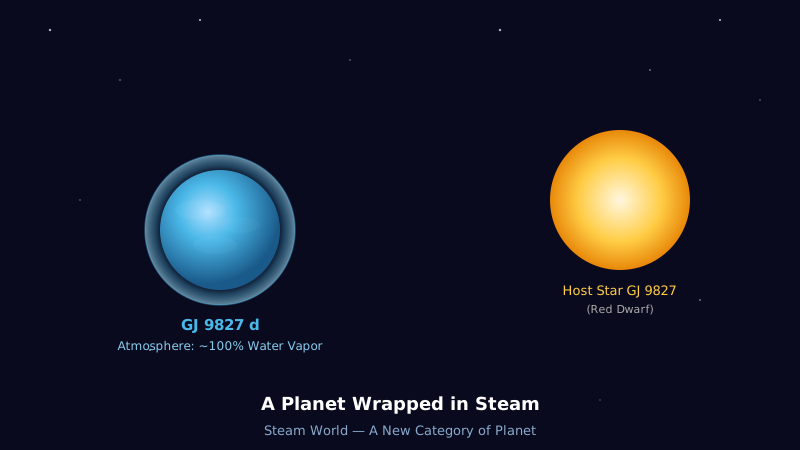
About 97 light-years away, there is a very strange planet.
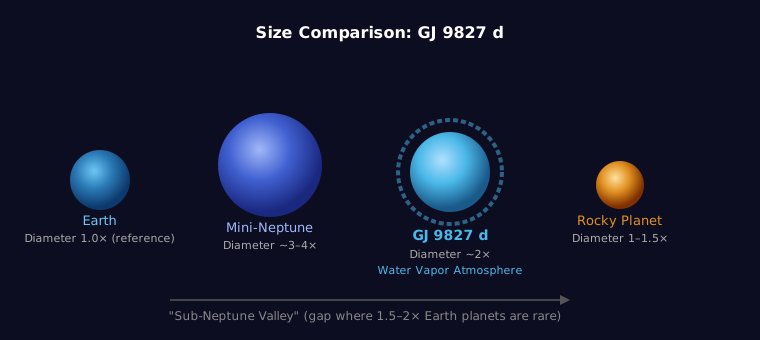
It is roughly twice the size of Earth. It completes one orbit around its star in about 17 hours. Its surface temperature exceeds 500°C. And its atmosphere is made almost entirely of water vapor.
Water exists there — and yet liquid water cannot. Life couldn’t survive, not even close. When we hear “water world,” we tend to picture something lush and blue. This planet is closer to the opposite. It’s closer to hell.
Since JWST published its observations in 2023, “GJ 9827 d” has drawn quiet but serious attention from planetary scientists. The reason: this planet is the first observationally confirmed example of what theorists had long predicted — a class of worlds called “steam worlds.”
How JWST Reads an Atmosphere 97 Light-Years Away
You can’t just point a telescope at an exoplanet and read off its chemical composition. GJ 9827 d is tiny and dim compared to its host star; directly imaging it is essentially impossible.
Instead, JWST used a technique called transmission spectroscopy.
When a planet passes in front of its star — a transit — some of the starlight grazes the planet’s atmosphere on its way to us. Molecules in that atmosphere selectively absorb certain wavelengths of light, like a molecular fingerprint. When you spread that surviving light into a spectrum and look for which wavelengths have dimmed, you can identify what’s doing the absorbing.
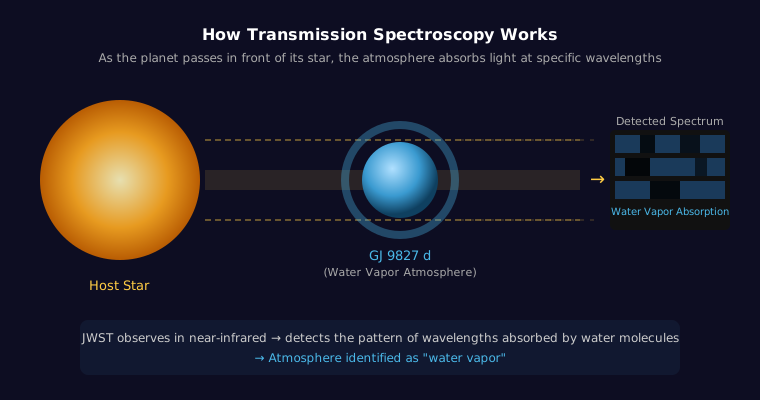
Water molecules absorb specific wavelengths in the near-infrared. JWST’s Near Infrared Spectrograph (NIRSpec) measures those wavelengths with remarkable precision. In GJ 9827 d’s spectrum, the water fingerprint stood out overwhelmingly against everything else.
Traces of other atmospheric components — hydrogen, helium, methane — were barely detectable. The research team interpreted this as the atmosphere being “dominated by water vapor.”
That was the surprising part. Most planetary atmospheres are a blend of multiple gases. Earth is 78% nitrogen and 21% oxygen. Venus is 96% carbon dioxide with 3.5% nitrogen. No planet in our solar system has an atmosphere built from a single constituent. GJ 9827 d breaks that pattern.
To be clear, saying “it’s basically all water vapor” still leaves some room for confirmation. There’s a non-zero chance that the atmosphere is so thin that observational uncertainties are stacking up. But this measurement was built from multiple transit observations by JWST, and the research community has broadly accepted it as the most reliable interpretation available.
What Exactly Is a Steam World?
Exoplanet classification is still fairly rough around the edges. We have categories like “rocky planet,” “ocean world,” “mini-Neptune,” and “gas giant” — but these are largely theoretical and statistical frameworks, not boxes that observations have filled in cleanly.
A steam world occupies the size range between rocky planets and mini-Neptunes — roughly 1.5 to 2 times Earth’s diameter.
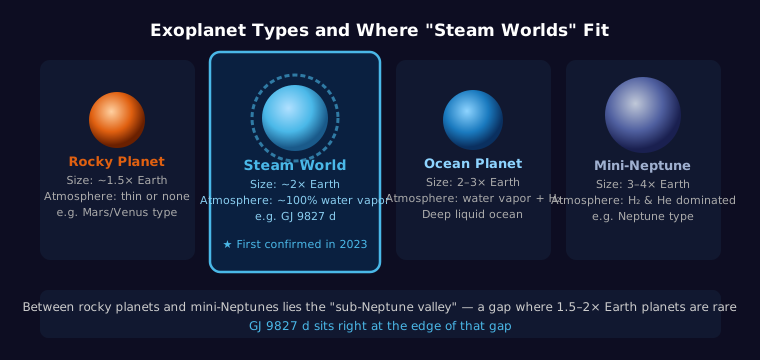
For a planet in that size range, there are two broad scenarios. One: a rocky or metallic core wrapped in a thin atmosphere. Two: a water-rich core surrounded by hydrogen and helium — a mini-Neptune. Steam worlds were proposed as a third possibility that fits neither description.
In this scenario, a rocky or icy core exists, and water that evaporated from it makes up the bulk of the atmosphere. The planet migrated close to its star, and most of the lighter gases — hydrogen, helium — escaped into space. Water vapor, denser than those gases, managed to hang on.
The “Sub-Neptune Desert” Connection
As exoplanet surveys have accumulated data, a statistical pattern has emerged called the “sub-Neptune desert” (or “radius gap”).
When you plot exoplanets by size, there is a distinct shortage of worlds in the 1.5-to-2 Earth-radii range. Rocky planets show up in abundance. Mini-Neptunes show up in reasonable numbers. But the zone between them is conspicuously empty.
Why the gap? The leading explanation is atmospheric escape.
When a mid-sized planet orbits close to its star, intense radiation strips away its atmosphere. A planet that started as a mini-Neptune can shed its gas envelope and shrink down to a bare rocky core. This “transformation” depletes the middle-size population.
GJ 9827 d sits right at the edge of that gap. Studying it as a planet in the act of losing its atmosphere gives scientists direct data on how the stripping process actually works — which is a big part of why researchers find it so valuable.
Water Doesn’t Mean Habitable
Water matters for life. That’s true. But “there’s water, therefore life might exist” is a completely different claim.
The surface temperature of GJ 9827 d is estimated at over 500°C — far above the range where water can exist as a liquid (0 to 374°C at standard pressure). The water vapor in its atmosphere isn’t bubbling like a boiling pot; it’s suspended in a state of such extreme heat and pressure that becoming liquid is out of the question.
On top of that, GJ 9827 d orbits a red dwarf — an M-type star that is smaller and cooler than the Sun but produces frequent, powerful flares. The planet circles this star at very close range, perpetually bathed in radiation.
That the water vapor atmosphere persists at all is almost surprising. Current theory suggests it is slowly but steadily leaking into space, and over timescales of billions of years it will likely thin out and eventually disappear.
The Questions a Fourth Category Opens Up
So steam worlds exist — observationally confirmed. What does that actually tell us?
For one thing, it gives us a window into planetary origins. By combining a planet’s size, atmospheric composition, and orbital parameters, scientists can infer where it formed, what materials it gathered, and what path it followed to its current state. Steam worlds represent evidence of a transitional process — planets that either never quite became rocky or are in the middle of becoming so.
It also sharpens the questions around habitability. If “water present” is supposed to increase the odds of life, does a planet made entirely of water vapor count? The answer is almost certainly no — but being able to explain precisely why it doesn’t count brings us closer to understanding what conditions would actually shift the answer toward maybe.
If a water-molecule-rich planet like GJ 9827 d were to exist in a habitable zone — at the right distance from its star for liquid water to be stable — the calculation would change. No such planet has been found yet. But now that steam worlds are an established concept, they’ve been added to the list of things worth searching for.
Ninety-seven light-years is a long way. No spacecraft is going to make that trip to check our conclusions in person. But the near-infrared light JWST captured crossed that distance and reached us. The wavelengths that water molecules absorb are the same everywhere in the universe.
Molecular fingerprints, traveling across space. That’s the quiet wonder at the heart of planetary science.