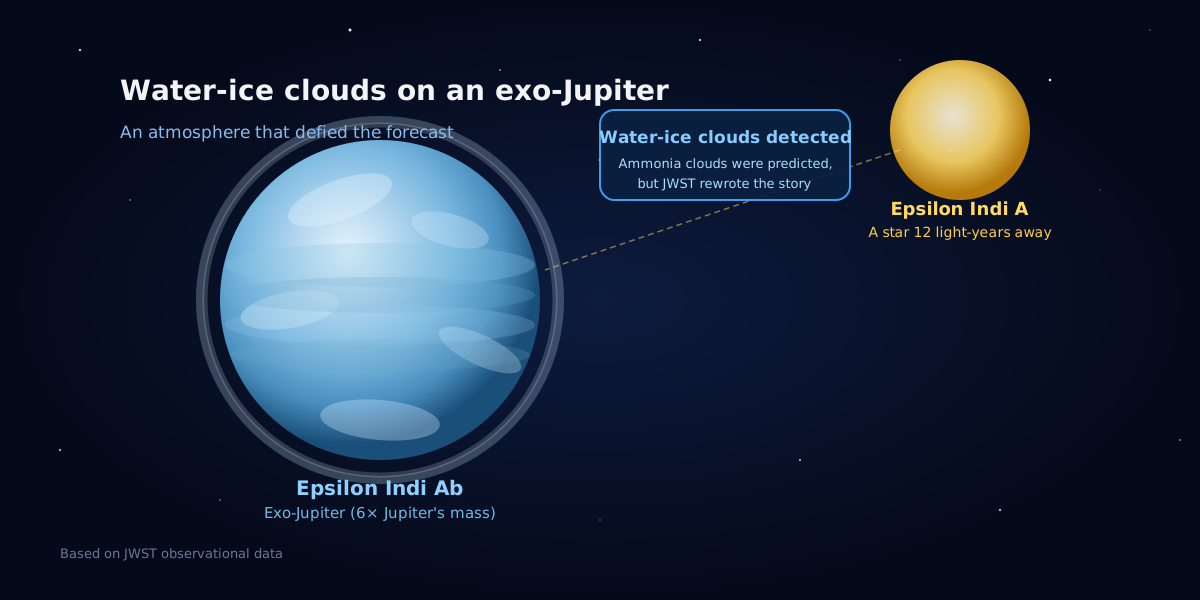
The prediction seemed airtight: ammonia clouds.
Take a Jupiter-sized exoplanet, make it cold enough, give it an observable atmosphere — and the textbooks say you get ammonia clouds up top. That conclusion took years of theoretical modeling to reach. Jupiter itself has them. It was just what you expected to find.
JWST found something else entirely. The clouds were made of water ice.
A Jupiter-Sized World, 12 Light-Years Out
The planet in question is Epsilon Indi Ab — a world orbiting a star called Epsilon Indi A, located 12 light-years from Earth.
Twelve light-years sounds abstract. In cosmic terms, though, it’s practically next door. The Milky Way spans roughly 100,000 light-years; 12 light-years puts Indi A about as close as a neighbor two houses down. Astronomers genuinely call distances like this “nearby” — which says something about how thoroughly the scale of the universe recalibrates your sense of close.
Indi Ab has about six times Jupiter’s mass, putting it squarely in the category of gas giant exoplanets. It orbits its star at roughly 11.55 AU — a distance that, in our own solar system, would place it between Saturn and Uranus. Its year lasts somewhere around 200 Earth years. A human born at the planet’s closest point to its star would never live to see it come full circle.
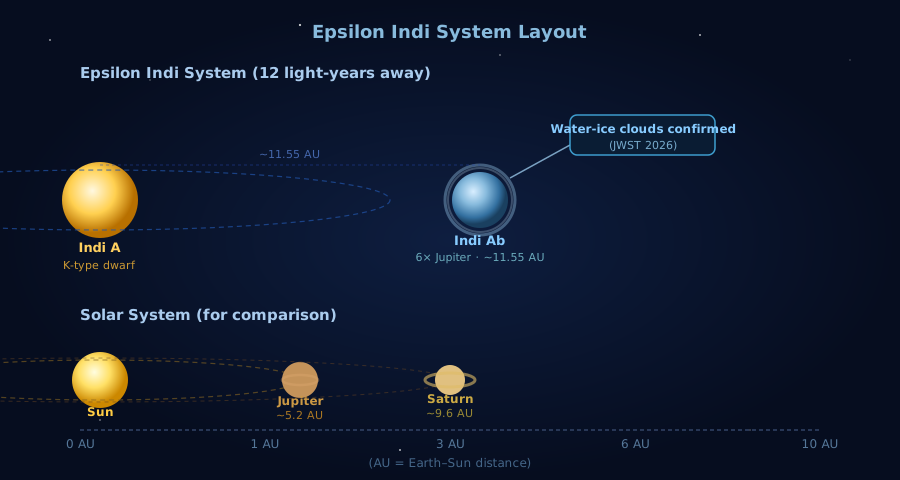
What makes this planet particularly valuable is that it can be directly imaged. Most exoplanets huddle too close to their host stars; the starlight overwhelms them. Indi Ab’s wide orbit gives JWST enough angular separation to isolate the planet’s own light — a rare advantage that opened the door to what came next.
Reading an Atmosphere from Across the Light-Years
JWST didn’t just photograph the planet. It broke the planet’s light apart and read what was inside.
When you split light by wavelength, you get a spectrum — a rainbow-like band where different molecules leave their mark. Each substance absorbs specific wavelengths, carving dark gaps called absorption lines into the spectrum. The pattern of those gaps is unique to each molecule, as distinctive as a fingerprint. Water vapor has its lines. Methane has its lines. Ammonia has its own.
This approach is well-known in the technique called transit spectroscopy, but Indi Ab doesn’t cross in front of its star as seen from Earth, so the team worked differently: they captured the infrared light the planet itself radiates. Rather than catching reflected starlight, JWST essentially read the planet’s own glow.
Using both MIRI (the mid-infrared camera) and NIRCam (near-infrared), the telescope analyzed Indi Ab’s spectrum in wavelength ranges that ground-based observatories can barely touch — Earth’s own atmosphere absorbs too much of the mid-infrared band. Only a space telescope gets a clear view. The result: strong absorption signatures from water and methane. No clear ammonia detection.

Why the Prediction Missed
The forecast of ammonia clouds wasn’t wrong-headed — it was grounded in solid theory. Jupiter’s cloud tops sit around −108°C, a temperature range where ammonia freezes readily into cloud particles. So Jupiter carries ammonia ice clouds in its upper atmosphere. That’s just physics.
The difference with Indi Ab comes down to temperature.
Indi Ab runs warmer than Jupiter. The exact reasons involve both its distance from Epsilon Indi A and residual heat from the planet’s interior. Because the cloud-top region sits at a different temperature than Jupiter’s, the ammonia never gets cold enough to condense — it stays in gas form. Water ice, meanwhile, settles into the upper atmosphere at that particular temperature range instead.
What’s interesting is how a shift in temperature reshuffles which ingredient takes center stage. Both water and ammonia exist in the atmosphere. But which one forms clouds depends entirely on where you are on the thermometer. Push a planet’s temperature a few dozen degrees in either direction, and its visible atmosphere transforms. It’s not so different from the principle behind snow versus rain on Earth — a two-degree swing changes everything. The scales here are vastly larger, but the underlying physics is the same.

Are Water-Ice Clouds Unusual?
From Earth’s surface, water clouds are unremarkable — look up on almost any day. But at the scale of exoplanets, water-ice clouds in the upper atmosphere require a fairly specific set of conditions to show up clearly.
Within our own solar system, water clouds exist deep inside Jupiter’s atmosphere, too deep to observe directly. The Galileo probe detected water traces when it plunged into Jupiter’s air, but “detecting a trace” is different from actually seeing a cloud layer. Saturn’s moon Titan has clouds, but they’re made of methane and nitrogen. Venus sports clouds of sulfuric acid. Even within our solar system, clouds are wildly different from one body to the next.
With exoplanets, it gets messier still. Atmospheric observations of any kind remain technically difficult. Some hot Jupiters are thought to have silicate clouds — essentially airborne glass particles — which are closer to a planet-wide sandstorm than anything we’d call a cloud. Confirmed water-cloud detections by direct imaging are rare.
Indi Ab appears to be among the first Jupiter-class exoplanets where water-ice clouds have been confirmed this way. And because the planet sits just 12 light-years out, future observations can go deeper. With enough data, it might eventually be possible to track seasonal shifts in cloud coverage, or trace how the clouds interact with the planet’s atmospheric circulation.
A Challenge to the Models
In astronomy, mismatches between observations and theory aren’t unusual. The field’s history is largely a record of models being revised whenever new data shows up.
What this discovery calls into question is the assumed temperature range that underpins current gas-giant atmospheric models. Those models were built largely on Jupiter — understandably, since Jupiter is the gas giant we know best. But exo-Jupiters aren’t uniform. They span a wide range of masses, temperatures, and orbital distances from their stars.
The assumption that “Jupiter-mass means Jupiter-like atmosphere” may need to go. Our solar system gives us exactly two gas giants to study up close — Jupiter and Saturn. Building a universal rulebook from two data points and expecting it to hold for thousands of exoplanets was, in retrospect, optimistic.
Indi Ab’s data suggests the field needs finer categories for Jupiter-class exoplanets — models tuned to different temperature regimes rather than stretched from a single reference case.
How do researchers take this? Mostly not with disappointment that a model broke, but with something closer to curiosity: here’s new material to work with. The predictions that miss always do the most to reveal what still needs to be understood.
Why Now?
JWST began science operations in 2022. In the four years since, the precision of exoplanet atmospheric observations has jumped considerably. Hubble studied exoplanet atmospheres too, but the broad infrared coverage and sensitivity that JWST brings — especially in the mid-infrared — puts it in a different league for this kind of work.
Indi Ab is not an isolated case. JWST has been systematically analyzing the atmospheres of multiple exoplanets, and planets that once seemed to match theoretical predictions have started returning unexpected data as well. More surprises are likely coming.
That we can identify the cloud composition of a planet 12 light-years away is something that would have seemed implausible not long ago. Now it’s routine enough to overturn textbook assumptions. Each time the data contradicts a model, it can feel like a setback or like evidence that the universe still has plenty left to show us — which framing you prefer probably says something about why you got into science in the first place.
Either way, the questions multiply when the predictions miss.
Somewhere 12 light-years out, water-ice clouds are drifting through the atmosphere of a giant planet. That alone is a pretty satisfying thing to know.