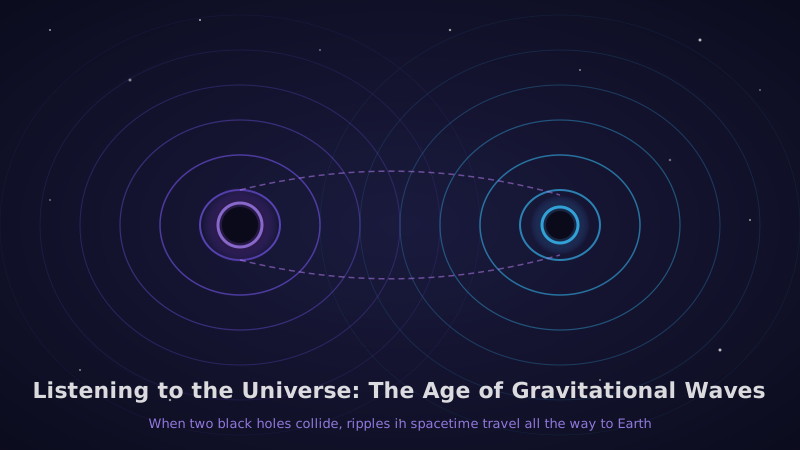
On the morning of September 14, 2015, a detector in Louisiana registered a faint tremor.
Not an earthquake. Spacetime itself had stretched and squeezed — by less than one-thousandth the width of a proton. Yet the researchers knew immediately what they had. A billion and a half years ago, two black holes collided somewhere in the cosmos, and the wave that event sent rippling through the fabric of the universe had just passed through Earth.
This was the first detection of gravitational waves in history — the moment an entirely new kind of “eye” opened on the universe.
What Gravitational Waves Actually Are
A gravitational wave is a disturbance in spacetime produced whenever a massive object accelerates.
“Spacetime rippling” sounds abstract, but try thinking of it this way. Drop a stone into a pool and ripples spread outward across the water. The medium — water — is disturbed. Gravitational waves work on the same principle: a moving mass shakes spacetime itself, and that shake travels outward at the speed of light. The medium is the fabric of the universe.
Einstein predicted this in 1916 as part of general relativity. It then took a century for anyone to detect it. Why so long? The answer is almost embarrassingly simple: the waves are unimaginably weak.
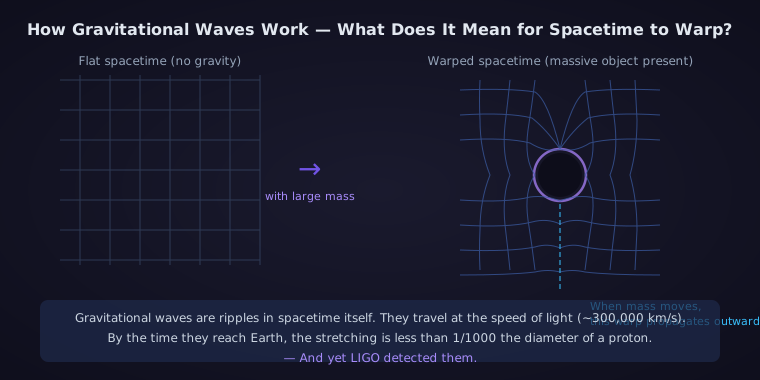
Even if the Sun somehow orbited the Earth, the gravitational waves it would produce are far too tiny to detect with any technology we have. You need something violent — something like two black holes spiraling into each other and merging, one of the most catastrophic events the universe can produce.
LIGO — A Ruler That Reads One-Thousandth of a Proton
To catch gravitational waves, scientists built LIGO: the Laser Interferometer Gravitational-Wave Observatory. It consists of two L-shaped detectors in the US, one in Louisiana and one in Washington State.
The concept is elegant: a ruler made of laser light.
Laser beams are sent down both arms of the L, bounce off mirrors at each end, and return. When a gravitational wave passes, one arm stretches while the other squeezes. That tiny difference in length shifts the interference pattern of the returning lasers, and that shift is the signal.
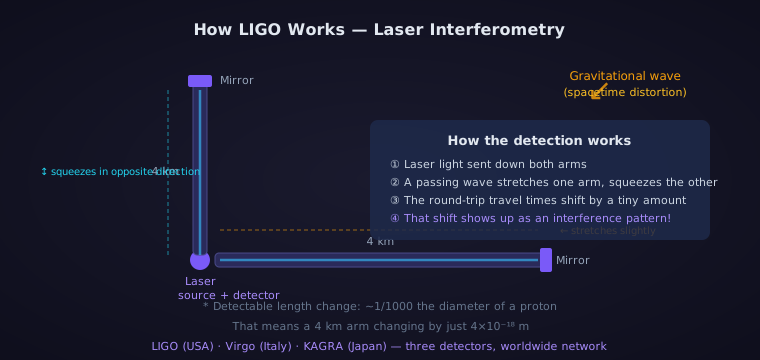
Each arm is 4 km long. The changes LIGO measures are on the order of 4×10⁻¹⁸ meters — roughly equivalent to detecting a shift of one-thousandth of a penny’s thickness across the distance between Tokyo and Osaka. I’ll be honest: when I first read that comparison, it didn’t really land. But what it does convey is the sheer extremity of the precision involved.
LIGO doesn’t work alone. Virgo in Italy and KAGRA in Japan (built inside the Kamioka mine, more than 200 meters underground) now operate as a global network. Multiple detectors cross-checking the same signal are what separate a real event from random noise. Knowing that a facility like KAGRA exists in Japan still surprises me a little.
GW150914 — What Did That First Signal Look Like?
The 2015 event, designated GW150914, captured two black holes spiraling inward toward each other before finally merging.
One black hole carried about 36 times the Sun’s mass, the other about 29 times. The resulting merged black hole weighed in at 62 solar masses. If you’ve already spotted that 29 + 36 = 65, not 62, you’re thinking correctly — the missing 3 solar masses were radiated away as gravitational wave energy in roughly 0.2 seconds. That energy outshone what the Sun will emit over its entire 10-billion-year lifetime, released in a fraction of a heartbeat.
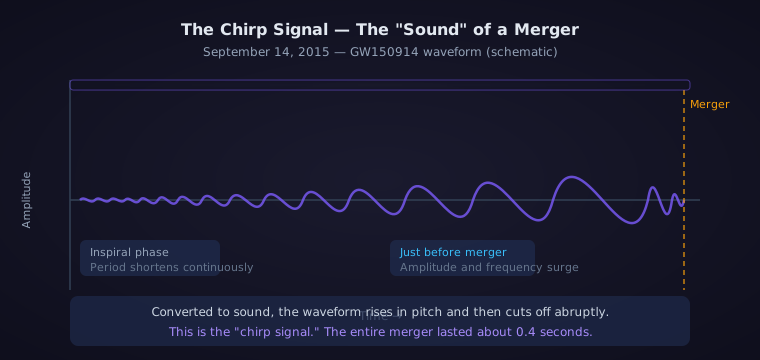
Convert the waveform to sound and you hear a tone that climbs in pitch and then vanishes — a brief whistle. Researchers call it a “chirp signal,” and there’s a description I’ve never been able to shake: the universe whistling, once, and going quiet.
The distance is worth sitting with for a moment. These two black holes merged roughly 1.3 billion light-years away — around the same era that multicellular life first appeared on Earth. That wave has been traveling through the cosmos ever since, and in 2015 it nudged our detector by a fraction of a proton’s width before passing on.
Listening to What Light Can’t See
Here’s the deeper significance of all this.
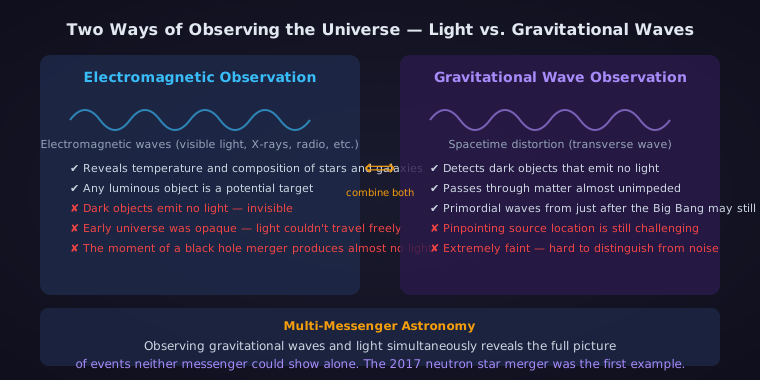
Astronomy, for most of its history, has meant collecting light. Visible wavelengths, X-rays, radio waves, infrared — everything is electromagnetic radiation. Telescopes of every kind have mapped the universe by gathering it.
But light has blind spots. When black holes merge, they produce almost no light. The early universe was a dense, opaque soup through which light couldn’t travel freely, so electromagnetic observations hit a hard wall in the past.
Gravitational waves don’t have those constraints. They pass through matter with barely any resistance. They carry information from places and moments light simply can’t reach.
Then in 2017, something historic happened: gravitational waves and electromagnetic radiation were detected simultaneously from the same event. When two neutron stars collided (GW170817), LIGO and Virgo caught the gravitational wave signal while telescopes worldwide swung to the same patch of sky. A short gamma-ray burst appeared. This is called multi-messenger astronomy, and it changed what we thought was possible.
One of the most striking findings from GW170817 was a long-standing puzzle it helped solve: where does gold come from? A leading theory held that heavy elements like gold and platinum are forged in neutron star mergers. That observation provided direct evidence that gold was indeed produced in the collision’s aftermath. Much of the gold on Earth was born in events like this one, somewhere in the universe’s distant past.
KAGRA’s Role, and Japan’s Place in This Story
Japan’s gravitational wave detector, KAGRA, is buried more than 200 meters underground in the Hida region of Gifu Prefecture, inside the Kamioka mine.
Going underground wasn’t just for aesthetics — there’s far less seismic noise below the surface. KAGRA also uses cryogenically cooled mirrors, chilled to around 20 Kelvin (approximately −253°C), to further reduce thermal noise. It’s a design choice unique among current-generation detectors.
KAGRA officially joined the network in 2020 and now collaborates with LIGO and Virgo on joint observation runs. With more detectors spread across the globe, the network can better triangulate where a signal came from, making it easier to point optical telescopes at the right spot in the sky.
What Comes Next
The detectors running today are considered “second generation.” Third-generation observatories are in the planning stages: the Einstein Telescope in Europe (an underground triangle-shaped design) and the Cosmic Explorer in the US, with arms stretching to 40 km. Dramatically improved sensitivity would let these instruments catch signals from the far edges of the observable universe.
There’s also the tantalizing prospect of primordial gravitational waves — echoes from the moments just after the Big Bang that may still be faintly imprinted on the cosmos. If we could detect them, it would give us a window into the birth of the universe, somewhere light can never take us.
ESA’s LISA mission is pushing the frontier into space. Three spacecraft, separated by 2.5 million km, will trail Earth in its orbit around the Sun and search for gravitational waves in frequency bands impossible to reach on the ground. The target: supermassive black hole mergers at the centers of galaxies, and other behemoths the current network can’t even see.
Why “Listening” Is the Right Word
Astronomers talk about gravitational waves as the universe’s “sounds,” and I’ve come to think that’s more than a metaphor.
Watching the universe through a telescope is a waiting game. You point, and you receive whatever light a source happened to emit. It’s fundamentally passive.
Gravitational wave detection is also passive, technically — but the experience feels different. Something passed through. Spacetime shuddered, carried the ripple from a collision more than a billion years ago, reached Earth, and kept going, already headed for wherever it goes next. The detector simply caught that passing moment and wrote it down.
As you read this, waves from events we’ve never seen and never will are passing through Earth. Through you. Unannounced.
Gravitational wave astronomy is the practice of naming and recording what passes. Since 2015, more than a hundred events have been logged. The universe, it turns out, is far noisier than we ever imagined. We just hadn’t found a way to hear it yet.