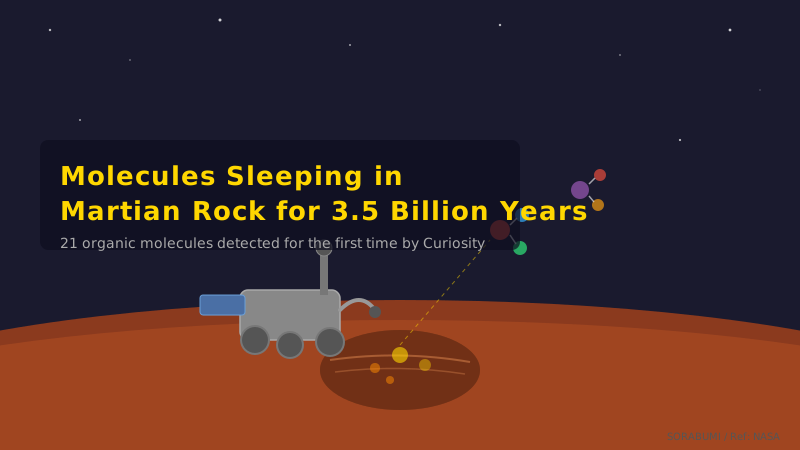
Researchers dissolved powder drilled from a Martian rock with a chemical reagent and identified 21 distinct organic molecules. Seven of them had never been detected on Mars before.
This is not a story about finding life. That needs to be said upfront. But calling it “merely not evidence of life” and moving on would be a disservice to what was actually found. Published in Nature Communications in April 2026, the study has real things to say about ancient Mars.
The Rock Curiosity Was After
The star of this discovery is a rock called “Mary Anning 3” — named after the 19th-century British paleontologist who excavated dozens of fossil species and helped lay the groundwork for modern paleontology. Naming a Martian rock after her doesn’t feel like a coincidence.
Curiosity drilled into this rock in 2020, pulverized it into powder, and fed the material into its onboard SAM (Sample Analysis at Mars) instrument. That part was routine. But one thing was different this time.
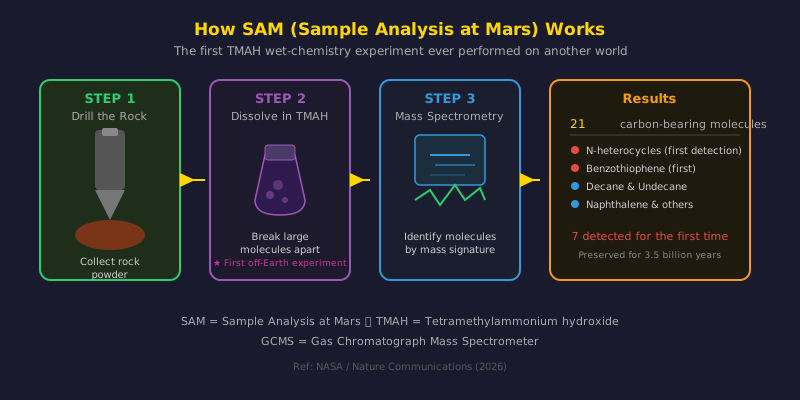
The team ran what’s called a “wet chemistry experiment” using TMAH — tetramethylammonium hydroxide. It was the first TMAH experiment ever conducted on another world. Dissolving the rock powder in this liquid allows larger organic molecules to survive analysis intact, rather than breaking down under the heat used in standard methods.
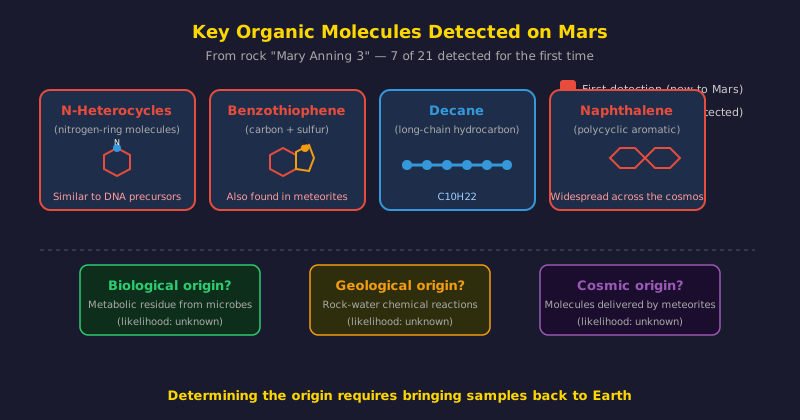
Among the 21 molecules that turned up were nitrogen-bearing ring compounds called N-heterocycles — detected on Mars for the first time. There was also benzothiophene, a molecule containing both carbon and sulfur that’s commonly found in meteorites and carries clues about the chemistry of the early solar system.
What Makes These Molecules Special
When people hear “organic molecules,” many assume something biological. That intuition is half right and half misleading.
Organic molecules are simply carbon-containing molecules. Life is built from them, but their presence doesn’t imply life. Mars has yielded organic molecules before — what’s notable here is the sheer variety and abundance.
The standout find is the N-heterocycles. These are ring-shaped structures with nitrogen atoms embedded in the carbon framework. The bases in DNA and RNA belong to this chemical family. When researchers think about how life might originate, the fact that these molecular building blocks were already present on ancient Mars carries weight.
The other striking detail is that these molecules survived for 3.5 billion years. Mars today is a brutal place for organic chemistry — the surface is hammered by ultraviolet radiation and ionizing radiation. How did anything last?
The answer lies in the rock itself. The powder came from a layer several centimeters underground, shielded from radiation by the rock above it. The Martian rock functioned as a remarkably effective archive.
What Ancient Mars Was Actually Like
Today’s Mars looks like a rust-colored wasteland. The atmosphere is thin enough to be nearly useless, nighttime temperatures drop below −80°C, and liquid water can’t exist on the surface.
But 3.5 billion years ago, things were different.
Ancient Mars is thought to have had a thicker atmosphere and liquid water flowing across its surface. River channels and lakebed sediments are still visible in the terrain. Some canyon systems look like the aftermath of catastrophic megafloods. Gale Crater — the roughly 154-km-wide depression Curiosity has been exploring — was probably a lake.
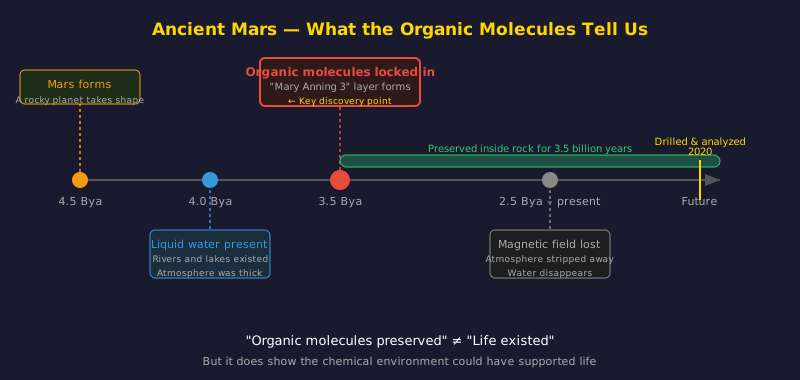
The molecules found in Mary Anning 3 were sealed into the rock during that era. What that means is that organic chemistry was happening on Mars 3.5 billion years ago. There was water, and there was an environment where organic molecules could form and be preserved. Some of the conditions thought necessary for life were present.
That said, there’s a wide gap between “conditions were present” and “life existed.” The research team is careful to keep those two things separate. They describe ancient Mars as having been “surprisingly habitable” while acknowledging that current technology cannot distinguish whether the detected molecules came from biology, geology, or meteorites.
Why the Caution?
Claiming evidence of life requires clearing a very high bar.
Organic molecules can form without any biology involved. Geochemical processes — water reacting with certain minerals — can produce them. So can meteorites: comets and space rocks are known to carry complex organic compounds in abundance. Claiming more than the evidence supports would undermine the scientific credibility that makes the finding matter in the first place.
And if anyone were to formally announce “evidence of life on Mars,” that claim would only carry real weight once samples had been returned to Earth and verified by research teams worldwide. SAM is a remarkable instrument, but it has limits. What it can do inside a rover on Mars is not the same as what a full laboratory on Earth can do.
Where This Points Next
More than anything, this discovery tells researchers where to look.
If deep rock layers can preserve organic molecules across geological timescales, sites with similar geology are worth prioritizing. Curiosity has been roving Mars for over 13 years, and this finding could reshape how that exploration is directed.
It also raises the stakes for the Mars Sample Return mission that NASA and ESA are pursuing. Perseverance — Curiosity’s successor — is currently depositing sealed sample tubes on the Martian surface. If those tubes ever make it back to Earth and into a state-of-the-art laboratory, determining whether the organic molecules inside came from something living becomes, at least in principle, possible.
“Molecules survived in 3.5-billion-year-old rock.” That alone seems like sufficient reason to keep exploring. Rocks talk — we just don’t have quite the right ears yet.
Summary
The 21 organic molecules Curiosity pulled from Mary Anning 3 offer a meaningful window into ancient Martian chemistry. The N-heterocycles — detected on Mars for the first time and structurally related to DNA bases — have caught the scientific community’s attention in particular.
This is not a life-detection announcement. But it does confirm that 3.5 billion years ago, Mars hosted the kind of chemical environment where life could have taken hold, and that this environment left traces durable enough to last. Identifying the source of those molecules will require bringing samples home. When Mars Sample Return happens, this rock may have more to say.
Source: NASA’s Curiosity Finds Organic Molecules Never Seen Before on Mars / Nature Communications (2026)