In May 2024, the Sun reminded us it’s not done yet.
A rapid-fire sequence of solar flares and coronal mass ejections (CMEs) triggered a geomagnetic storm so intense that auroras were visible as far south as Hokkaido, Japan. The images flooded social media — but the same storm also reached Mars. And Mars experienced it in a way Earth never could.
NASA’s fleet of Mars spacecraft — MAVEN, Mars Odyssey, Curiosity, and InSight — all recorded the storm’s arrival at the same time. While people on Earth were photographing curtains of green and purple light, radiation levels on Mars were spiking to the highest values ever measured there.
Why does the same storm produce such wildly different outcomes? The answer comes down to something Earth has that Mars has lost entirely.
The Invisible Shield: Earth’s Magnetosphere
Earth is, in the most literal sense, a giant magnet. Convection currents in the liquid iron outer core generate a magnetic field that wraps around the entire planet like a bubble. This structure — the magnetosphere — deflects most of the charged particles streaming in from the Sun, or funnels them toward the poles.
The aurora is where that funneling happens. Particles guided along magnetic field lines collide with nitrogen and oxygen atoms in the upper atmosphere and release light. It’s beautiful, yes — but it’s also proof that the particles were stopped here, not at your doorstep.
Mars has no such system.
It once did. Up until about 4 billion years ago, Mars likely had active convection in its core, just like Earth. Then, for reasons still being debated, the core cooled and solidified, and the global magnetic field rapidly collapsed. What remains today are isolated patches of crustal magnetism — certain ancient rocks that recorded the old field like a fossil record — but nothing close to a planet-wide shield.
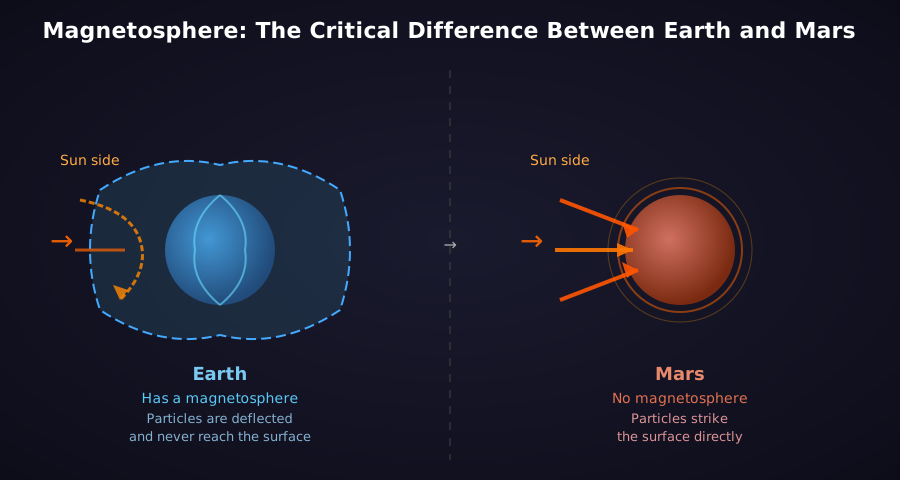
The consequence is direct: when a solar storm arrives, the particles that Earth deflects simply pour straight into the Martian atmosphere — and onto the surface.
What “Record High” Actually Means
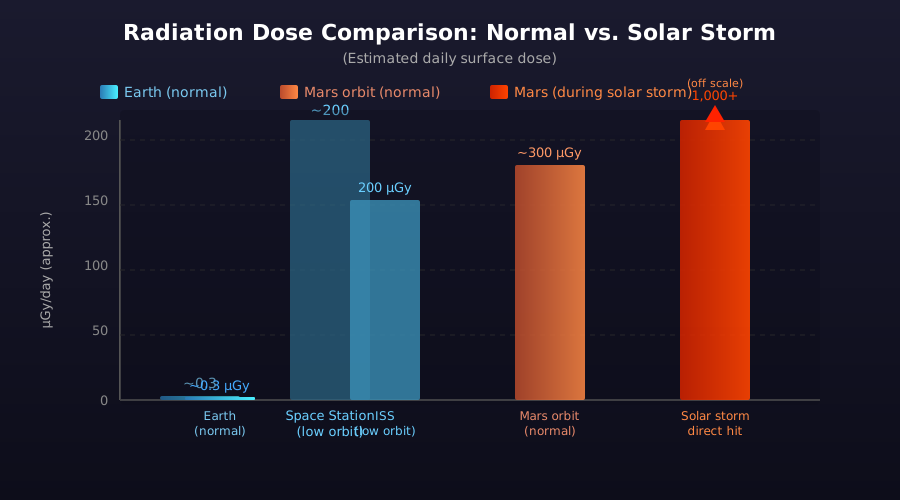
During the May 2024 storm, the RAD radiation sensor aboard the Curiosity rover recorded a dose of 8.1 mGy (milligray) — dozens of times the daily baseline, all arriving in a single burst at the storm’s peak.
For context: a full-body CT scan delivers roughly 10 mSv (millisieverts). The units differ, so a direct comparison isn’t clean — but the dose that accumulated over the storm’s duration was not negligible by any medical standard.
Of course, Curiosity is a robot. It doesn’t care.
But what if a person had been standing there?
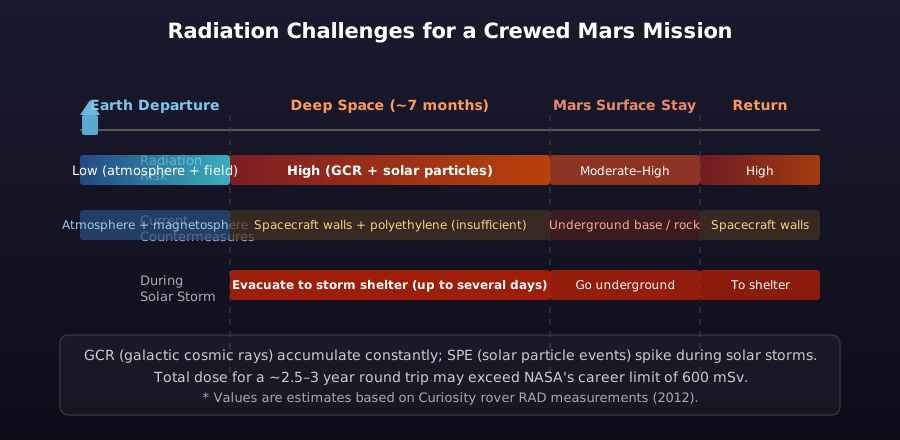
NASA’s older career radiation limit for astronauts sits at 600 mSv. Estimates suggest that a Mars mission — transit, surface stay, and return trip included — could approach or exceed that figure even without any storms. Add a major solar event on top of that, and the numbers get genuinely uncomfortable.
The Thin Atmosphere Is the Same Problem in Slow Motion
Radiation isn’t the only issue that traces back to the missing magnetosphere. So does the thinness of the Martian air.
Mars has an atmospheric pressure about 0.6% of Earth’s. You can’t breathe it. Meteors don’t burn up in it. And one of the main reasons it got so thin is a process called atmospheric sputtering — solar storms, hitting an unprotected planet over and over, physically knocking atmospheric particles out into space.
MAVEN (Mars Atmosphere and Volatile Evolution) observed this happening directly. Every storm that passes, Mars loses a small fraction of its remaining air. Multiply that by a few billion years, and you end up with the near-vacuum we see today. The thinness of Mars’s atmosphere isn’t just a quirk of its size — it’s the long-term bill for losing its magnetic field.
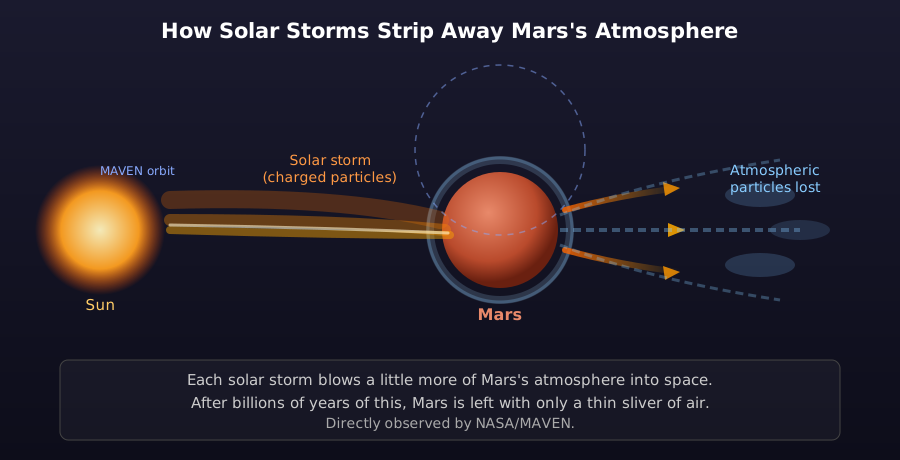
Seen this way, Earth’s magnetosphere isn’t just deflecting particles — it’s actively protecting the atmosphere itself. The reason Earth still has a thick, wet, life-supporting environment is that its core never stopped generating that field.
How Would Humans Survive on Mars?
Given all this, what would a crewed Mars mission actually look like?
Three main strategies are being seriously considered.
1. Better shielding in spacecraft and habitats Hydrogen-rich materials like polyethylene scatter incoming radiation more effectively than metals. There’s also a proposal to line the walls with water tanks, which serve double duty as radiation shields. The problem is weight: adding shielding in every direction drives up launch costs enormously, and some radiation can’t be blocked cheaply at all.
2. Storm forecasting and shelter evacuation Electromagnetic radiation from a solar flare travels at the speed of light, but the energetic particles that follow take hours or even days to arrive. That window — sometimes just enough — allows astronauts to reach the most heavily shielded part of the spacecraft or base before the worst of the storm hits. Underground shelters are also highly effective; just one to two meters of bedrock provides nearly complete protection.
3. Timing the mission around the solar cycle Solar activity follows an approximately 11-year cycle. Planning a mission during solar minimum reduces the chance of encountering a major flare. The catch: orbital mechanics and solar activity don’t always cooperate, and solar minimum also brings its own radiation problem (more on that in a moment).
None of these solutions is complete on its own. In practice, the goal is to combine them and keep total dose within an “acceptable” range — though what “acceptable” means for a multi-year Mars mission remains an open question.
The Other Threat You Can’t Dodge: Galactic Cosmic Rays
There’s actually a threat harder to manage than solar storms: galactic cosmic rays (GCRs).
These are ultra-high-energy particles born from supernovae and other violent events far outside our solar system. Unlike a solar storm, which comes in sudden spikes, GCRs arrive from every direction, all the time, never letting up. They’re not dramatic — they just quietly accumulate.
Here’s the twist: GCRs are actually worse during solar minimum. When the solar wind is strong, it partially deflects incoming galactic particles. When solar activity is low, less shielding means more GCRs getting through. So the “go during solar minimum to avoid flares” strategy trades one radiation problem for another.
Earth’s magnetosphere blocks a significant fraction of GCRs too. Mars gets none of that protection either.
Rethinking What’s “Normal” About Living on Earth
From the surface of Earth, the magnetosphere is completely invisible and easy to forget about. But every living thing on this planet survives inside it — a vast, invisible shield that has been quietly doing its job for billions of years.
Every time a solar storm rolls in and triggers auroras, billions of charged particles are being deflected and herded toward the poles. That’s what the light is telling you. Earth is that kind of planet.
Mars stopped being that kind of planet a very long time ago. Figuring out exactly when, and why, matters not just for understanding Mars — it raises uncomfortable questions about how long Earth’s own magnetic field will last.
The spacecraft that recorded the May 2024 storm didn’t just put numbers on Mars’s harshness. They put numbers on the problem humans will face the moment they step beyond this planet’s protection. Going to space means leaving the shield behind.
Sources: NASA/MAVEN, NASA/Curiosity RAD, ESA Mars Express observational data; NASA May 2024 solar storm observation report