X-rays are the kind of radiation you encounter at a hospital — the invisible light that passes through soft tissue and shows you what’s beneath. You can’t see them with your eyes.
So if someone asked you which objects in the universe emit X-rays, you’d probably picture the usual suspects: black holes, pulsars, supernova remnants. Things with energy levels far beyond anything in our neighborhood.
And you’d be right. But here’s the twist: the solar system itself glows in X-rays. Not faintly and ambiguously — measurably, clearly.
How Solar Wind Lights Up Space
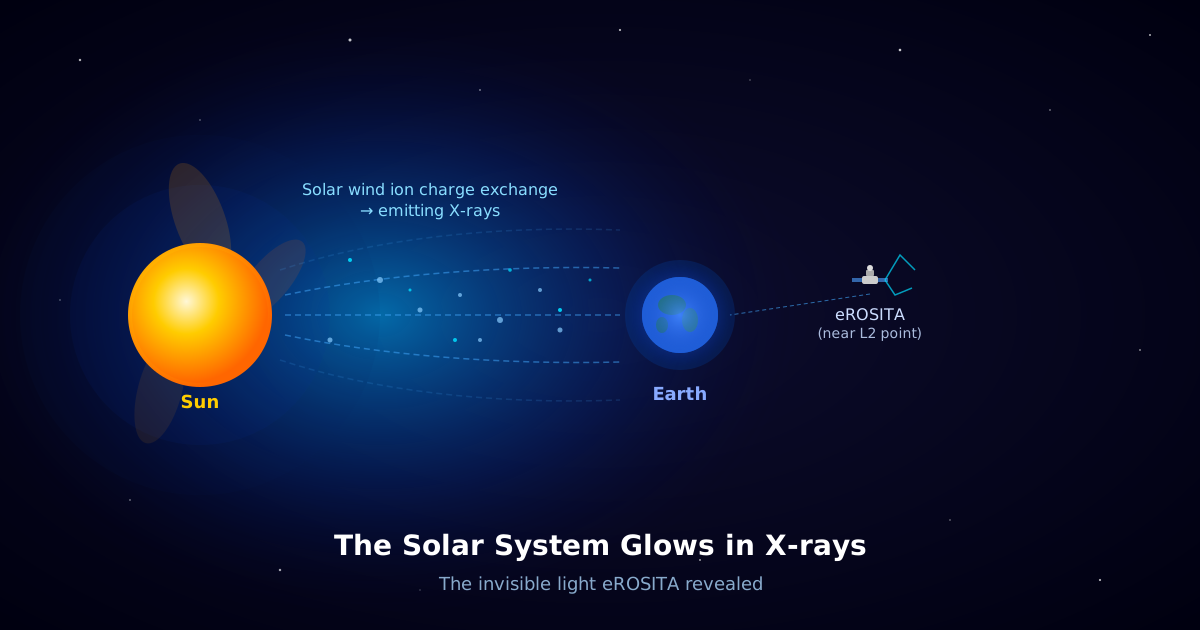
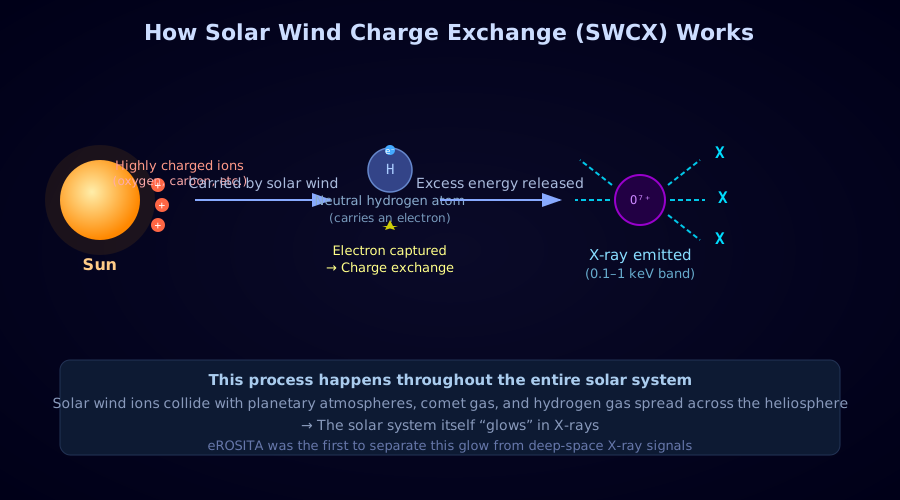
The Sun constantly blasts outward a stream of plasma called the solar wind. This flow carries not just protons and electrons, but also ions of oxygen, carbon, and other elements — and these aren’t ordinary ions. They’re highly charged, meaning electrons have been stripped away and the ions are hungry to replace them.
When one of these electron-hungry ions encounters a neutral hydrogen atom drifting through the solar system, it snatches the electron. This reaction is called charge exchange.
Right after the exchange, the ion finds itself in an excited state, temporarily holding more energy than it can keep. When it sheds that extra energy, it does so as an X-ray photon.
Honestly, the first time I heard this, it gave me pause. The same kind of radiation used in medical imaging is happening spontaneously, all over the solar system.
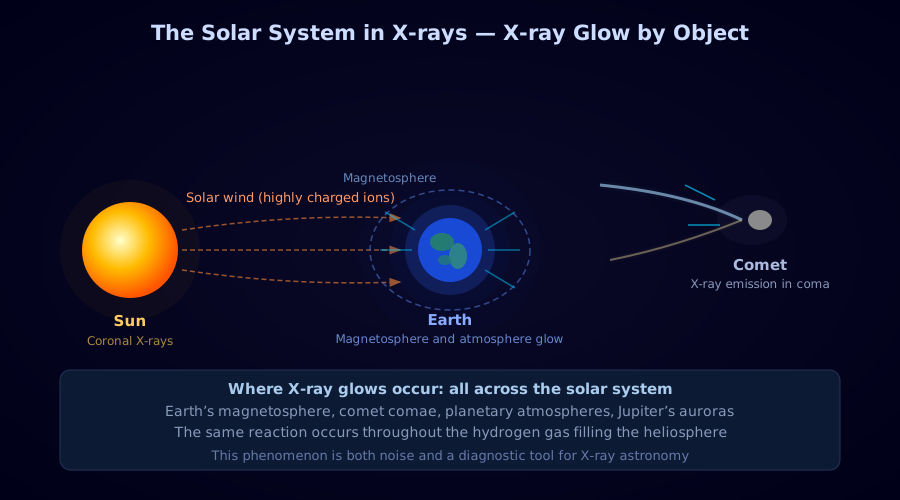
This phenomenon first drew serious attention in 1996, when X-ray emission was detected from a comet for the first time. Gas surrounding the comet was colliding with solar wind ions and lighting up in X-rays. Similar signatures were later found in Earth’s magnetosphere, the atmosphere of Mars, and Jupiter’s auroras.
In short: wherever the solar wind reaches, this reaction can happen. The entire solar system is wrapped in a faint but real X-ray glow.
The Invisible Glow eROSITA Untangled
The SRG/eROSITA mission — a German-Russian collaboration — is an all-sky X-ray survey telescope. Positioned at the L2 Lagrange point about 1.5 million km from Earth, it conducted repeated scans of the entire sky between 2019 and 2021.
What this research achieved was a kind of X-ray disambiguation.
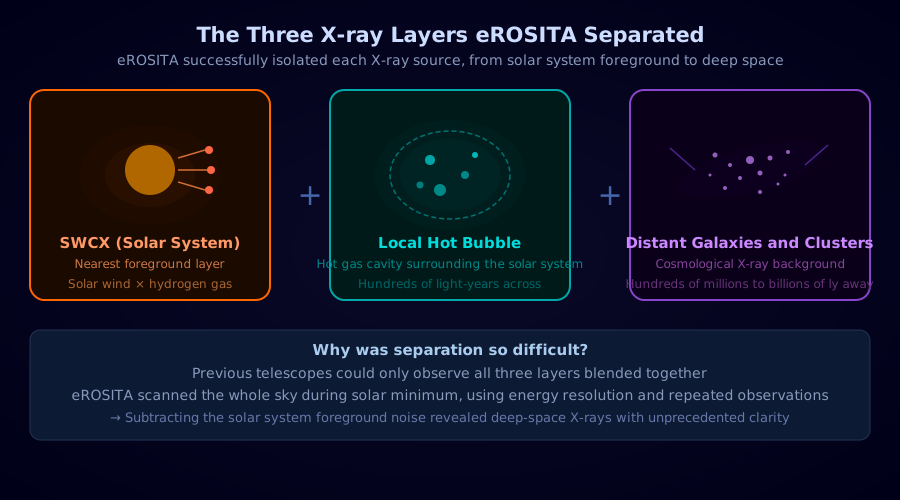
X-ray astronomy has long struggled with a layering problem. When you observe the sky, X-ray signals arrive from multiple sources stacked on top of each other. Closest in is the solar system’s own SWCX emission. Behind that sits the Local Hot Bubble — a cavity of superheated gas extending hundreds of light-years around us. And beyond that lies the cosmological X-ray background from distant galaxies and galaxy clusters.
For decades, all of these signals arrived mixed together.
eROSITA managed to pull them apart. By scanning the whole sky repeatedly during solar minimum — when the Sun is relatively quiet — and combining that with energy-band resolution and time-variable signals, the team could subtract the solar system foreground as a known quantity.
A research team at the Max Planck Institute published results in early 2026 showing that by precisely calculating and removing the SWCX contribution from within the solar system, they could separate the Local Hot Bubble and deep-space X-rays with far greater clarity than before.
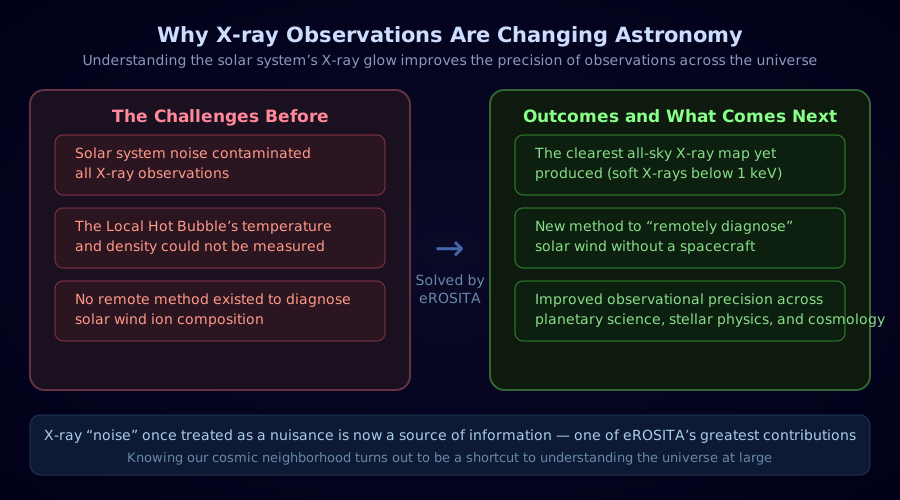
The headline result: the cleanest all-sky map yet produced in the soft X-ray band (below 1 keV).
When Noise Becomes Information
What’s interesting about this result is its double nature.
On one hand, solar-system X-rays have always been a headache for deep-space observers — noise to subtract, not signal to study. But on the other hand, that noise turns out to be its own kind of diagnostic tool.
The ion composition of the solar wind is tightly linked to solar activity. When the Sun gets more active, it pumps out more high-energy ions, and the X-ray intensity changes accordingly. By tracking those variations, eROSITA has shown it may be possible to remotely sense the heavy-ion content of the solar wind from Earth’s vicinity — without sending a probe to the Sun.
That connects to space weather forecasting. When solar flares and storms head toward Earth, knowing what kinds of ions are incoming could sharpen predictions of their impact.
There’s also a planetary science angle. Analyzing the X-ray patterns generated by solar wind interactions can reveal the state of a planet’s magnetic field and atmosphere — details that are otherwise hard to get at remotely.
What Is the Local Hot Bubble?
A short detour, because the Local Hot Bubble is worth knowing about.
The solar system sits inside a cavity hundreds of light-years across. This void is thought to have been carved out by nearby supernova explosions in the distant past, and its interior is filled with gas at temperatures exceeding one million degrees.
This “Local Hot Bubble” has long been known to emit soft X-rays, but separating its signal from the solar system’s SWCX was never clean. With eROSITA’s results, researchers can now map its boundaries and temperature distribution with a precision that wasn’t possible before.
Knowing what kind of cosmic neighborhood the solar system inhabits matters for understanding our place in the larger structure of the galaxy. To see the big picture, you have to know the ground you’re standing on.
What Invisible Light Tells Us
X-rays are invisible. So describing the solar system as “glowing” in them can feel abstract.
But put a number to it, and it starts to feel different. The heliosphere — the bubble of solar wind surrounding the solar system — stretches roughly 150 to 200 astronomical units in diameter. That’s 150 to 200 times the Earth-Sun distance. Across that entire volume, ions traveling at hundreds of kilometers per second are grabbing electrons from hydrogen atoms, and each grab produces an X-ray.
It might seem like a subtle phenomenon. But it’s evidence that the Sun is constantly acting on the space around it. The solar system is not a closed system; it’s in continuous exchange with the cosmos beyond.
What eROSITA gave us isn’t just an X-ray map. It’s a record of how our solar system connects to everything outside it.
Every time our ability to read invisible light improves, the universe shows us a different face.
Conclusion — See What’s Close to See What’s Far
For decades, X-rays from within the solar system were treated as interference — noise to subtract before getting to the real science. eROSITA has turned that interference into a tool.
There’s something satisfying about the logic here: measure and remove what’s in the foreground, and the signal from distant galaxies comes into focus. In astronomy, subtraction is a way of seeing.
The solar system isn’t just a place that receives X-rays from the universe. It generates them, and in doing so it participates in an electromagnetic conversation that spans billions of light-years.
When you think about it that way, the sunlight arriving at Earth starts to feel like just the visible part of something much stranger going on all around us.