I’ll be honest — when I first saw the numbers, I laughed a little.
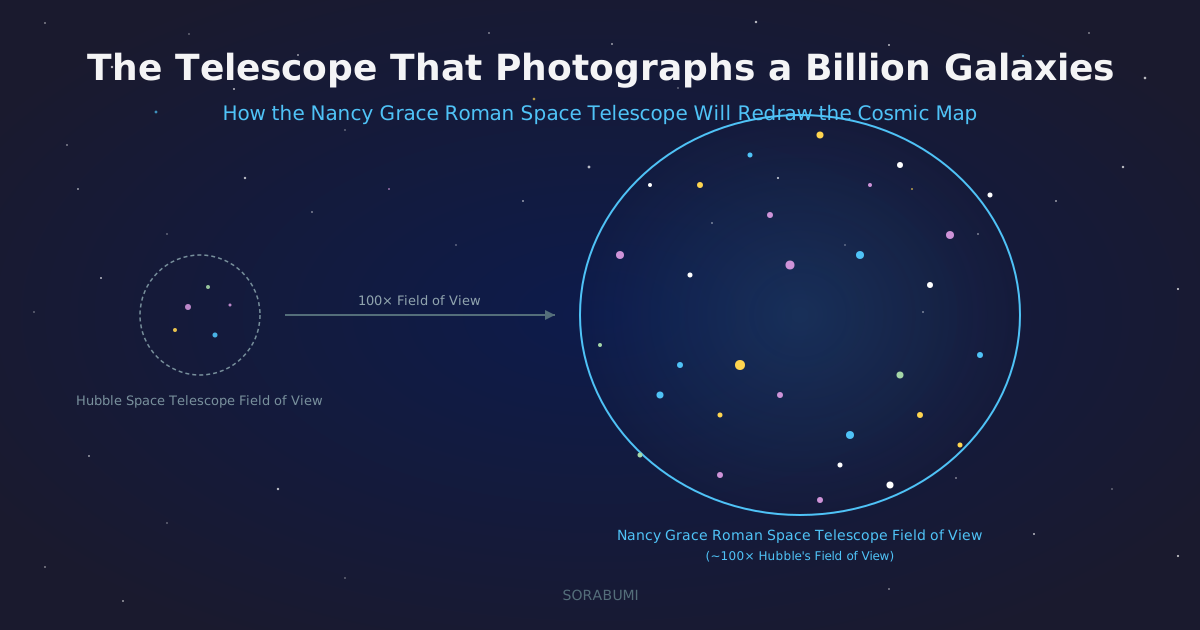
If Hubble’s field of view is 1, the next-generation instrument clocks in at roughly 100 times that. It fits five full moons into a single image. That’s the Nancy Grace Roman Space Telescope — Roman for short — scheduled for launch in 2026.
Everything Hubble has spent more than three decades doing, Roman might redo in a few years. That’s what this is about.
Hubble’s Greatness — and Its Blind Spot
There’s an image called the Hubble Deep Field. In 1995, astronomers pointed the telescope at a patch of sky that looked essentially empty and held the shutter open for ten days. The resulting photograph was packed with hundreds of galaxies. The world was stunned. All that darkness, and underneath it — an uncountable number of galaxies.
But the slice of sky that photograph covered was only about 1/12 the diameter of the full Moon. Extraordinarily narrow.
Hubble has phenomenal resolution, but a cramped field of view. Think of it like a top-of-the-line monocular: the image is sharp, but you can only take in a tiny piece of the sky at a time. To map the universe in any broad sense, you’d have to repoint the telescope thousands of times.
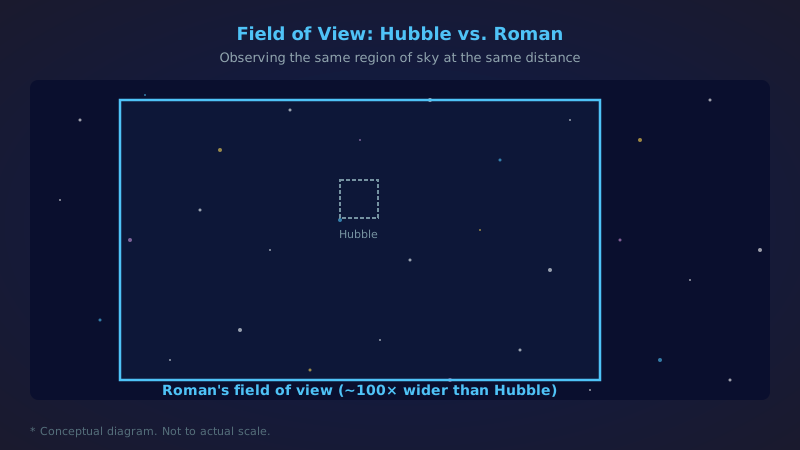
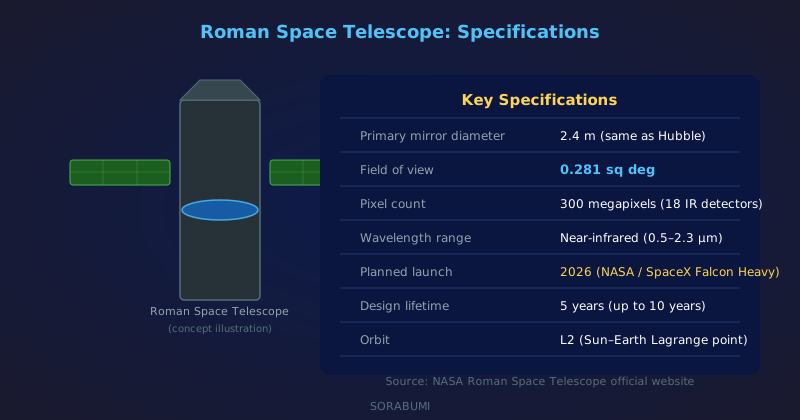
Roman changes that calculus entirely. It carries a primary mirror the same diameter as Hubble’s — 2.4 meters — yet its field of view spans roughly 0.281 square degrees. That’s about 100 times the sky in a single exposure. Same depth, same image quality, a hundred times faster cosmic cartography.
Why a Wider Field Is Such a Big Deal
Let’s slow down for a moment. Why does field of view matter so much?
Many of the universe’s deepest mysteries can’t be cracked by staring hard at one point. To find patterns, you need to look broadly.
Take the accelerating expansion of the universe — discovered in the late 1990s and attributed to some mysterious ingredient that permeates all of space. We call it dark energy, and we still have no idea what it actually is.
Figuring out the nature of dark energy requires mapping the distribution of galaxies across cosmic scales. By studying the statistics of how billions of galaxies are arranged across billions of light-years, astronomers can reconstruct the history of the universe’s expansion. And for that kind of work, surveying huge swaths of sky all at once isn’t just more efficient — it makes previously invisible patterns visible for the first time.
Doing that with Hubble would take a mind-bending amount of time. Roman can gather the same data at a pace that isn’t really comparable.
Three Mysteries Roman Is Going After
Roman is NASA’s answer to the question: what could we learn if we had a wide-angle eye in space?
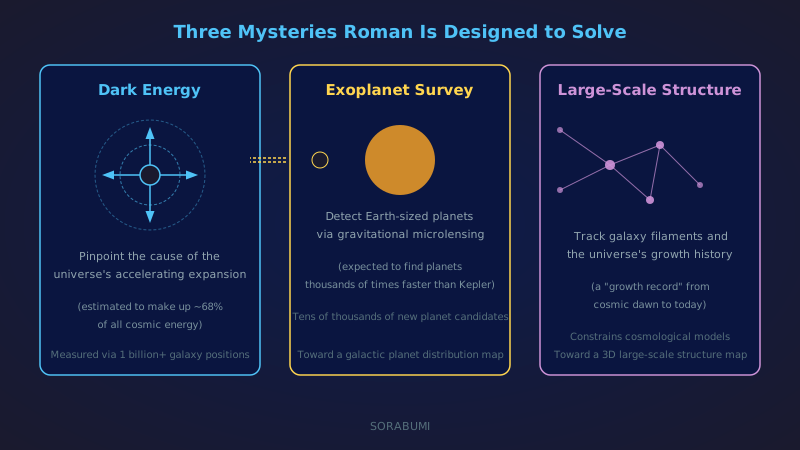
First: the nature of dark energy. Dark energy is thought to account for roughly 68% of the total energy content of the universe, yet it can’t be directly observed. Roman will track the positions and motions of more than a billion galaxies to determine whether dark energy is constant or has been changing over time. It’s one of the deepest open questions in modern physics.
Second: a census of exoplanets across the Milky Way. Roman will use a technique called gravitational microlensing to detect planets in wide orbits — the kind that Kepler’s transit method struggled to catch. Astronomers expect it to find tens of thousands of planetary candidates, building a statistical map of planet distributions throughout the galaxy. That map will help answer how common Earth-sized planets really are.
Third: the large-scale structure of the universe. Galaxies don’t scatter randomly through space. They congregate along filaments in a vast web-like pattern. Roman will continuously observe this three-dimensional structure across wide fields, letting researchers trace how the universe grew into its current shape.
All three goals demand the same thing: statistics and large-scale mapping. None of them yield to the “look deeply at one spot” approach.
Looking Far Away Means Looking Back in Time
Roman’s reach extends from a few billion to well over ten billion light-years. A light-year is the distance light travels in a year — so seeing light from ten billion light-years away means seeing the universe as it was ten billion years ago.
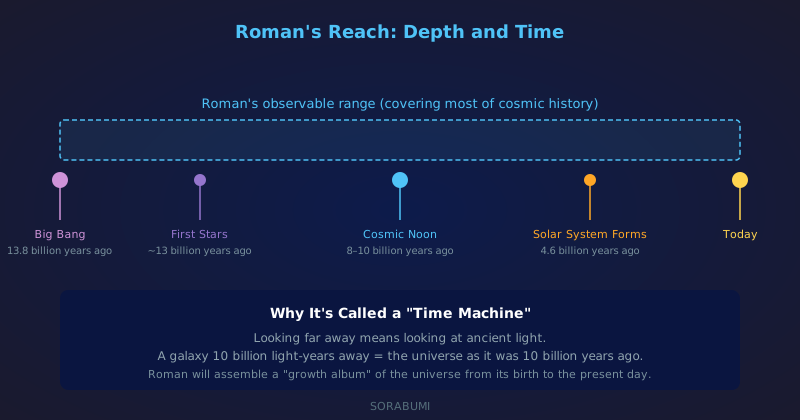
The universe is about 13.8 billion years old. Roman can observe across most of that history. Picture it as assembling a “growth album” for the cosmos — from the era when the first galaxies were forming all the way to the present.
The period astronomers call “cosmic noon,” roughly 8 to 10 billion years ago, was the most active era of galaxy formation. Roman will capture enormous numbers of galaxies from that epoch, providing crucial data on what drove galaxies to grow — and what eventually slowed them down.
The Name
“Nancy Grace Roman” honors NASA’s first Chief of Astronomy, Nancy Grace Roman (1925–2018). Working in the 1960s and ’70s, she was one of the people who helped conceive of what would become the Hubble Space Telescope. She’s sometimes called the “Mother of Hubble.” She reportedly learned, before her death in 2018, that a major new space telescope would carry her name.
She must have been delighted. There’s also something quietly poignant — and faintly ironic — about the fact that the telescope named for the person who helped build Hubble will survey the sky a hundred times more broadly than Hubble ever could.
Launch in 2026 — and What Comes After
Roman is scheduled to launch in 2026 aboard a SpaceX Falcon Heavy rocket. Like JWST, it will be deployed at the L2 Lagrange point — a stable orbital position on the far side of Earth from the Sun. Its design lifetime is five years, with an operational goal of up to ten.
If JWST delivers astonishing close-up portraits of distant galaxies and the fine structure of cosmic objects, Roman will provide the statistical skeleton — the macroscopic architecture of the whole universe. They aren’t rivals. They’re complements.
JWST digs deep; Roman sweeps wide. Maybe understanding the universe always needed both kinds of eyes.
Researchers are already drafting proposals for what they’ll do with Roman’s data. By the 2030s, combining Roman and JWST observations should kick cosmological research into a genuinely new gear.
The launch is close. When Roman captures its first light, I’m quietly curious about just how many galaxies will fit in that single frame.