For a long time, black holes seemed simple: they pull things in and never let go.
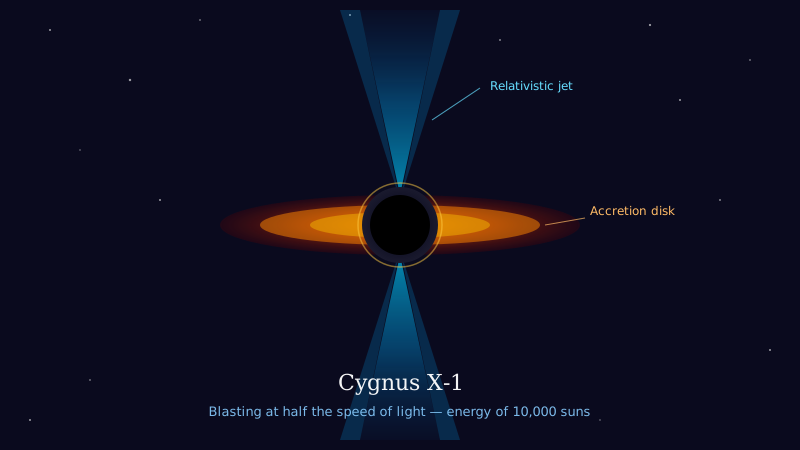
The reality is messier — and more spectacular. A black hole devours matter while simultaneously blasting some of it back out. This outflow, called a jet, tears through space at half the speed of light carrying the energy equivalent of 10,000 suns. In April 2026, that figure was confirmed through direct measurement for the first time.
The black hole in question is Cygnus X-1 — the first one humanity ever confirmed to exist.
What a Black Hole Actually Spits Out
Saying that everything near a black hole gets swallowed is a bit too simple.
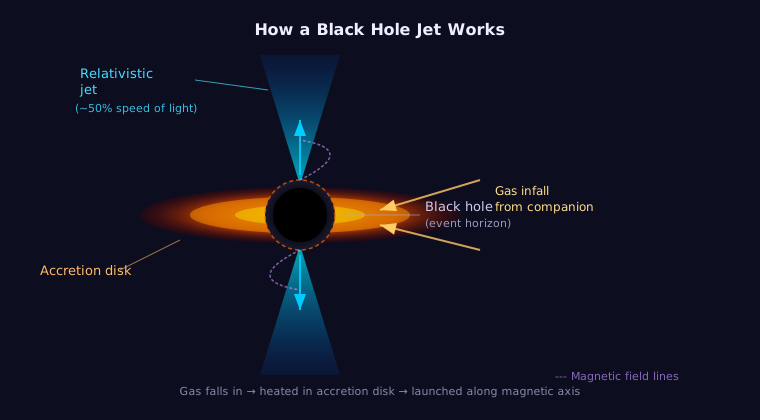
Gas falling toward a black hole doesn’t plunge straight in. Instead, it forms a vast spinning structure called an accretion disk, spiraling inward over time. Friction and compression heat the disk to tens of millions of degrees, producing intense X-ray radiation.
That part is fairly well known. But the story doesn’t end there.
At the inner edge of the accretion disk, powerful magnetic fields form and fling a fraction of the infalling gas along the black hole’s rotation axis — upward and downward, into space. The result is what astronomers call a relativistic jet: a beam of matter moving so close to the speed of light that the physics of time and space shift noticeably. That’s what “relativistic” means.
If you’ve ever seen an image of the galaxy M87, you’ve seen this in action — that long bluish streak extending from the galaxy’s core is a relativistic jet stretching thousands of light-years. Cygnus X-1 is a stellar-mass black hole, far smaller than the supermassive giants lurking in galaxy centers, yet the underlying mechanism is strikingly similar.
Cygnus X-1 — The First Black Hole We Ever Confirmed
The name “Cygnus X-1” is shorthand for the first X-ray source discovered in the constellation Cygnus. It was detected in 1964 during a balloon-borne observation, and subsequent work made a strong case that it had to be a black hole. By the 1990s that case was essentially settled. Today, astronomers estimate its mass at roughly 21 times that of the Sun, located about 6,000 light-years from Earth.
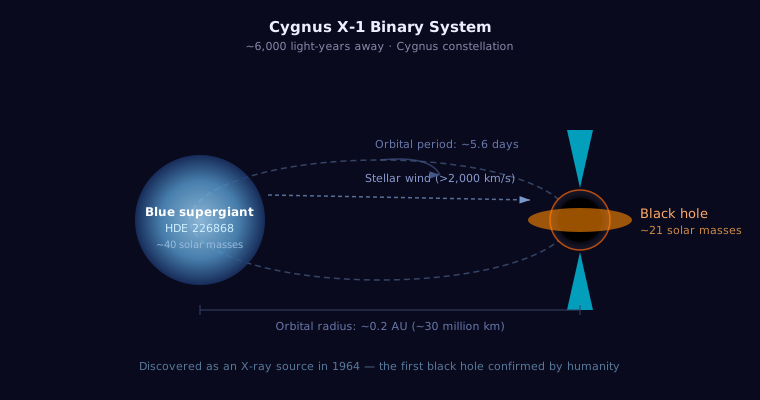
What sets Cygnus X-1 apart from many other black holes is its companion star. The system is a binary: the black hole orbits a blue supergiant called HDE 226868, which is about 40 times the mass of the Sun. The two complete one orbit around each other roughly every 5.6 days.
Their separation is remarkably tight — only about one-fifth the distance between Earth and the Sun. At that range, the stellar wind blowing off the supergiant flows directly into the black hole’s gravity, continuously feeding the accretion disk and powering the jet.
A Wobbling Jet Reveals Its Secrets
Astronomers had known the jet existed for years. What they couldn’t do was measure its energy directly.
The problem is straightforward: a jet is visible, but extracting an accurate instantaneous power reading is hard. Previous estimates relied on long-term averages and indirect inferences. There was no way to ask, in real time, “how much energy is this jet carrying right now?”
The breakthrough came from an unexpected angle — the jet’s wobble.
The team studying Cygnus X-1 noticed that the jet wasn’t shooting straight. The stellar wind from the companion was pushing against it, causing the jet to bend and sway periodically. It looked, in the researchers’ words, like dancing.
That wobble turned out to be the key. The strength of the stellar wind can be independently determined. The degree to which it deflects the jet is visible through radio observations. Combine the two and you can calculate the force needed to produce that deflection — which is the jet’s power.
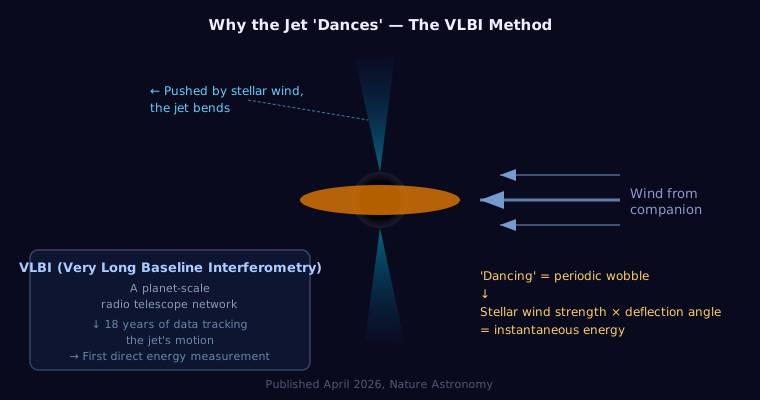
The technique used was VLBI — Very Long Baseline Interferometry — which links radio telescopes spread across Earth to create, in effect, a single telescope the size of the planet. Eighteen years of high-resolution radio images showed the jet’s motion in enough detail to make the calculation possible.
The results appeared in the journal Nature Astronomy on April 16, 2026.
What “10,000 Suns” Actually Means
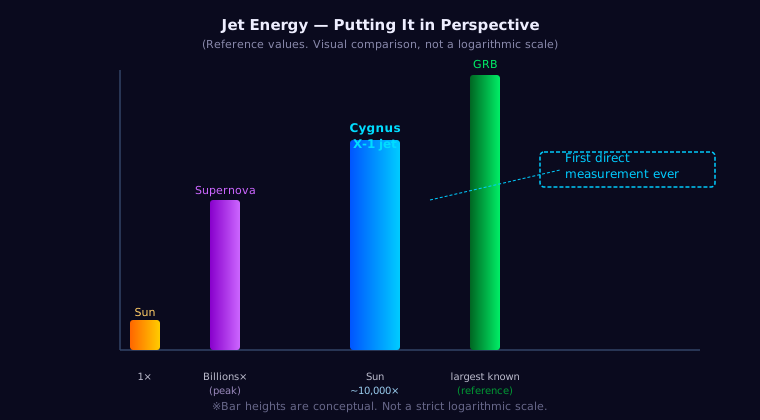
The numbers from the calculation: Cygnus X-1’s jet is releasing energy at roughly 10,000 times the Sun’s total output while traveling at about 50% the speed of light.
Ten thousand suns sounds abstract until you put it in concrete terms. Earth intercepts about 174 trillion watts of solar energy every second. Ten thousand times that is roughly 1.74 quintillion watts — continuously, every moment the jet is active.
But the headline number isn’t the most important finding.
The more significant result is the ratio: roughly 10% of the energy carried by infalling matter gets redirected into the jet and shot back out. That figure had long been used in simulations of cosmic structure as an assumed constant — a number theorists needed but couldn’t verify. Now it has direct observational backing. Theory and observation aligned for the first time.
Jets Shape the Universe We Live In
You might reasonably wonder why any of this matters beyond Cygnus X-1 itself.
Here’s why it does. Stellar-mass black holes — a few to a few dozen times the Sun’s mass — and the supermassive black holes sitting at the hearts of galaxies — millions to billions of solar masses — operate on completely different scales, but their underlying physics appears to follow the same rules. What we measure in one can be applied to the other.
That means the “10% efficiency” figure measured at Cygnus X-1 likely holds for the supermassive black holes that anchor galaxies across the universe.
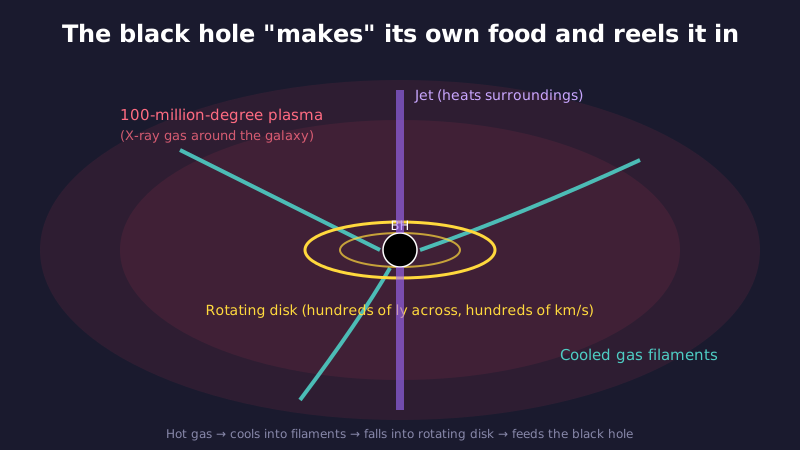
And that matters enormously. Galaxies are not passive structures. Jets from their central black holes heat and compress the surrounding gas, sometimes sparking new star formation, sometimes suppressing it. This back-and-forth — astronomers call it feedback — is one of the key processes that determined why galaxies look the way they do today.
It took a while to fully register, but the “black hole swallows everything” picture is only half the story. Without the energy black holes push back out, the universe’s large-scale structure would look entirely different. That 10% figure — now measured rather than assumed — is woven into the shape of everything we see.
Humanity first spotted Cygnus X-1 more than sixty years ago, and spent decades just confirming it was a black hole. Now the same object is teaching us exactly how much a black hole gives back to the cosmos. In astronomy, the objects you find first often turn out to have the most to say.