In March 2025, officials from ESA and JAXA sat down in Tsukuba and signed a joint statement pledging deeper cooperation on Moon and Mars exploration. Agreements like this come out somewhere almost every year, so it didn’t exactly make headlines.
But think about it for a moment. Why would the space agencies of Japan and Europe bother going to the Moon and Mars together? “Because cooperation is good” doesn’t hold up as a reason to sink billions of dollars into a project.
There’s a simpler, more honest explanation underneath.
No Single Country Can Do This Alone
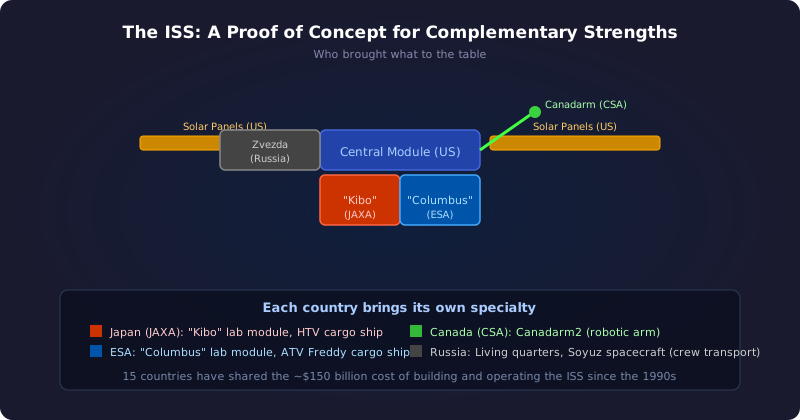
The International Space Station was built and is operated by 15 countries sharing a total cost of around $150 billion. Why all that complexity? Because the project was beyond what any one country could handle on its own.
Even the United States needed partners to fill budget gaps and technical holes. Japan’s Kibo laboratory module, ESA’s Columbus module, Canada’s Canadarm2 robotic arm — each nation brought what it did best.
That dynamic only intensifies when you’re talking about Moon and Mars exploration.
Cost estimates for the Artemis program over the next decade run into the tens of trillions of yen. It’s politically difficult for the US to carry that alone. Congressional approval requires allied buy-in, and the framing has to be “this isn’t just for America.” Conversely, Japan and ESA get a ticket to crewed lunar exploration they couldn’t afford unilaterally — paying in cash and technology, getting crewed flight opportunities and scientific data in return. That’s a fair trade.
To put it in concrete terms: Japan’s share of ISS construction costs came to about 12% of the total. In exchange, Japan got Kibo — its own dedicated research lab in space. Building a space station from scratch would have cost far more. The same math plays out again on the Moon.
Technical Specialties Drive the Division of Labor
Which country does what ultimately comes down to who’s good at what.
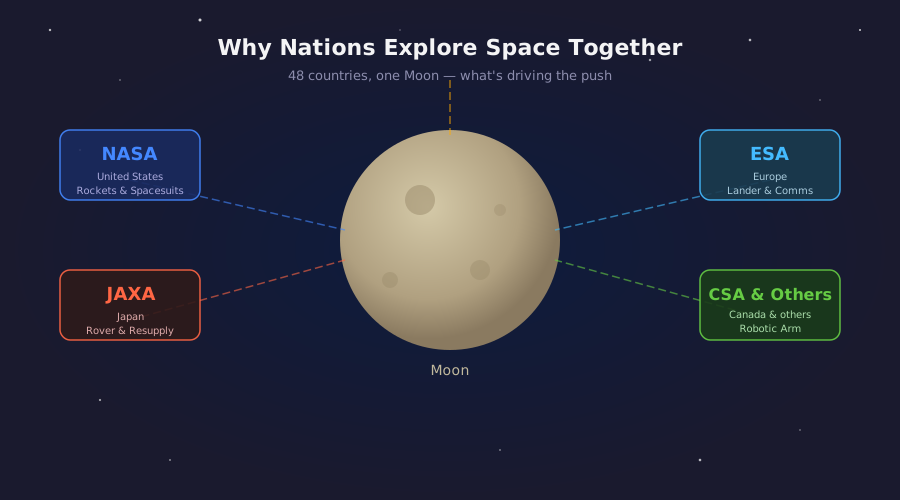
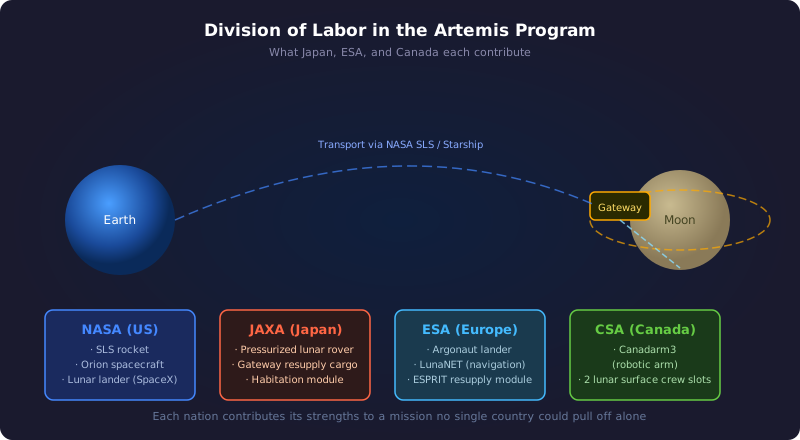
NASA handles rockets and spacecraft, including plans to use SpaceX’s Starship as a lunar lander. JAXA’s strength is mobility. The pressurized rover it’s co-developing with Toyota can keep two astronauts alive for a month without spacesuits — and right now, Japan is the only country that can offer a vehicle capable of driving hundreds of kilometers across the lunar surface.
ESA is focused on communications and navigation infrastructure. It’s developing LunaNET, essentially a GPS network for the Moon, and there are plans to put receivers on JAXA missions. Once someone builds that infrastructure, every subsequent mission benefits. That’s the whole logic for cost-sharing.
Canada has effectively made robotic arms its specialty. Canadarm2 has been running on the ISS for more than 28 years; its successor, Canadarm3, is slated for the Gateway lunar station. In exchange for that contribution, Canada has secured two crewed lunar surface slots.
The core of international space cooperation isn’t idealism — it’s complementarity. Everyone brings something the others don’t have.
Why 48 Countries Signed the Artemis Accords
When the Artemis Accords launched in 2020, eight countries signed on. By late 2024, that number had reached 48.
Why so many?
Part of it is the growing sense that space is becoming a “plant your flag first” competition. The Moon’s south pole is believed to harbor water ice — a potential future source of fuel and drinking water. The thinking goes: whoever gets there first and establishes a track record gets to help write the rules.
There’s also a deliberate strategic element on the US side. The Accords function as a diplomatic tool for rallying allies through a non-military channel. With China and Russia advancing their own lunar programs, NASA and the State Department have an interest in building the image of democratic nations cooperating in space.
For smaller signatories, joining means getting your name on the list of advanced space nations. Even with limited technology and funding, membership opens a door to future benefits.
Idealism and calculation mix together — and that’s how you get to 48 countries.
ESA and JAXA Set Their Sights Beyond the Moon
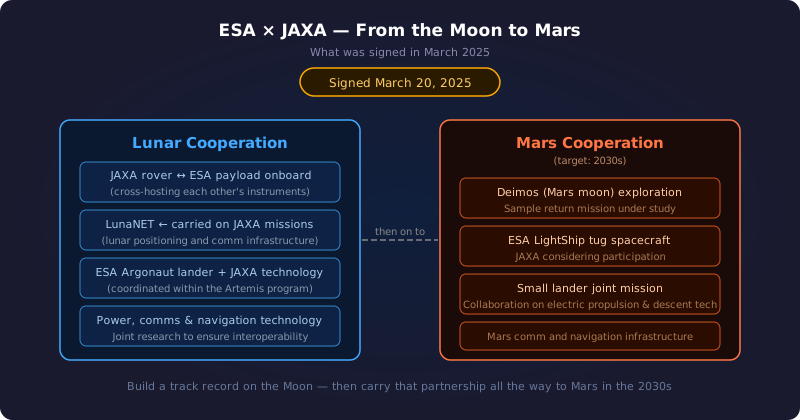
The interesting thing about the March 2025 statement is that it reaches beyond the Moon to Mars.
On the Moon, ESA’s Argonaut lander and JAXA’s rover will combine technology and share communications. The deal also includes cross-hosting arrangements — mounting each other’s payloads — which substantially cuts costs for both sides.
For Mars, both agencies are exploring the possibility of a joint small lander mission in the 2030s. There are also early-stage plans for a sample return from Deimos, one of Mars’s two moons. JAXA’s MMX mission targets samples from Phobos; a future Deimos mission could bring ESA into the picture.
Also worth noting is the agreement’s language on “cooperation in electric propulsion technology.” In deep space, ion engines beat chemical fuel for efficiency. JAXA has been refining that technology through the Hayabusa series; ESA has been investing in the same field. Sharing the results gets both agencies further than working independently.
The Real Costs of Doing It Together
To be fair, international cooperation comes with genuine drawbacks.
Decision-making is slow. When you need all 15 ISS partner agencies to agree on something, it takes time. Technical standardization is a huge overhead. For JAXA and ESA to use the same lunar positioning system, their hardware and software have to be compatible — and retrofitting separately designed systems is far harder than it sounds.
There’s also the information-security problem. Some space technology overlaps with military technology, and “how much do we share?” is always a live question. The US’s ITAR (International Traffic in Arms Regulations) restricts the transfer of certain technologies even to allies. It’s not unusual for a JAXA engineer working at a NASA facility to encounter rooms they’re simply not allowed to enter.
Despite all that, cooperation is still the rational choice. Lunar and Mars exploration rank among the most expensive long-duration projects humanity has ever attempted. No single country can carry that weight anymore.
When International Cooperation Became the Default
When the first ISS modules reached orbit in 1998, it still felt like something of a miracle that Japan, America, Russia, and Europe were building a space station together — only a decade after the Cold War ended.
Today, international cooperation in space exploration is unremarkable. JAXA and ESA signing agreements, NASA bringing allies into Artemis — it’s all become routine. If anything, announcing you’re going it alone is the attention-grabbing move. The fact that China and Russia’s independent lunar base plans generate so much commentary is partly a reflection of how thoroughly cooperation has become the norm.
Space is simply too large for any one nation to tackle. Not because the ideals are beautiful, but because there’s no practical alternative — and that’s the honest version of the story.
The piece of paper signed in Tsukuba in March 2025 was just the latest product of that reality.