The 47th session of the International Space Cooperation Committee opened two hours behind schedule.
“First, I’d like to confirm,” said chairperson Lawrence, the Swedish delegate, leafing through the thick stack of documents before him. “The framework agreement for this lunar base project is grounded in the lofty principle of advancing space development peacefully and sustainably, for the benefit of all humanity.”
“Agreed,” said Kawachi, the Japanese delegate.
“Naturally,” said Schmidt from the ESA.
“Absolutely,” said Johnson from NASA.
Everyone nodded. Nobody argues with a lofty principle.
The trouble started five minutes later.
“Next, let’s turn to Annex C — the proposed sector allocations,” Lawrence said, and the air in the room shifted.
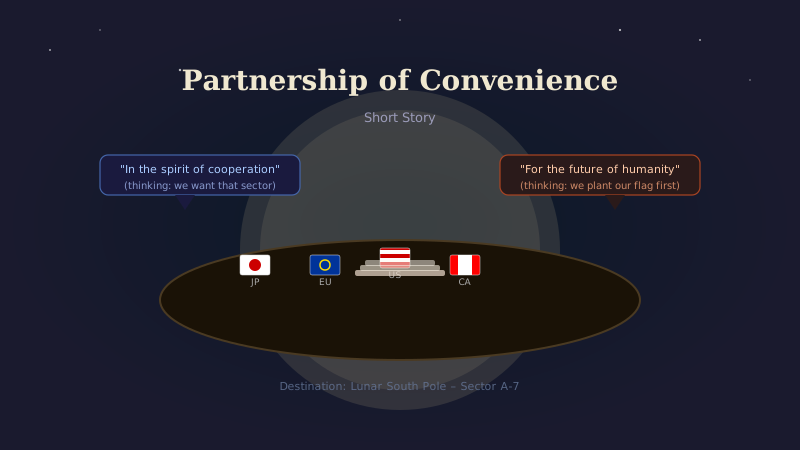
A map of the lunar south pole region appeared on the screen. Color-coded sectors arranged in a grid. NASA’s flag floated over the red sector in the upper left. JAXA’s logo sat in the blue sector beside it. The ESA star emblem was provisionally placed one column to the right.
“Hold on,” said Johnson. “Why are we in B-2 instead of A-7? The sun exposure is completely different.”
“A-7 is the sector we’ve been requesting since the early rounds of negotiations,” said Kawachi. His voice was calm, but his grip on the documents tightened slightly.
“Well,” Schmidt cut in, “the discovery of water in A-7 was based on our satellite data. Which would suggest, from the standpoint of exploration priority rights——”
“Which article covers exploration priority rights?” asked Kawachi.
Schmidt flipped through four pages of the A4 document. Nothing. Three more pages.
”…That language hasn’t been drafted yet.”
The argument ran two hours.
Sun exposure angles, subsurface ice volumes, future power infrastructure placement, communications antenna elevation — all of it landed on the table. The lofty principle got left somewhere behind as everyone pressed their case for A-7 with full conviction.
After a break, Lawrence floated a proposal.
“As a compromise: A-7 is designated as joint administration shared equally among NASA, JAXA, and ESA, with an operations committee established to coordinate annually. That would give all three agencies a rational basis for building the base together.”
Everyone studied the documents again. Kawachi ran the numbers on his calculator. Johnson checked the map scale. Schmidt made a note.
After a moment, all three nodded.
“We agree — in the spirit of cooperation,” said Johnson.
“For the future of humanity,” said Kawachi.
“In the interest of sustainable space development,” said Schmidt.
Lawrence confirmed the title field on the agreement form, then picked up his pen.
“Framework Agreement on International Cooperation in the Lunar South Polar Region”
Signatures done, everyone exchanged nods — good, good, that went well. Out in the corridor, Kawachi quietly checked his phone. One missed call from his supervisor.
“Did we get A-7?”