Somewhere in the universe, something extraordinary is happening right now.
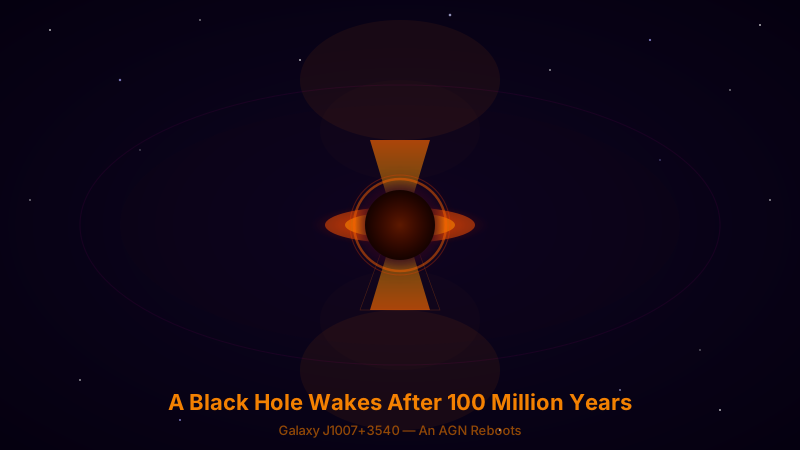
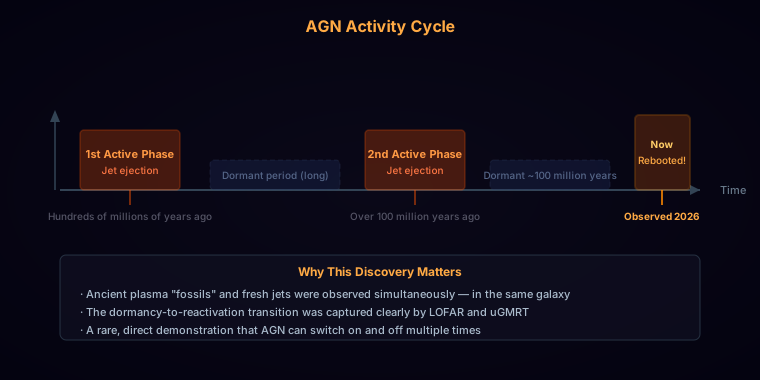
In April 2026, an image from a radio telescope stopped astronomers cold. At the center of galaxy J1007+3540, a black hole that should have been sleeping for over 100 million years had suddenly launched a new jet of plasma. Stranger still, the galaxy still carried the “fossil” of a previous eruption from long ago. Old scars and fresh wounds, layered on top of each other in the same place — an unusual sight by any measure.
So why do black holes go quiet? And what wakes them back up?
Why a Black Hole Goes Silent
The popular image of a black hole is an unstoppable cosmic vacuum cleaner, swallowing everything in reach. Reality is more nuanced. Black holes don’t eat continuously — they need a steady supply of fuel.
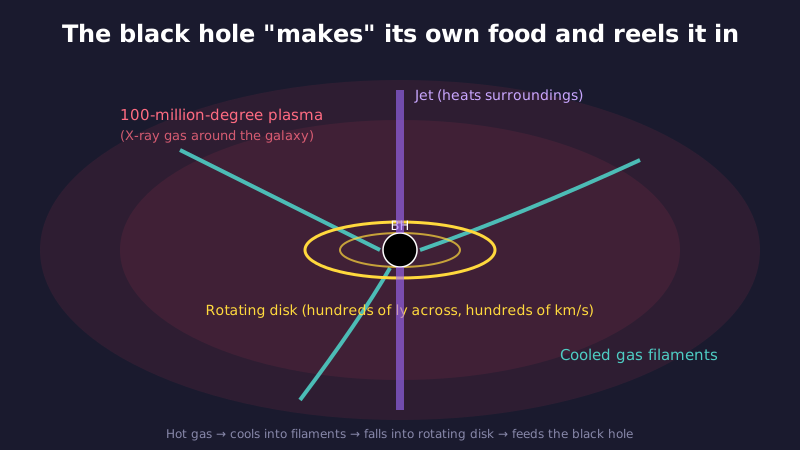
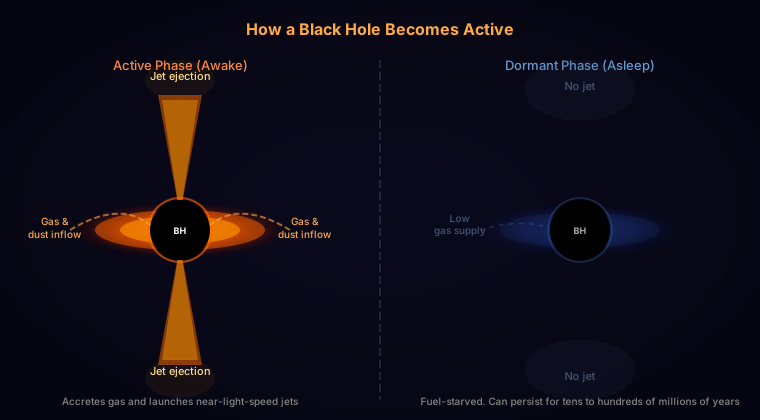
A supermassive black hole at the center of a galaxy becomes active only when enough gas and dust have gathered nearby. As that material spirals inward, it forms an accretion disk — a swirling structure where friction generates enormous amounts of energy. Magnetic fields then funnel some of that energy into two narrow beams, called jets, firing outward from both poles at close to the speed of light. That’s what an active galactic nucleus, or AGN, actually is.
The problem is that fuel runs out.
When the gas supply dries up, the accretion disk thins, the jets weaken, and the black hole falls silent. In a gas-poor environment, even material that does fall in can’t be efficiently converted into energy. The result is a black hole that looks, for all practical purposes, asleep.
That dormancy can last tens of millions to hundreds of millions of years. In cosmic terms, it’s routine. On a human timescale, it’s almost incomprehensible.
Fossils and Fresh Growth, Side by Side
The galaxy where all this played out, J1007+3540, sits within a galaxy cluster. Two radio observatories took a close look: LOFAR, the Low-Frequency Array in the Netherlands, and uGMRT, India’s upgraded Giant Metrewave Radio Telescope.
What they found had a clear two-layer structure.
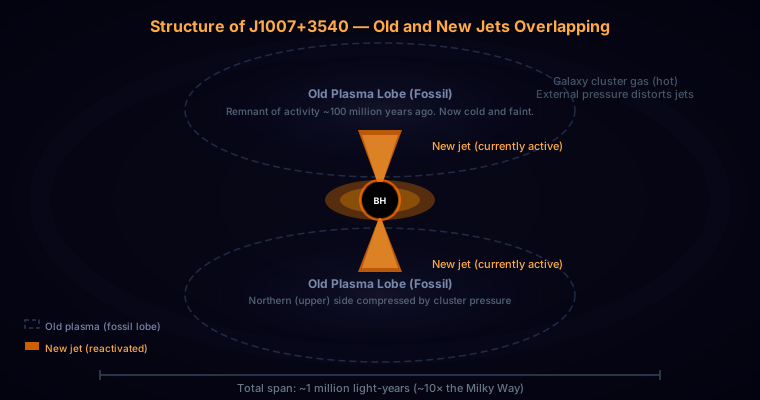
Spread across the outer regions of the galaxy is a large, faint oval haze — ancient plasma from an eruption more than 100 million years ago. The material lost its energy long since, expanded, and now drifts cold and dim through space. Think of it as a fossil of the black hole’s past activity.
Nested inside that fossil, however, is something bright and compact: a fresh jet, actively firing right now. It looks like a new sprout growing inside an old, decaying pod.
The research team, whose findings were published in the Monthly Notices of the Royal Astronomical Society, described it as a “restarted active galactic nucleus” — direct evidence that an AGN went dormant for an extended period and then switched back on. That kind of clear, simultaneous record of before and after is rare.
How the Cluster Reshapes the Jets
There’s more going on here than a simple on-off switch.
Galaxy J1007+3540 lives inside a galaxy cluster, and that environment leaves visible marks on the jets. Galaxy clusters are filled with extremely hot gas, and its pressure squeezes the jets from the outside. In the images, the older plasma lobes appear asymmetric — one side has been compressed by the cluster gas more than the other.
There’s also a feedback effect worth noting. When a jet plows into the cluster gas, it creates shockwaves. Without that heating, the cluster gas would cool and collapse into far more stars than we actually see. The jet, by injecting heat into the surrounding medium, effectively throttles star formation. The idea that a black hole’s activity controls the “temperature” — and therefore the growth — of an entire galaxy cluster is one of the more surprising results to come out of AGN research.
Even while the black hole was dormant, its fossil plasma was still there. Once it woke up, it started reshaping its environment all over again.
Why 100 Million Years? Nobody Really Knows
The honest answer is that we don’t have a complete explanation.
The leading candidates involve a new injection of gas — either from gravitational interactions between nearby galaxies, or from gas recycled inside the galaxy when old stars die. There’s also a scenario where a cold molecular cloud falls toward the black hole and triggers a sudden burst of feeding. Any of these could plausibly restart an AGN.
What’s harder to explain is the specific timescale. All of human history spans a few thousand years. The dinosaurs died out 66 million years ago. This black hole slept for longer than that — and then, for reasons still unknown, flipped back on. Whatever controls that timing hasn’t been pinned down.
What makes this observation particularly valuable is that it preserves both records at once. Without the fossil, there’d be no way to prove the earlier episode of activity ever happened. Because the fossil and the fresh jet are visible simultaneously, researchers can confirm this galaxy has gone through at least two cycles of activity and dormancy — and probably more.
Reading the History Written in the Sky
Observing the universe is, in a sense, reading the past. Light and radio waves travel at a finite speed, so the farther out you look, the further back in time you see.
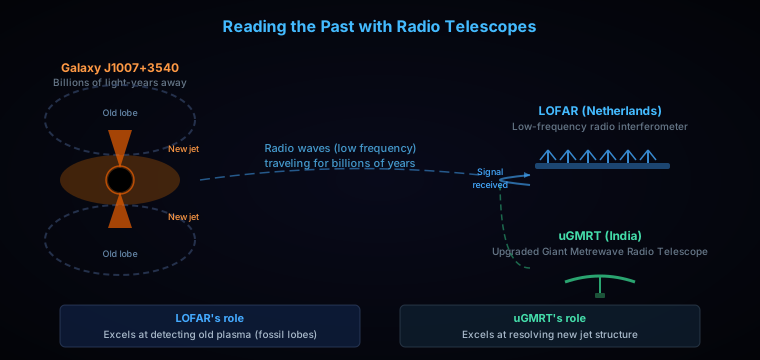
The case of J1007+3540 illustrates this beautifully. The old plasma lobes are evidence of past activity; the new jet is evidence of present activity. But the observer doesn’t receive them at different points in time — they arrive together, frozen into a single image of the galaxy as it appears right now.
That picture was only possible because of the complementary strengths of two instruments. LOFAR is tuned to detect weak, low-frequency emissions — exactly the kind of faint signal that old, cold plasma gives off. uGMRT offers the sensitivity and resolution needed to pick apart the compact structures of the newer jet. Together, they revealed a complexity that neither could have shown alone.
A Universe That Keeps Waking Up
The idea that AGN cycle on and off has been around in theory for a while. But observational confirmation — especially the kind where you can see old and new activity cleanly layered in the same galaxy — remains rare.
As more examples accumulate, the relationship between AGN cycles and galaxy evolution will come into sharper focus. The rate at which stars form, and the way galaxies grow over billions of years, is closely tied to when and how intensely a black hole chooses to be active. Black holes don’t just consume their host galaxies — they regulate them. Observations like this one are slowly building the case for that picture.
One hundred million years is a long time. To the universe, though, it’s just the pause between one event and the next.
The sleeping giant woke up. Its voice is now spreading across more than a million light-years of space.
Sources
- Monthly Notices of the Royal Astronomical Society, 2026; 545 (4), DOI: 10.1093/mnras/staf2038
- ScienceDaily: “Black hole wakes after 100 million years and erupts like a cosmic volcano” (2026)
- Space.com: “Reborn black hole seen erupting across 1 million light-years of space” (2026)