Hearing that “temperatures are uneven in space” probably doesn’t raise many eyebrows. Stars run at different temperatures. Nebulae are hot in some spots and cool in others. That’s just how the universe is.
But when the outer envelope of your own galaxy — the galaxy you live in — turns out to be warmer on one side than the other, that’s a different kind of strange.
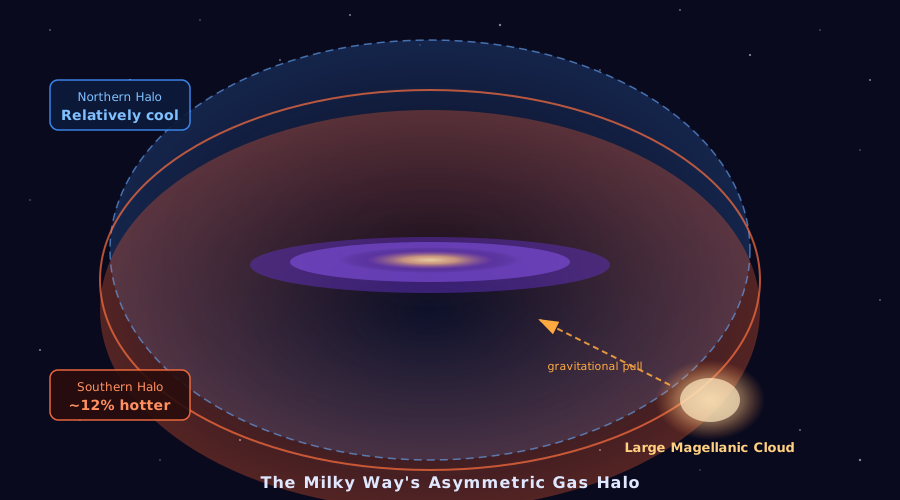
A research team analyzing 2024 X-ray observatory data confirmed exactly that. The hot gas halo surrounding the Milky Way is about 12% hotter on the southern side than the northern side.
The reason: the Large Magellanic Cloud, a small galaxy making a close pass through our cosmic neighborhood.
Galaxies Have an Outer Shell
Let’s start with a quick tour of galactic structure.
When most people picture the Milky Way, they see that thin band of light stretching across the night sky — the disk, the flat rotating slab that holds hundreds of billions of stars including the Sun.
But there’s more to a galaxy than its disk. Surrounding it is a roughly spherical layer of gas called the halo. At more than 600,000 light-years across, it dwarfs the disk itself, which spans about 100,000 light-years.
The halo is extraordinarily thin. Its density is thousands of times lower than the disk’s, which is exactly why it went unmeasured for so long.
Recent advances in X-ray astronomy changed that. The gas in the halo sits at temperatures of several million degrees, faintly emitting X-rays. By capturing that emission, astronomers have slowly been able to map the halo and take its temperature.
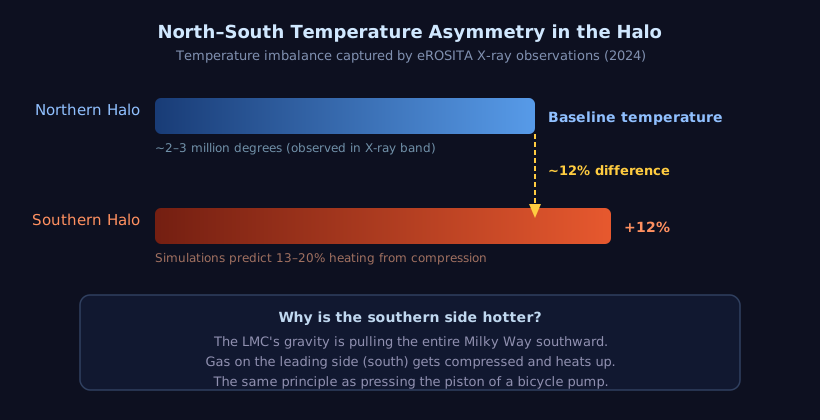
In 2024, a team analyzing data from eROSITA — an X-ray space telescope developed jointly by Germany and Russia — reported something surprising: the Milky Way’s halo is about 12% hotter on the southern side than the northern side.
Twelve percent might sound like a small gap. But think about the scale here. We’re talking about a temperature asymmetry stretched across hundreds of thousands of light-years in a single direction. That kind of imbalance doesn’t just happen. Something is doing this.
A Close Neighbor Named the LMC
The Milky Way has two small companion galaxies: the Large Magellanic Cloud (LMC) and the Small Magellanic Cloud (SMC). From the Southern Hemisphere, both are visible to the naked eye as hazy patches of light. They sit about 160,000 and 200,000 light-years away, respectively, and orbit the Milky Way under the pull of its gravity — classic satellite galaxies.
Of the two, the LMC turns out to be the key to this mystery.
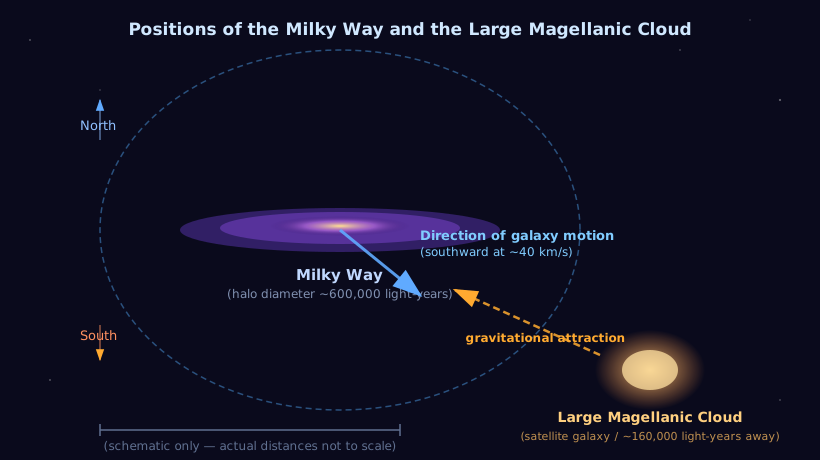
The LMC is pulling on the Milky Way. More precisely, the two galaxies pull on each other — but since the LMC’s mass is only a fraction of the Milky Way’s, the effect is lopsided. The LMC is slowly drawing the Milky Way toward it, shifting our entire galaxy in that direction.
The speed of this drift: roughly 40 kilometers per second.
Whether that sounds fast or slow is hard to gauge intuitively. By cosmic standards, it’s fairly gentle. On any human timescale, the motion is completely imperceptible. But over tens of millions — or hundreds of millions — of years, the galaxy has unmistakably moved.
One key detail: recent research has found the LMC is considerably more massive than once thought. About 150 billion solar masses — somewhere between one-fifth and one-tenth the mass of the Milky Way. For a satellite galaxy, that’s substantial. And it’s precisely that mass which gives the LMC the gravitational leverage to deform the Milky Way’s halo. If the LMC were lighter, the temperature difference would be smaller, maybe too faint to detect at all.
Think of a Bicycle Pump
If the Milky Way is drifting southward — toward the LMC — then the gas on the southern side is getting pushed.
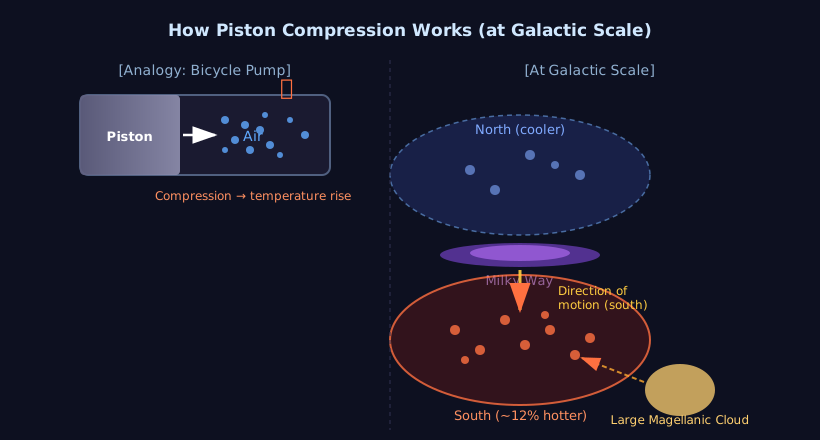
The analogy the research team reached for was a bicycle pump. Press the piston inward and the air ahead of it gets compressed, raising its temperature. That same principle is playing out at galactic scale.
As the Milky Way moves south, the thin gas in the southern halo is squeezed against the direction of travel. Compressed gas gets hot. That’s the 12% temperature excess you see in the data.
Computer simulations back this up: the compression effect heats the southern halo by roughly 13–20%. The observed 12% fits squarely within that range.
There’s another interesting wrinkle here. A 2019 simulation actually predicted this asymmetry — five years before the observations caught up. “The theory got there first, but the instruments weren’t sensitive enough yet” is a recurring pattern in astrophysics, and it says something both about the power of theoretical modeling and about how much observation technology has advanced.
A Hundred Million Years in the Making
This temperature difference didn’t appear overnight.
According to simulations, the north–south halo asymmetry developed within the past 100 million years. That’s an unimaginably long time by human standards, but cosmically speaking — given the universe’s age of roughly 13.8 billion years — it’s fairly recent.
In other words, right now, at this very moment in cosmic time, the Milky Way is being pulled southward by the LMC, and the southern halo is gradually, steadily warming. We’re watching the process in progress.
What happens further down the line? The LMC is expected to eventually merge with the Milky Way. When that happens, the direction of gravitational pull will shift, and this temperature asymmetry will either dissolve or give way to some new form of imbalance.
The universe’s “now” is just one frame in a long, slow story.
Why the Halo Matters
You might wonder why measuring the halo’s temperature distribution is worth all this effort.
One reason is that the halo is essentially the galaxy’s gas reservoir. It holds enormous amounts of material that could eventually fall inward, cool down, and collapse into new stars. A hotter halo makes that harder — the gas stays too warm to cool and condense efficiently. A cooler region, conversely, offers more favorable conditions for star formation.
In that sense, the halo’s temperature map might be shaping what kinds of stars the Milky Way will produce going forward.
There’s also a broader implication. Studying our own halo could serve as a template for interpreting distant galaxies. If a galaxy shows a temperature asymmetry in its halo, that asymmetry might reveal what satellite galaxies it hosts, or what past interactions it’s had with neighbors. Temperature imbalance could become a kind of fingerprint of galactic history.
Living in the Asymmetric Epoch
Step back for a moment and the strangeness of this really sinks in.
Our galaxy is not uniform. The southern halo is hotter than the northern one, and the gap is growing at this very moment. The cause is a galaxy 160,000 light-years away, tugging on us with its gravity.
And we can see it. We pointed instruments at hot gas hundreds of thousands of light-years away, measured a 12% temperature difference between the two hemispheres of our own galaxy’s halo, and then explained it with computer simulations.
The cosmos may look smooth and uniform at a glance, but look closer and everything is being pulled somewhere, asymmetrically deformed, mid-transformation. We just demonstrated that using our own galaxy as the subject.
When I first learned that a galaxy could have one hot side, I laughed — not from skepticism, but from the sheer scale of it. It’s the kind of thing that’s almost too big to take seriously. But it’s real. Our galaxy is lopsided. And probably most things in the universe are too.