When you hear “ice giant,” most people picture a planet literally made of ice. But neither Uranus nor Neptune has ice on its surface. The name is a bit misleading, honestly.
The interior is where things get truly strange.
In April 2026, researchers at the Carnegie Institution for Science published a paper that could overturn conventional thinking about what these two planets are made of. Deep inside them, they suggest, there may exist a fourth state of matter — neither solid nor liquid — called the superionic state.
Why They’re Called “Ice Giants” at All
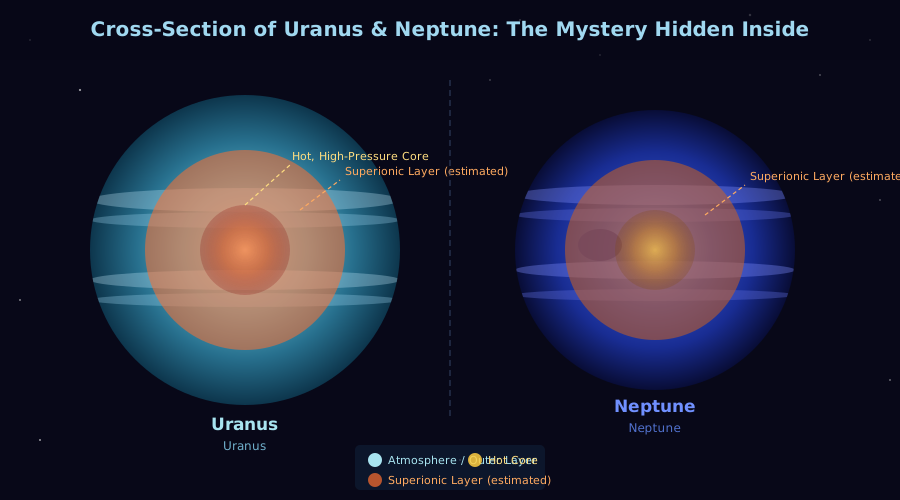
The term comes from composition, not temperature. Uranus and Neptune are rich in water, methane, and ammonia — compounds that were frozen as ice in the outer solar system when the planets formed. That ice served as their building material, hence the name.
Researchers also wanted to distinguish them from Jupiter and Saturn, which are dominated by hydrogen and helium gas. The ice giants have a fundamentally different recipe.
But the word “ice” carries the implication of something cold and solid inside. In reality, the interior of Uranus reaches temperatures of several thousand degrees, with pressures millions of times greater than Earth’s atmosphere. No ice survives those conditions. So what is actually in there? That’s the question this research set out to answer.
A State of Matter Between Solid and Liquid
“Superionic state” isn’t something you encounter in everyday life, so let’s back up for a moment.
Matter usually comes in three forms: solid, liquid, and gas. In a solid, atoms are locked into a rigid lattice. In a liquid, they roam freely. Gas takes that freedom even further.
The superionic state sits between solid and liquid — think of it as a hybrid. Some atoms hold their lattice structure and don’t move at all. Others flow freely, like a liquid. Two different types of atoms, two completely different behaviors, coexisting in the same material.
What this study focused on is a superionic state in hydrocarbons — compounds of carbon and hydrogen (CH). Both elements are abundant deep inside Uranus and Neptune. Under extreme heat and pressure, those hydrocarbons may enter a superionic state where carbon atoms hold their hexagonal lattice and don’t budge, while hydrogen atoms drift through the gaps in helical paths.

Hydrogen on a Spiral Track
What makes this study especially striking is the specific way the hydrogen moves.
In an ordinary liquid, atoms scatter in every direction at random. But in superionic hydrocarbons, hydrogen follows a defined route. It spirals along the central axis of the hexagonal carbon lattice — a precisely constrained path inside what is otherwise a chaotic, high-pressure environment.
Hydrogen, which is free to move in three dimensions, ends up traveling what’s essentially a one-dimensional channel. The researchers called this a quasi-one-dimensional superionic state.
Why a helix? It comes down to symmetry. The hexagonal carbon lattice creates a potential energy landscape where spiraling along the axis is the most stable path available. Think of it like walking along a spiral staircase railing — the route is fixed, but you’re still moving.
Here’s why that excites researchers: hydrogen carries electric charge. When it flows in a consistent direction, it creates an electric current. Current produces a magnetic field. And magnetic fields sit at the center of one of Uranus and Neptune’s longest-standing mysteries.

The Planets’ Baffling Magnetic Fields
Earth’s magnetic field is relatively tidy. The magnetic poles roughly align with the geographic poles — that’s why a compass points north. The spin axis and the magnetic axis run close to parallel.
Uranus and Neptune are anything but tidy.
Uranus’s magnetic field is tilted about 59 degrees from its rotation axis. Worse, the field doesn’t even originate near the planet’s center — it’s noticeably off to one side. Neptune has the same kind of problem: a tilt of about 47 degrees, and again, the magnetic poles are offset from the center.
No other planet in the solar system looks like this. Jupiter and Saturn, like Earth, have magnetic fields that roughly align with their spin axes. Since Voyager 2 flew past Uranus in 1977 and Neptune in 1989, this lopsided geometry has remained one of the solar system’s open puzzles — nearly 50 years without a good explanation.
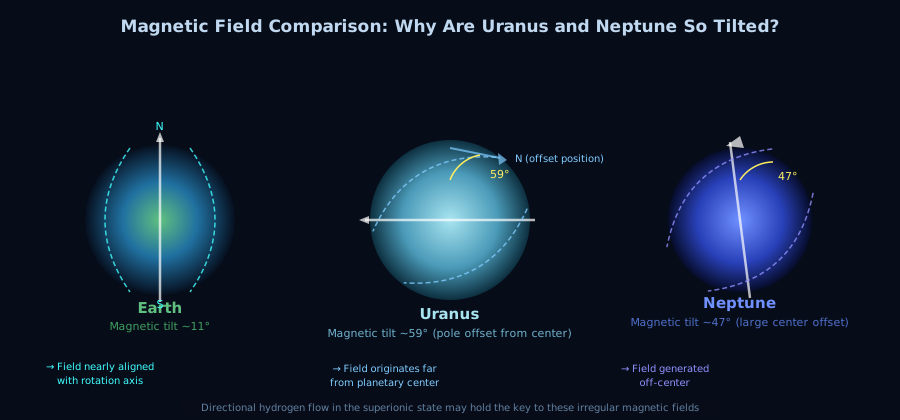
Normally, a planet’s magnetic field is generated by the dynamo effect: convecting liquid metals inside the planet produce electric currents, which produce the field. Earth’s liquid iron outer core is the classic example.
For Uranus and Neptune, the material running this dynamo may be in an unusual state. That’s where superionic hydrocarbons enter the picture as a candidate. The team’s analysis suggests that the directional, helical flow of hydrogen in this state could be responsible for generating the irregular, off-axis magnetic fields that have puzzled planetary scientists for decades.
Still a Prediction, Not a Confirmed Observation
To be honest about where the science stands: this is still a computer simulation. The researchers — Cong Liu and Ronald Cohen — used high-performance computing and machine learning to model hydrocarbon behavior at conditions roughly equivalent to 5 to 30 million times Earth’s atmospheric pressure and temperatures between about 3,700 and 5,700 degrees Celsius. Under those extremes, the quasi-one-dimensional superionic state appeared in their simulations.
Whether that matches what’s actually happening inside Uranus and Neptune still needs experimental confirmation.
One path forward is high-pressure lab work. Diamond anvil cells — devices that squeeze material between two diamonds to generate extreme pressures — can recreate millions of atmospheres in a laboratory setting. Putting hydrocarbons through those conditions and watching for the superionic transition is technically feasible.
The other path is a spacecraft. Voyager 2 is still the only probe that has visited either planet, and both encounters were brief flybys. NASA is currently developing concepts for a Uranus orbiter, and if that mission launches, it could return detailed data on the planet’s interior structure and magnetic field.
The ice giants represent one of the biggest gaps in planetary science. Exoplanet surveys have shown that planets of this size — somewhere between Earth and Neptune — are among the most common in the galaxy. Yet we understand surprisingly little about our own two examples. A dedicated orbiter mission would change that substantially.
Matter Is Stranger Than You Learned in School
What I find personally compelling about this research is the simple reminder that matter is more complex than the three-state model most of us grew up with.
Solid, liquid, gas — that’s the basic picture. But push material into extreme conditions and a much wider zoo of states opens up: superfluids, degenerate electron gases, quark-gluon plasmas, and now superionic states with hydrogen threading through carbon cages like water through a pipe.
The idea that two planets sitting at the edge of our solar system might be filled with this kind of material — something that doesn’t fit in any standard textbook category — feels exactly like the kind of thing the universe would do.
The mystery of Uranus and Neptune’s tilted magnetic fields isn’t solved yet. But the picture this research sketches — carbon frozen in place, hydrogen spiraling through in a directed flow — offers at least one coherent answer to the question of why the field is so far off-axis.
The study was published in Nature Communications. Experimental verification is still ahead, but when researchers next get the chance to observe Uranus up close, they’ll have this prediction in hand as a guide.