April 2026 brought a comet you could actually see.
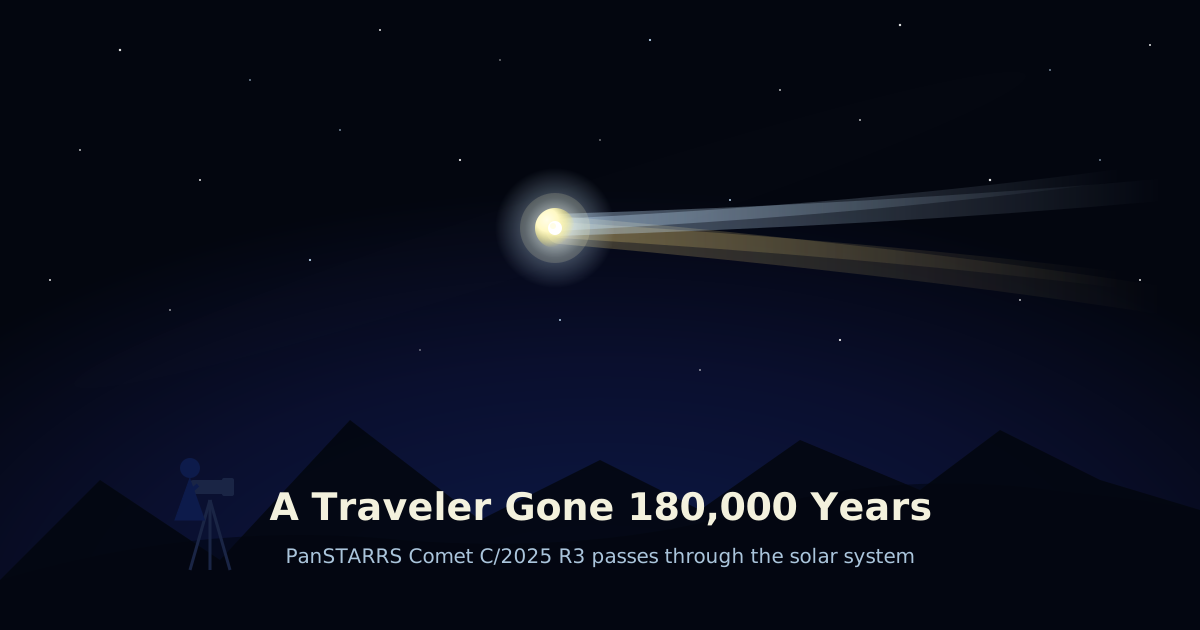
Comet PanSTARRS (C/2025 R3) was discovered by a Hawaiian survey system in September 2025. From early to mid-April, it appeared in the eastern sky before dawn — faint, but visible to the naked eye from a dark enough location. That kind of comet doesn’t show up all that often.
The last time this particular comet visited the solar system was roughly 180,000 years ago, around the time early humans were beginning to leave Africa. This pass is its last. It won’t return.
What a Comet Actually Is
Comets are often called “dirty snowballs” — clumps of ice, dust, and organic material, typically just a few to a few dozen kilometers across. Compared to any planet, they’re tiny.
But proximity to the Sun changes everything. The surface ice begins to sublimate, venting gas and dust that get pushed back by sunlight and the solar wind to form a tail. That long, luminous trail is essentially the comet burning itself up.
Where do comets come from? There are two main sources. The Kuiper Belt is a region of icy bodies beyond Neptune’s orbit. The Oort Cloud is a vast, roughly spherical shell thought to surround the solar system at distances of 10,000 to 100,000 AU. Comets like PanSTARRS, which follow hyperbolic trajectories, likely originate from the Oort Cloud — or may have traveled in from interstellar space entirely.
An earlier article here covered how comets develop two distinct tails: a blue-white ion tail and a yellowish dust tail. Under good conditions, both would have been visible with Comet PanSTARRS.
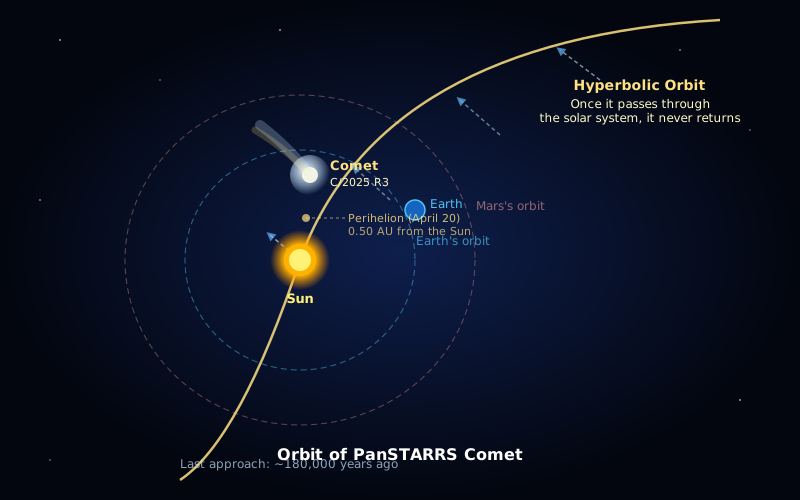
Comet PanSTARRS has been classified as a hyperbolic orbit. It came in from the outer dark, swung past the Sun, and is now heading back out — for good. Unlike Halley’s Comet, with its reliable 75–76 year loop, this one doesn’t return. This pass is the whole story.
Perihelion — the closest point to the Sun — was April 20, at a distance of 0.50 AU (about half the Earth-Sun distance). The weeks surrounding that date were the observing window.
What Does “Magnitude 1–2” Actually Look Like?
At peak brightness, reports put it at magnitude 1 to 2. Numbers alone don’t say much, so here’s some context.
The magnitude scale runs backwards — lower numbers mean brighter objects, and it dips into negative territory from there. For reference: Venus sits around magnitude −4, Vega (one of the Summer Triangle stars) is roughly magnitude 0, and Polaris comes in around magnitude 2.
Magnitude 3 is bright enough to catch your eye in a suburban sky. The catch with comets, though, is that their light is spread out. Unlike a point-source star, a comet’s glow is diffuse — even a relatively bright one tends to look dimmer than the number suggests.
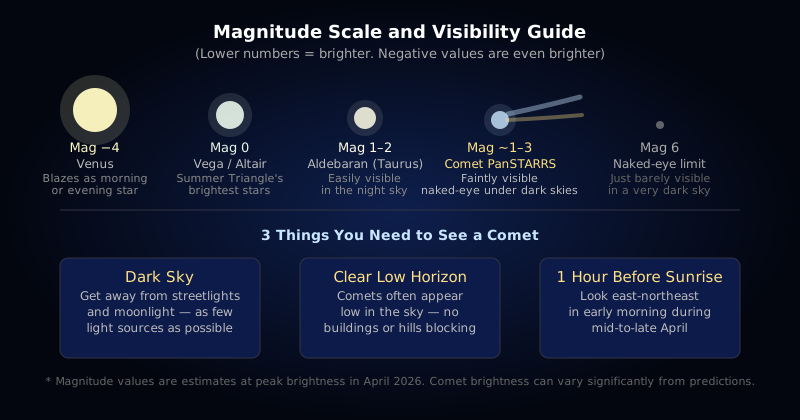
Spotting a comet with the naked eye takes three things.
First, a dark sky. Moonlight and light pollution are the main enemies — trying to catch a magnitude 3–4 comet from a city center is a tough ask. Second, a clear view of the horizon. Comets often appear low in the sky, and hills or buildings can easily block them. Third, timing. For this one, you needed to be facing east-northeast about an hour before sunrise.
“Wake up early, drive somewhere dark, and you might see a fuzzy smudge.” People still do it. Why?
When Waiting Was the Only Option
Throughout human history, comets were often read as omens. Records from cultures around the world connect comet appearances to wars, plagues, and the deaths of rulers.
When Halley’s Comet returned in 1910, there was genuine public panic over the fact that Earth would pass through its tail — which was known to contain cyanogen compounds. Nothing happened, of course, but the fear was real.
Japan was no different. The 12th-century court diary Meigetsuki records a comet sighting in 1145. What the author calls it is interesting: kyakusei, or “guest star” — not a permanent resident of the sky, but a visitor. That framing captures something true about comets.
Even after science explained them, comets kept their special status. They’re time capsules from the solar system’s earliest era, preserving material that formed 4.6 billion years ago essentially unchanged. They may also have delivered water and organic molecules to early Earth. By measuring the isotopic ratio of hydrogen in cometary ice, researchers can trace connections to Earth’s oceans. Data from ESA’s Rosetta mission — which rendezvoused with Comet 67P/Churyumov-Gerasimenko in 2014 — advanced exactly that kind of research.
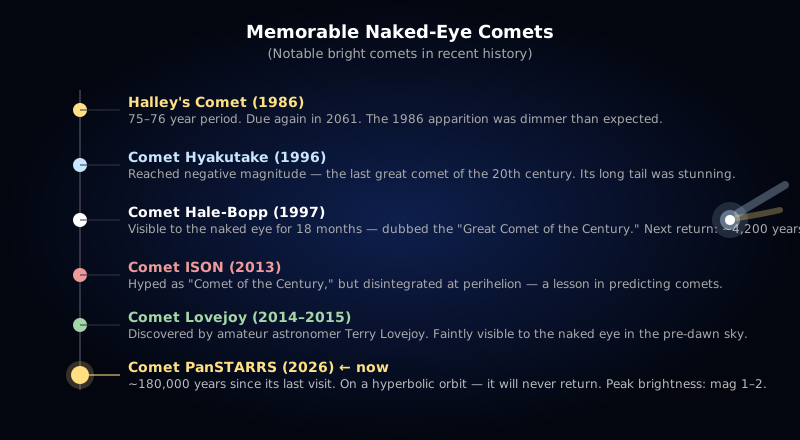
Halley’s Comet runs on a 75–76 year cycle. When it last appeared in 1986, it was well-placed for southern hemisphere observers but underwhelming from Japan. Next return: 2061. Anyone in their 30s or 40s today has a reasonable shot at seeing it.
Comet Hale-Bopp in 1997 was naked-eye visible for 18 months. Two distinct tails, unmistakably bright in the pre-dawn sky. People who saw it say they haven’t forgotten it. Its next return is roughly 4,200 years away.
For Anyone Who Missed It
Honestly, Comet PanSTARRS wasn’t easy to observe.
From Japan, you needed to catch the eastern horizon before dawn in mid-April, with the Moon often getting in the way and weather adding another layer of uncertainty. Even when conditions cooperated, most people would have seen a diffuse glow at best, not the photogenic tail you see in long-exposure images.
But here’s the thing: “I didn’t see it” is its own kind of relationship with the universe.
Comet PanSTARRS is pulling away from the solar system right now. Whether you saw it or not, that object passed close by — partway through a 180,000-year journey, near our corner of space for a few weeks in 2026.
There’s no redo with celestial events. Some come back; some don’t. The feeling of having missed something, though, can itself be a doorway into thinking about the scale of what’s out there.
What Comets Teach You
Part of what makes comet watching interesting is that it resists prediction.
Comet ISON in 2013 was billed as potentially the comet of the century. It disintegrated at perihelion. The brightness predictions were spectacularly wrong, and people watching the live feeds from observatories were openly disappointed.
Comet brightness is genuinely hard to forecast. Internal structure and composition determine how vigorously a comet vents gas as it nears the Sun, and those details aren’t known in advance. A prediction of “magnitude X” can easily miss by two or three magnitudes.
PanSTARRS actually outperformed expectations for a stretch, with some reports of peak brightness reaching magnitude 1–2. When that happens, you get the sense that researchers are quietly pleased — not because their model was vindicated, but because the comet did something unexpected and interesting. That’s kind of the whole appeal.
Planets move on rails you can calculate centuries ahead. Comets keep you guessing every time.
Looking up at the sky means letting go of the idea that you can predict everything. A chunk of ice that had its orbit nudged 180,000 years ago by some gravitational encounter happened to pass near Earth in the spring of 2026. Calling that a coincidence doesn’t quite capture how it feels.
The next likely naked-eye comet might be Halley’s in 2061, or it could be a new discovery that shows up with no warning. Either way, keeping an eye on the night sky seems like a reasonable habit to develop.
Comet PanSTARRS C/2025 R3 is somewhere near Jupiter’s orbit now, still heading outward. Its next destination is the space between stars.
Sources: