Every planet in our solar system orbits the Sun. That feels obvious — almost tautological. But zoom out to the scale of the galaxy and you start to realize how unusual that arrangement might be. Out there, scattered across the Milky Way, are enormous numbers of planets that orbit nothing at all. No parent star, no fixed path through space. Researchers call them rogue planets, and they are stranger than they sound.
In January 2026, the study of these objects took a meaningful step forward. For the first time, astronomers simultaneously measured the mass and distance of a rogue planet — one roughly the size of Saturn. Why does “first time” apply to something that basic? The answer reveals just how peculiar these objects are to work with.
A Planet That Orbits Nothing
When most people picture a planet, they picture something going around a star. Earth circles the Sun; Jupiter and Saturn do the same. That relationship — planet, star, orbit — feels fundamental.
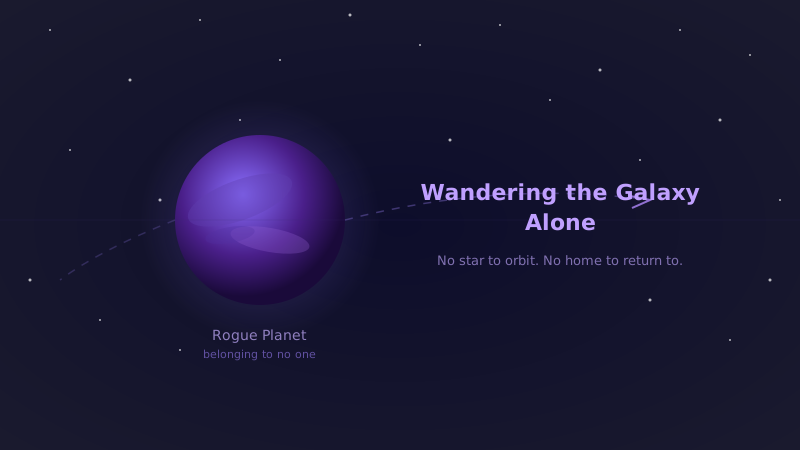
Rogue planets break it entirely. True to their name, they belong to no system. No star, no orbit, just an object coasting through interstellar space on its own momentum.
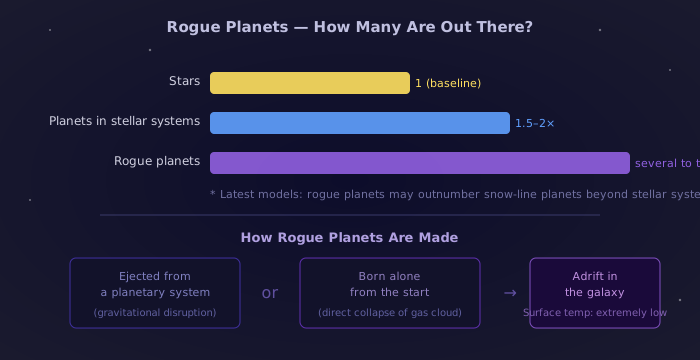
There are two main ways a world ends up like this.
The first is ejection. Planets form from clouds of gas and dust, and the process is messy. Multiple planets gravitationally tug on each other as they coalesce, and sometimes one gets flung out of the system entirely — booted beyond its star’s gravitational reach by a close encounter with a larger neighbor. In cosmic terms, it’s the equivalent of getting kicked out by your own family.
The second path is lonelier still: born alone. When a star forms, a dense knot of gas collapses under its own gravity. A slightly smaller knot can go through the same process and produce something planet-sized rather than stellar — a world that never had a parent star to begin with.

Either way, the result is the same: a solitary sphere adrift in the galaxy. With no nearby star to warm it, the surface temperature drops to near-absolute-zero levels. In visible light, these objects are essentially invisible.
Finding Something That Doesn’t Shine
The core problem with observing rogue planets is simple. They don’t emit light. Stars burn through nuclear fusion and blaze across the sky; planets don’t. Conventional exoplanet detection works by watching how a planet interacts with its host star — blocking starlight, reflecting it, tugging the star gravitationally. Rogue planets have no host star to interact with.
So how do you find one?
The key technique is gravitational microlensing, a prediction of Einstein’s general theory of relativity. Gravity bends light — and when a massive object passes in front of a distant background star, the intervening object’s gravity acts like a lens, focusing the background star’s light toward the observer. The distant star appears to briefly brighten.
This brightening happens even for planet-mass objects. When a rogue planet drifts across our line of sight to a distant star, the background star flares up slightly — over hours to days — and then fades back. That distinctive brightening pattern tells you something passed by.
The problem is that the pattern alone leaves a lot of ambiguity. Mass and distance can’t be pinned down independently from a single observation. A small, nearby object and a large, distant one can produce similar-looking brightening curves. So while microlensing can flag a rogue planet’s presence, it historically couldn’t tell you how big it was or how far away.
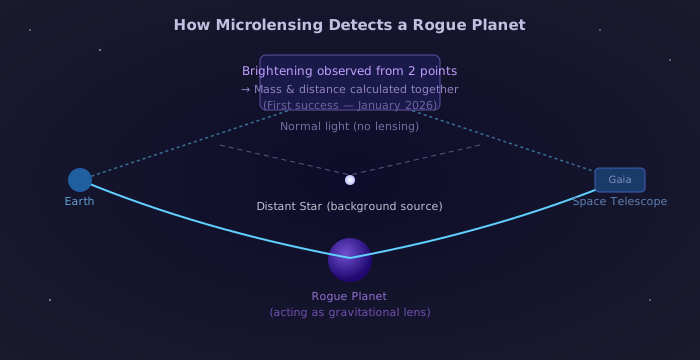
The January 2026 result cracked that problem open. Researchers observed the same microlensing event simultaneously from two vantage points: Earth and ESA’s Gaia space telescope. When you look at the same object from two different locations, the background star appears shifted slightly in position — parallax. Measure that shift, and you can calculate the distance. Once you have the distance, the shape of the brightening curve gives you the mass.
The result: mass roughly 0.22 times Jupiter’s (close to Saturn’s), distance about 10,000 light-years. For the first time, both numbers belonged to the same rogue planet.
How Many Are Out There?
Honestly, we don’t know yet. But if current models are anywhere near correct, the answer is staggering.
Some estimates suggest the number of rogue planets in the Milky Way equals or exceeds the number of stars. One calculation goes further: rogue planets may outnumber the class of planets found beyond the snow line of stellar systems by a factor of 19.
Nineteen times. That would mean the majority of planets in the galaxy are not orbiting anything. Not a fringe population — the main one.
These are model predictions, not a direct count. But microlensing surveys back up the basic picture: rogue planets seem genuinely common. The reason comes down to how planet formation works. It’s a violent process. Giant planets scatter smaller ones. The early solar system may itself have ejected bodies that are now drifting somewhere in the galaxy — at least a few researchers think so.
The Unexpected Question of Life
Rogue planets and life. Put like that, the combination sounds absurd. No sun means no light, no warmth, no photosynthesis. What could possibly live there?
And yet some researchers take the possibility seriously enough to write papers about it.
The focus is internal heat. Even without a star, planets generate warmth from the decay of radioactive elements in their rock. Earth does this — our interior stays hot independently of the Sun. A larger planet has more of this heat. And if a rogue planet retains a thick atmosphere, that atmosphere can trap the heat like a blanket, keeping conditions more moderate than you’d expect.
Under the right conditions, liquid water might exist — not on the surface, but underground. We already have examples in our own solar system: Enceladus and Europa maintain subsurface liquid oceans powered by tidal and radiogenic heat, with no meaningful contribution from sunlight. Something similar might work on a rogue planet.
That said, “might” is doing a lot of work in the paragraph above. We currently have almost no direct means to probe the atmospheres or interiors of rogue planets. It’s a question to revisit when the instruments catch up.
What the Next Telescopes Will Reveal
Astronomers broadly agree that the real era of rogue planet science hasn’t started yet. That changes soon.
NASA’s Nancy Grace Roman Space Telescope is the most anticipated instrument for this work. Its wide field of view and high sensitivity are specifically designed to sweep the galactic plane for microlensing events. The handful of rogue planet candidates known today could grow into the thousands.
JWST is opening a parallel path. Its infrared precision makes it possible, in some cases, to directly detect the thermal emission from large rogue planets and even probe their atmospheric composition.
China’s Earth 2.0 satellite, targeting a 2028 launch, also plans a wide-field microlensing campaign. Multiple overlapping surveys mean, for the first time, we’ll be able to gather real statistics.
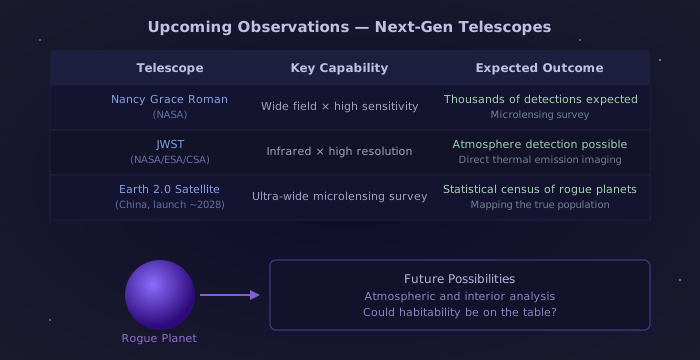
Once the numbers come in, we can start answering questions like: what’s the mass distribution of rogue planets? Which sizes dominate? Are they clustered in particular regions of the galaxy? Those answers will feed back into our understanding of how planetary systems form — and how often they fall apart.
What Lonely Planets Are Telling Us
Researchers often describe rogue planets as a window onto the “typical fate” of a planet. The solar system, with its planets locked in stable orbits around a middle-aged star, might be the exception rather than the rule.
If most planets in the galaxy are unattached, drifting freely — then life on Earth, born in one of the rare stable systems, is the beneficiary of an unusual stroke of luck.
Or you can flip that around. If rogue planets are that numerous, some of them — statistically, given the sheer scale of things — might host life in some form. Life that emerged in the dark, powered by internal heat, in an environment no one would have thought to look. Space has a way of making the phrase “that’s impossible” age badly.
A quiet measurement in January 2026: one mass, one distance, one planet 10,000 light-years away. Behind that number lies a galaxy full of dark, wandering worlds, each with its own unknown history. When the next generation of telescopes turns their attention to the darkness, it will be worth watching what they find.