Kato took pride in his work.
“Planetary Atmosphere Forecaster” — scan the entire galaxy and you’d be hard-pressed to find anyone else with that title. To be precise: his job was to predict what kind of clouds hang in the atmosphere of a planet outside our solar system, what gases drift through it, all before anyone pointed a telescope at the thing and actually looked.
Predict sounds like gambling. Kato didn’t see it that way. Give him the laws of physics, temperature readings, and pressure data, and the answer was essentially a single road. His accuracy sat above 93%. Best on the team, by a margin.
That morning, he poured his coffee and opened the latest observation report.
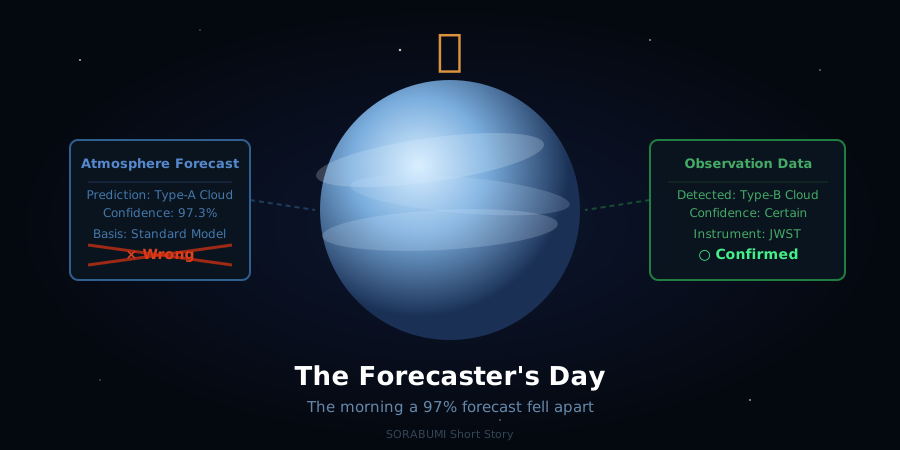
Same target as always. A planet twelve light-years out — roughly six times the size of Jupiter, orbiting well away from its star. Temperature already on record. Kato had submitted his forecast the previous month: Type-A clouds, confidence 97.3%.
The reasoning was straightforward. At that temperature range, that composition forms clouds. The standard model said so. Comparable planets backed it up. If anything, 97.3% was conservative.
He read the first line of the report and said, “Oh.”
Just that. A single syllable.
Type-A clouds: not detected. Type-B clouds — a different composition entirely — confirmed.
Kato set his coffee down slowly.
”…Type-B.”
He read it again. It still said the same thing.
Team leader Yamashita walked in ten minutes later.
“Kato-san — you saw the report?”
“I saw it.”
“So, uh. Not Type-A.”
“I know.”
“The confidence was 97.3%, right?”
“I know,” Kato said again. Lower this time.
Yamashita looked at his face, then quietly drifted toward the coffee maker. Said nothing. Smart call, Kato thought.
He spent the rest of the day going through the data.
He pulled up the standard model. Checked every input value. Questioned the temperature measurements. Ran the instrument error calculations. The conclusion didn’t move. The observation was correct. His forecast was wrong. That was all there was to it.
By evening he had a sheet of notes in front of him:
Why Type-B instead of Type-A. Hypothesis: temperature distribution may not be uniform. Alternatively: assumption X in the model may not hold in all cases.
The further he got into the hypotheses, the more interesting it became. This kind of work — chasing down the reason something went wrong — was honestly more engaging than the day after a correct prediction. He wasn’t going to pretend otherwise.
The next morning, Yamashita came back with coffee.
“Did you make sense of yesterday?”
“More or less. The model needs fixing. Three places, maybe.”
“That sounds… pretty involved.”
“It is. I’ll do it.”
Yamashita thought for a second. “When’s the next forecast? Next week?”
“Next week.”
“What confidence level are you going to put down?”
Kato drank his coffee. Left a beat.
“95%.”
“Wait — you’re raising it?”
“I know why I was wrong. So this time I’m confident.”
Yamashita stared at him like he’d said something slightly unreasonable. But Kato meant it. The morning after you’re wrong is also the morning something came loose and you finally understand it. He couldn’t think of a good reason to stop being proud of that.