Have you ever looked up at the night sky and wondered about two stars sitting unusually close together? Often it’s just a line-of-sight coincidence — unrelated stars that happen to line up from our vantage point on Earth.
But when astronomers find two objects that are truly side by side at cosmic scales, the story changes completely. That kind of proximity is no accident. It’s a sign of one of the most violent events the universe produces.
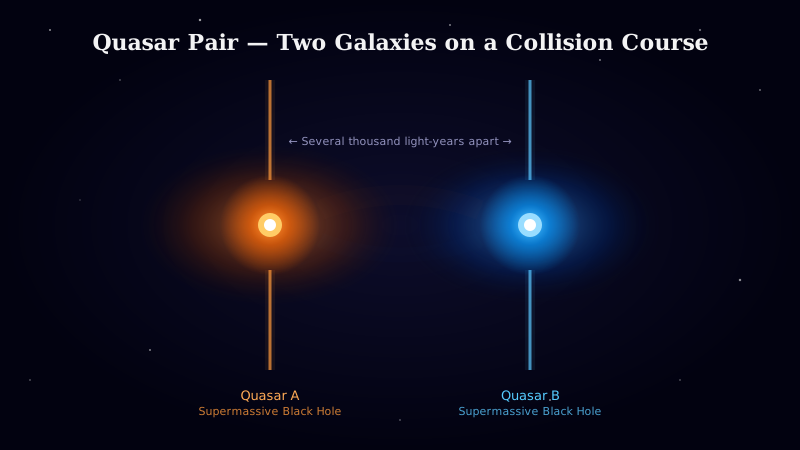
Reports of “quasar pairs” have been coming in steadily. In one case, two quasars were found just a few thousand light-years apart, 12.8 billion light-years away. In another — a system nicknamed the “Cosmic Joust” — two galaxies separated by 11 billion light-years were caught blasting each other’s gas with intense radiation as they closed in. To understand what this means, we first need to understand what a quasar actually is.
Quasars — The Brightest Objects in the Universe
The word “quasar” comes from “quasi-stellar object.” Through a telescope, a quasar looks like a point of light — just like a star — but it is something else entirely: an almost unimaginably bright beacon pouring out of the center of a distant galaxy.
The power source is a supermassive black hole sitting at the galaxy’s core. These black holes can weigh hundreds of millions to billions of times the mass of our Sun. As they pull in surrounding gas, that material doesn’t fall straight in. Instead, it forms a swirling structure called an accretion disk.
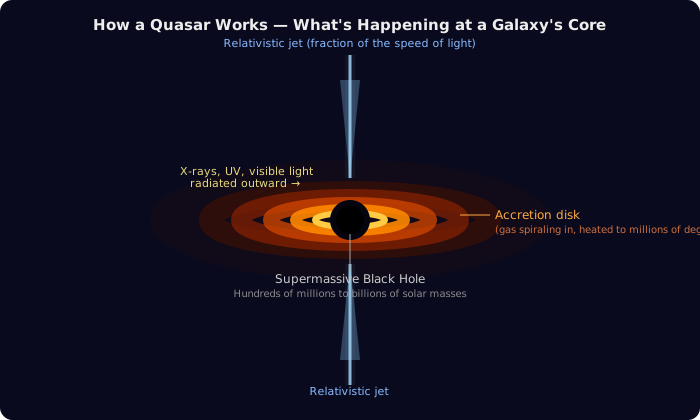
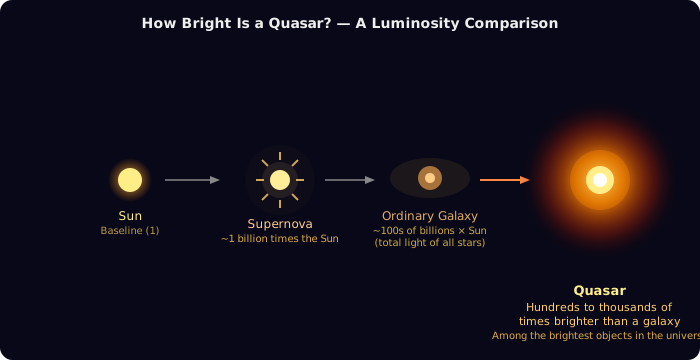
Inside the disk, the gas is compressed and heated ferociously — temperatures climb to millions of degrees. That energy radiates outward across the entire electromagnetic spectrum, from X-rays to visible light. A single quasar can outshine an entire ordinary galaxy — a system containing hundreds of billions of stars — by a factor of hundreds or even thousands. They sit at the very top of the cosmic luminosity scale.
What makes this even more striking is where the energy comes from. An ordinary galaxy spans tens of thousands of light-years. A quasar’s output emerges from a region smaller than our solar system — just the immediate neighborhood of the black hole. An enormous flood of light from an impossibly compact space. That is why quasars puzzled astronomers for so long.
Why Would Two Appear Together?
Two quasars found near each other in the sky. Think about what that actually implies.
Most of the time, the supermassive black hole at a galaxy’s center is relatively quiet. Without a steady supply of infalling gas, the accretion disk stays cold and dim. The black hole is there, but it doesn’t shine as a quasar. So what turns one on?
The leading answer: a galaxy collision.
When two galaxies are drawn together by gravity, vast amounts of gas and dust get churned up in the chaos. That gas flows toward each galaxy’s center, dramatically increasing the fuel supply to the black holes. Each black hole starts gorging on material, and the accretion disks flare to life as quasars.
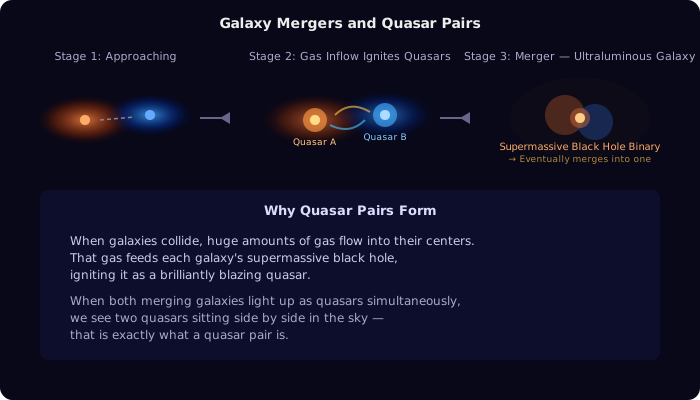
If both merging galaxies ignite their central black holes at the same time, you get two quasars close together in the sky. A quasar pair, in other words, is a live snapshot of two galaxies caught mid-collision.
The Cosmic Joust — announced in 2025 — offered a particularly vivid example. Astronomers confirmed that intense radiation from one galaxy’s quasar was chemically altering the gas in its neighbor. These two were not just sharing the same patch of sky; they were actively changing each other.
Looking Back to the Universe’s Dawn
There is another reason quasar pairs matter: the sheer distance to them.
Light from a distant object takes time to reach us. The quasar pair 12.8 billion light-years away sent that light 12.8 billion years ago — when the universe was roughly 900 million to one billion years old. The universe itself is about 13.8 billion years old, which means we are looking at the infant cosmos, just after the first galaxies switched on.
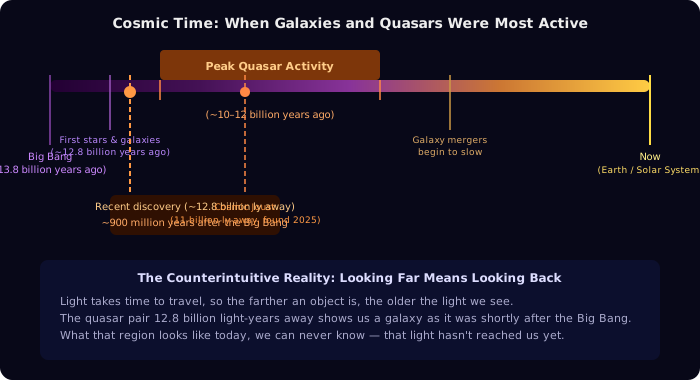
Why were there so many quasars in the early universe? Because everything was packed closer together. The young universe was smaller than today; galaxies were nearer to one another and collisions were far more common. That collision rate drove a surge in quasar activity.
Astronomers call this the “quasar golden age” — a period roughly 10 to 12 billion years ago when quasars were at their most numerous. As the universe expanded, galaxies drifted apart, mergers became less frequent, and the quasar population steadily declined.
Today, quasars are rare. You have to look far back in time — which means far away in space — to find them in large numbers. That trend itself is a record of cosmic history, written in light.
How Quasars Shape the Galaxies Around Them
A quasar is not simply a very bright thing. We now know it is an active agent in its galaxy’s evolution.
The energy a quasar releases — radiation, high-energy particles, powerful winds — can heat up and blow away the surrounding gas. Astronomers call this “feedback.” It matters enormously for how galaxies grow.
In the Cosmic Joust, the radiation from one quasar was observed altering the physical state of gas in the neighboring galaxy. When gas gets superheated, it can no longer cool down and collapse to form new stars. The quasar was essentially suppressing star formation in its neighbor from a distance.
The effect can also run in the opposite direction. After a quasar switches off, the gas may eventually cool and fall back toward the galactic center, triggering a burst of star formation. Quasars cycle on and off, and each cycle leaves a mark on how quickly stars are born inside their host galaxy.
The evidence is piling up that supermassive black holes and their host galaxies grow together. Which comes first? How do they regulate each other’s growth? These questions sit right at the heart of modern astronomy.
The Challenge of Finding a Pair
It is worth pausing to appreciate how hard these discoveries are.
Quasar pairs had been predicted theoretically, but spotting them in practice is another matter. Quasars are extraordinarily distant. Resolving detail at 12.8 billion light-years requires the sharpest instruments humanity has built.
On top of that, because two quasars in a pair are so close together, they can easily blend into a single point of light from Earth. In one case, the Hubble Space Telescope initially cataloged what turned out to be a quasar pair as a single object; it took careful re-analysis to separate the two sources.
The Atacama Large Millimeter/submillimeter Array (ALMA) in Chile measures gas distributions and velocities with remarkable precision. It can detect whether two galaxies are approaching each other — the closing speed shows up as a Doppler shift of several hundred kilometers per second. Japan’s National Astronomical Observatory of Japan is a key partner in ALMA, and this kind of kinematic measurement is one of ALMA’s strengths.
The Subaru Telescope takes a different approach: sweeping wide-field surveys of the sky at high resolution to flag quasar candidates in large numbers. In one notable discovery, it was a researcher manually scanning Subaru images who first noticed two red dots sitting unnervingly close together. Automated pipelines had missed it. A human eye made the call.
A Galaxy Collision, Frozen in Time
The mergers that happened frequently in the early universe are a big part of why galaxies today look the way they do — whether they are spiral or elliptical, star-rich or star-poor. The details of how two galaxies collide determine the star-formation history, the final mass of the central black hole, and ultimately the galaxy’s character.
A quasar pair is a freeze-frame of that process. And the ones 12.8 billion light-years away show us the merger floor during the most turbulent period in cosmic history.
Galaxy mergers still happen today. The Milky Way and the Andromeda Galaxy will collide in a few billion years. In principle, if both central black holes accumulate enough material, they could ignite as quasars — but in the present, gas-poor universe, that seems unlikely.
The image of two quasars blazing side by side is a relic of a time when the universe was young, dense, and ferocious. That light left its source 12.8 billion years ago. Today our telescopes are finally sharp enough to pull the two apart and read what is written there — a record of how galaxies fed, grew, and became what surrounds us now.