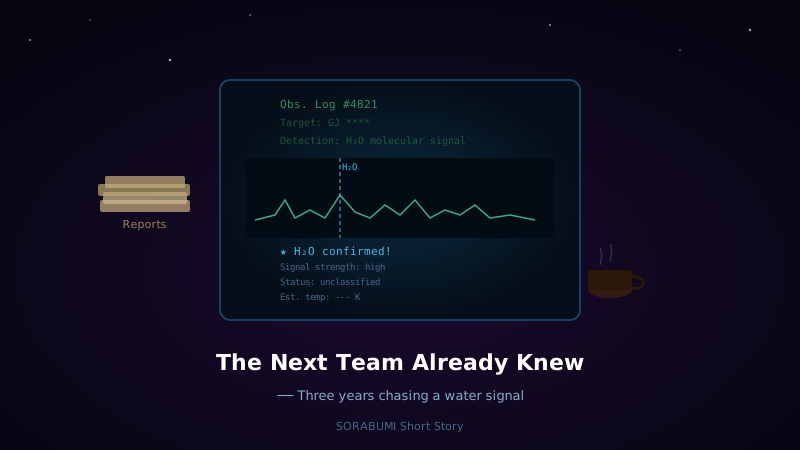
The exoplanet Yui Haruyama had been chasing for three years had already been written up by the team across the hall.
She found this out the day before yesterday. It was the night she’d finally felt certain — overlaying her own data with JWST’s public archive, watching the water-vapor signature lock into place. She’d gone straight to her section chief, practically buzzing. He’d said: “Takeuchi’s group published on that last year.”
Haruyama sat at her desk for three days and got nothing done.
On the morning of the fourth day, she knocked on the door of Takeuchi’s lab. She wasn’t angry, exactly. Something else was driving her — she couldn’t have named it.
Takeuchi was in the middle of a team meeting. When Haruyama said she just needed a minute, he glanced at the grad students watching from inside and stepped out into the hallway.
“Haruyama-san. I heard from Hayashida. Same object, right?”
“Yes. GJ 9827 d. Water-vapor atmosphere. I have three years of data.”
Takeuchi folded his arms. He was in his fifties — quiet, unhurried.
“Have you read our paper?”
“All of it. Yesterday.”
“And?”
Haruyama took a breath. She’d rehearsed this part the night before.
“The atmospheric model you used to estimate surface temperature — I think it’s too simple.”
Something shifted in Takeuchi’s expression. Not annoyance.
“How so?”
“You assumed a constant mixing ratio for the water vapor. But in my data, the absorption depth varies across transit phases. The atmospheric composition may change with altitude.”
Takeuchi held her gaze for a moment, then leaned back against the wall.
“Peer review flagged that too. We didn’t have enough data to answer it.”
Haruyama took her laptop out of her bag. Three years of transit data. Absorption depth as a function of orbital phase. Statistical treatment of the seasonal variation. Takeuchi leaned in and stopped scrolling more than once.
“Haruyama-san — how many transits is this?”
“Eighty-seven.”
“We wrote the paper on twelve.”
He was quiet for a while.
“Would you consider a collaboration? Honestly — we don’t have budget left to allocate more observation time to this object. But with your data, we could get into the vertical structure of the atmosphere.”
Haruyama’s mouth started to open, then stopped.
For three years she’d thought of this as hers alone. Three days ago she’d thought it had been taken from her. But what Takeuchi was saying now was something else: there’s a problem here that can’t be solved without what you spent three years building.
“I have one condition.”
“Go ahead.”
“First author is me.”
Takeuchi narrowed his eyes for just a moment. Then he nodded.
“Given the data volume, that’s fair.”
Haruyama closed her laptop. They didn’t shake hands. Instead they settled on a time to meet next week.
Walking back down the hallway, she noticed her feet felt lighter. The feeling she’d mislaid over the last three days was returning — but it wasn’t anger, and it wasn’t resignation. She couldn’t quite tell what it was.
Back at her desk, her section chief Honda glanced over.
“You went to see Takeuchi?”
“Yes.”
“And?”
“Co-authored. With me as first.”
Honda raised his eyebrows.
“Takeuchi agreed to that? You actually pulled it off.”
Haruyama took a sip of coffee. It was still warm.
“I showed him eighty-seven transits. That did it.”
Honda looked like he was going to say something, then decided not to, and went back to his work.
Haruyama opened her monitor. Three years of data, lined up the same as always. The same data. But starting tomorrow, she wouldn’t have to look at it alone.
Whether that made her happy or a little sad, she still couldn’t tell.