Only a Few Dozen People Have Ever Seen It
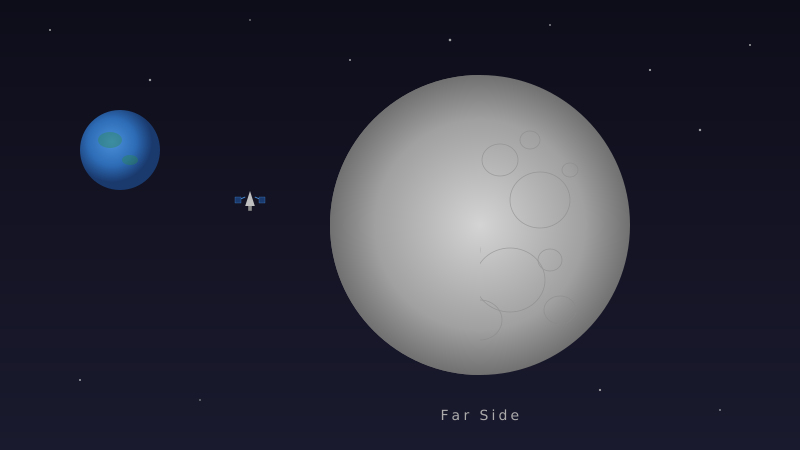
In all of human history, just 27 people have seen the Moon’s far side with their own eyes — every one of them an Apollo astronaut. The last were the crew of Apollo 17 in December 1972. For more than half a century after that, nobody got another look.
April 2026 changed that. The four astronauts aboard Artemis II’s Orion capsule swung around the far side and spent that time cataloguing roughly 35 geological features in real time, calling their observations back to Earth from a distance of 252,760 miles — farther from home than any humans have ever traveled, surpassing even the record set by Apollo 13.
But before getting into what they saw, it’s worth stepping back and asking a simpler question: what exactly is the “far side,” and why does it exist? Because once you understand that, the Moon’s whole origin story starts to come into view.
Why the Moon Always Shows the Same Face
Look up at the Moon on any clear night, and you’ll see the same pattern — the dark blotches that some people read as a rabbit, others as a crab. That near side never changes. The far side, by definition, is the hemisphere Earth never sees.
This isn’t a coincidence. It’s the result of a physical process called tidal locking.
The Moon used to spin faster. But Earth’s gravity pulls unevenly on the Moon — slightly harder on the near side than the far side — and over billions of years that created a subtle but relentless torque. The Moon’s rotation gradually slowed until its spin period matched its orbital period exactly: 27.3 days each way. One complete rotation, one complete trip around Earth. The same face, permanently pointed inward.
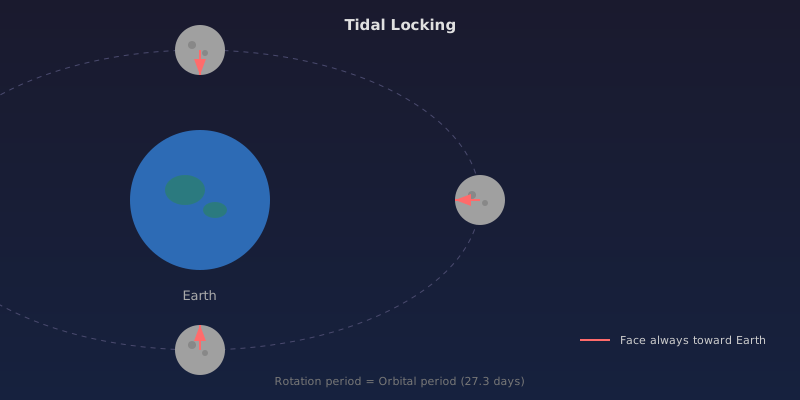
The Moon isn’t alone in this. Most large moons in the solar system are tidally locked to their host planet. Jupiter’s Io, Ganymede, Saturn’s Titan — they all keep one face turned toward home. Out in the solar system, tidal locking is the norm, not the exception.
Two Completely Different Worlds
The near side of the Moon is dominated by the maria — dark, flat plains that take up about 31% of its surface. They’re the dark patches visible to the naked eye, and they aren’t water: they’re ancient basaltic lava flows that pooled in low-lying basins roughly 3 to 4 billion years ago.
The far side looks like a different planet. Maria cover barely 1% of its surface. Instead, craters crowd every inch — overlapping, layered, piled on top of each other in a way that makes the terrain look almost impossibly ancient.
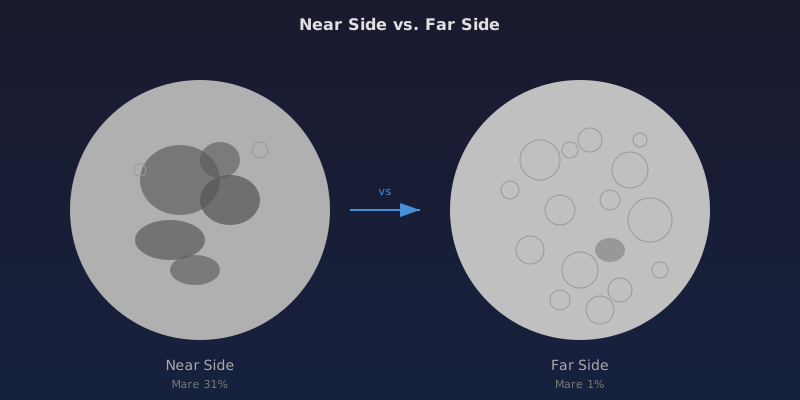
When the Soviet probe Luna 3 sent back the first-ever photographs of the far side in 1959, scientists were taken aback. The images were grainy, but the near-total absence of maria was unmistakable. Today, this stark contrast goes by an official name: the lunar dichotomy. It remains one of the biggest unsolved questions in lunar science.
The Crust Holds the Key
So why does the far side have almost no maria? The answer lies in the thickness of the crust.
In 2012, NASA’s GRAIL mission mapped the Moon’s gravitational field in extraordinary detail. The data revealed something striking: the near-side crust averages roughly 20 km thick, while the far side averages around 50 km — more than twice as thick.
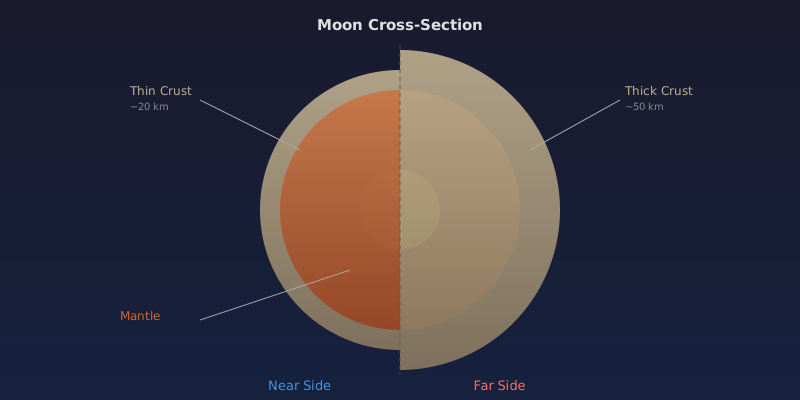
That difference in thickness drives everything. When a large meteorite slams into the near side, it punches through the thin crust and opens fractures. Hot mantle material seeps up through those fractures, floods the crater basin, and solidifies into the dark plains we call maria. The near side has plenty of them because its crust is thin enough for lava to breach the surface.
On the far side, the crust is simply too thick. Meteorites still punch craters, but the lava can’t reach the surface — it stalls well below. The craters stay craters, slowly accumulating over billions of years. That’s why the far side is so heavily cratered and so dark-plain-free.
The next question is harder: why is the crust asymmetric in the first place?
A Giant Impact and an Ocean of Magma
One leading hypothesis reaches back to the Moon’s very first moments.
The Moon most likely formed about 4.5 billion years ago from the debris of a Mars-sized body smashing into the early Earth — the Giant Impact. The newborn Moon was a roiling ball of molten rock, a global magma ocean from pole to pole.
Here’s where the asymmetry may have started. The near side faced Earth, and Earth was radiating enormous heat. That kept the near-side magma ocean warmer for longer. The far side, exposed to cold space, cooled first. As it cooled, lighter minerals — mainly plagioclase feldspar — crystallized and floated to the top, building up a thick, buoyant crust. The near side, still partially molten, never accumulated as much. It ended up thinner.
This “tidal heating model,” published by a Penn State team in 2014, remains one of the most compelling explanations for the lunar dichotomy.
A rival hypothesis proposes a second impact: shortly after the Moon formed, a smaller companion body — perhaps a third the Moon’s diameter — collided with the far side at low velocity and piled on extra crustal material. This idea came from a UC Santa Cruz team in 2011.
Neither hypothesis has been definitively confirmed. The two may even work together. What is clear is that the near-side/far-side difference isn’t random — it’s a fingerprint of how the Moon was born and how it evolved.
The Solar System’s Biggest Scar
The most dramatic feature on the far side is the South Pole-Aitken Basin: roughly 2,500 km across and about 8 km deep. It’s the largest confirmed impact crater in the solar system — wide enough to swallow all of Japan with room to spare (the Japanese archipelago spans about 2,000 km north to south).
The basin formed around 4.2 billion years ago. The impact was so violent that it likely punched through the crust entirely, exposing mantle material at the surface. GRAIL data supports this: the crust inside the basin is significantly thinner than the surrounding terrain.
China’s Chang’e 4 lander became the first spacecraft to touch down on the far side in January 2019, settling into Von Kármán Crater within the South Pole-Aitken Basin. Its instruments found minerals consistent with mantle origin in the local soil — a tantalizing clue about what lies beneath the Moon’s surface.
What Artemis Opens Up
Artemis II was a flyby, not a landing, so the crew didn’t set foot on the far side. But they observed it with their own eyes and captured high-resolution imagery of the 35 or so geological targets NASA had designated — crater wall structures, evidence of lava flows (or their absence), and the texture of ancient highland terrain.
Future Artemis missions aim to land near the lunar south pole, close to the rim of the South Pole-Aitken Basin. That region holds permanently shadowed craters — depressions where sunlight has never reached — and there’s strong evidence those craters contain water ice. Drilling into the far side’s thick crust to probe the interior directly, harvesting ice from permanently shadowed craters, returning rocks from the basin that date to that 4.2-billion-year-old impact — these are the goals that will define lunar science for decades.
The Moon is just three days away by spacecraft. It’s the closest body in the solar system to Earth. And yet we still don’t fully understand why its two faces look so different from each other. The hypotheses are compelling, but the definitive answers are still locked inside the rock.
The Artemis II crew saw a gray, crater-pocked landscape rolling by their windows — the first human eyes on it in more than 50 years. What they were really looking at, though, was a 4.5-billion-year-old story written in stone. One that we’re only now starting to read.