The Planet Nobody Expected to Have an Atmosphere
The universe has places where Earth’s rules don’t apply.
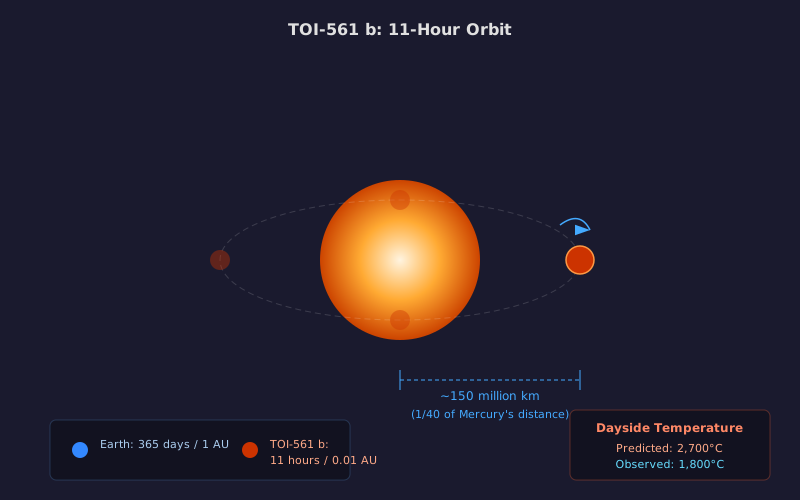
TOI-561 b is one of them. It’s about 1.4 times Earth’s diameter. Its year lasts just 11 hours — less than half a day. The planet sits roughly 40 times closer to its star than Mercury sits to the Sun. It races around in an orbit that would fit inside the Sun itself.
The dayside surface temperature sits around 1,800°C — well above the melting point of iron. The entire surface is a global ocean of molten rock. And because the planet is tidally locked, the same hemisphere faces the star forever. Day and night are permanently fixed.
Under those conditions, almost no one expected an atmosphere. The relentless radiation and stellar wind from such a close star should strip away any thin gas layer within tens of millions of years.
And yet JWST — the James Webb Space Telescope — just observed exactly that “impossible” thing.
The Temperature Mismatch That Gave It Away
The discovery started with a number that didn’t add up.
JWST’s NIRSpec spectrograph targeted the moment when TOI-561 b passes behind its star — what astronomers call secondary eclipse. By comparing the system’s brightness just before and just after the planet disappears, you can isolate the planet’s own thermal emission and infer its temperature.
If there were no atmosphere — just bare, molten rock — the dayside should have registered around 2,700°C. Instead, the measurement came in at roughly 1,800°C. That’s 900 degrees cooler than expected.
What does a 900-degree gap mean? Heat is being transported from the dayside to the nightside. And the only thing that moves heat around a planet that efficiently is atmospheric circulation. There are winds. A thick blanket of gas is flowing over the lava sea.
The research team described it as a “wet lava ball” — an atmosphere laden with water vapor blanketing a magma ocean, redistributing heat across the whole planet. It’s the same principle that keeps Earth’s day-night temperature difference from being extreme, just on an absolutely alien scale.
Secondary Eclipse Spectroscopy — Subtracting Your Way to a Planet’s Secrets
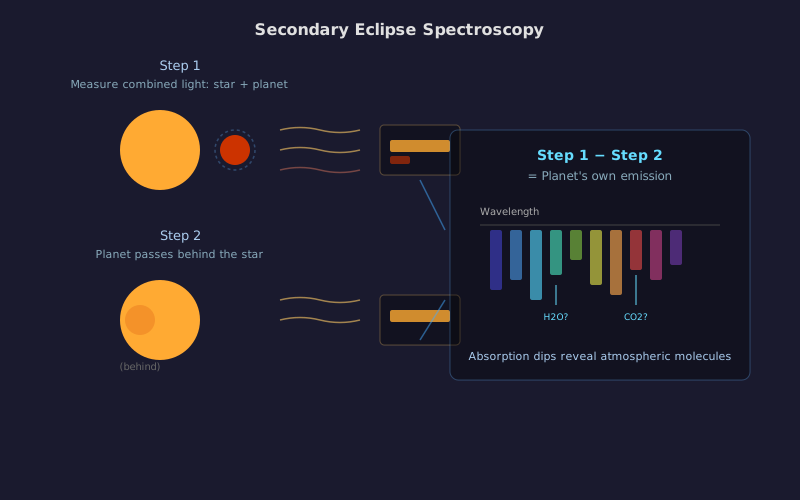
So how do you actually study the atmosphere of a planet 280 light-years away?
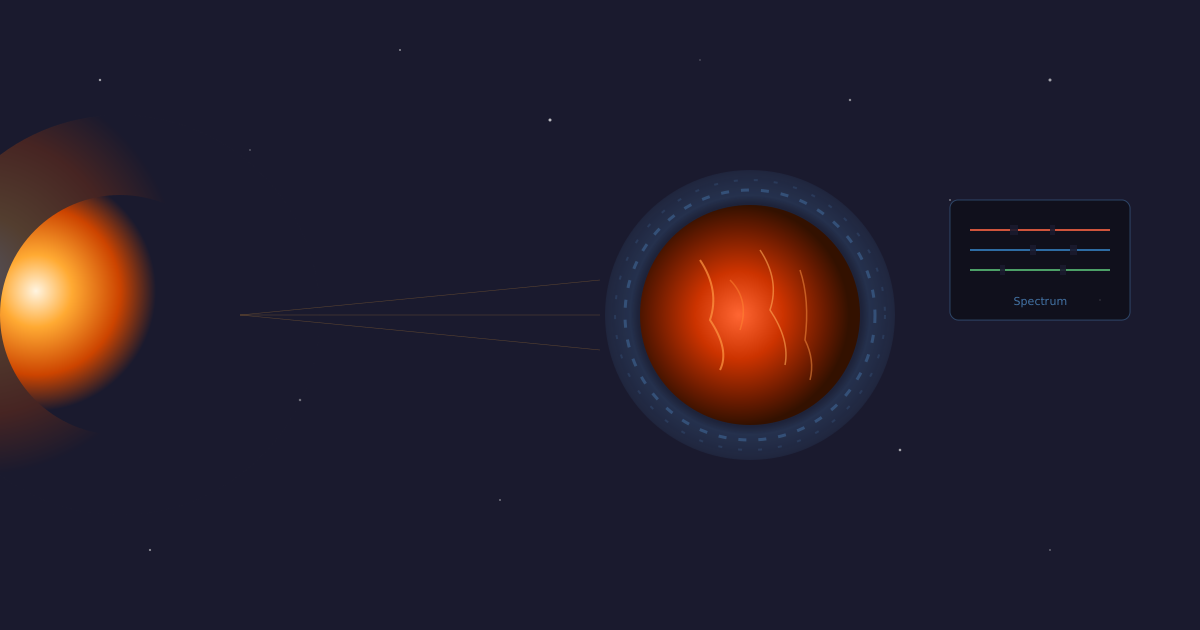
The technique used here is called secondary eclipse spectroscopy, and the logic is elegantly simple. First, you measure the light when the planet is visible beside its star — you’re capturing “starlight plus planet light.” Then you measure the light when the planet slides behind the star — now it’s “starlight only.” Subtract the second measurement from the first, and what’s left is the planet’s own light.
Spread that light across wavelengths, and you get a spectrum. Water vapor absorbs at specific wavelengths. Carbon dioxide leaves a different fingerprint. Each molecule has its own unique dip in the spectrum, letting researchers identify what’s there and roughly how much.
The logic is simple; the execution is extraordinarily hard. A planet’s light is typically thousands of times fainter than its star’s. Picking out absorption features buried in that noise requires the kind of sensitivity only JWST can deliver.
TOI-561 b’s spectrum pointed toward water vapor traces and what appear to be clouds made of silicate particles — the stuff of rocks. Earth’s clouds are water droplets. On this planet, clouds are made of vaporized rock. If it rains there, it rains lava.
How a Magma Ocean Keeps Generating Its Own Atmosphere
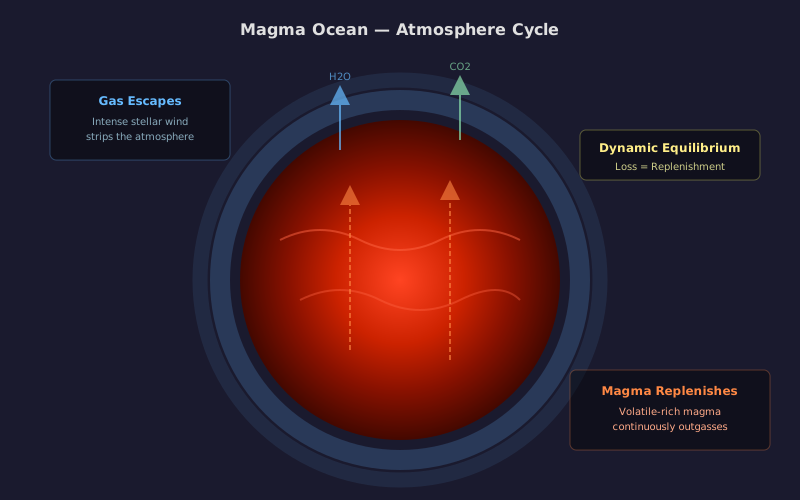
Here’s the obvious question: with a star blasting radiation at such close range, why hasn’t the atmosphere been stripped away already?
The answer is underfoot. The magma ocean itself.
Molten rock carries dissolved volatiles — water, carbon dioxide, sulfur compounds. When the temperature is high enough, those gases boil out of the surface and into the air above, much like carbonation fizzing out of a soda bottle when you crack the cap.
Stellar wind continuously tears at the top of the atmosphere, pushing gas into space. Under normal circumstances, the atmosphere would just dwindle. But on TOI-561 b, the outgassing from the magma ocean and the stellar wind stripping are in balance — a kind of dynamic equilibrium.
Think of a sink with the tap running and the drain open. The water level stays steady. The atmosphere works the same way: the inflow from below matches the outflow from above.
A few conditions have to line up for this to work. The magma ocean needs to be large enough. The planet needs a healthy reserve of volatiles. And the planet’s gravity needs to hold onto gas well enough to slow the escape. TOI-561 b’s radius is about 1.4 times Earth’s, giving it slightly stronger gravity. It’s a precarious balance — but it holds.
What an Ancient Star System Actually Tells Us
There’s another detail about this system worth sitting with. TOI-561 is very old.
The host star is roughly twice the age of the Sun — around 10 billion years. It belongs to the Milky Way’s “thick disk,” a population of ancient stars that formed when the galaxy was young. It’s metal-poor, meaning it contains fewer elements heavier than hydrogen and helium than younger stars do.
Conventional thinking held that metal-poor stars struggle to form rocky planets — not enough raw material. And yet TOI-561 b exists. It has a planet. That planet has an atmosphere.
The implication: atmospheric rocky worlds were possible very early in cosmic history. One of the prerequisites for life — a stable atmosphere — may have been available in the universe far earlier than anyone assumed.
To be clear, nobody is suggesting life exists on a 1,800°C lava planet. But the finding does expand the envelope of where atmospheres can survive. And that matters for the broader conversation about the habitable zone. Whether a planet holds onto its atmosphere isn’t just a function of how far it sits from its star.
Does This Overturn Previous “No Atmosphere” Results?
Since JWST reached full operational capability, several rocky exoplanets have been scrutinized for signs of an atmosphere.
The TRAPPIST-1 planets attracted enormous attention for their Earth-like sizes and habitable-zone orbits. But early observations found little or no evidence of thick atmospheres around at least some of them. Planets like LHS 475 b and GJ 486 b also left detection results ambiguous.
Against that backdrop, TOI-561 b stands out sharply. It’s the first case where there’s strong, direct evidence that a rocky exoplanet carries an atmosphere.
A caveat matters here, though. TOI-561 b’s atmosphere is a peculiar beast — sustained by a magma ocean, nothing like the temperate, chemistry-rich atmospheres that might support life. It doesn’t point to biology.
What it does demonstrate is methodological. Secondary eclipse spectroscopy works on rocky planets. That unlocks the technique for future targets: temperate, Earth-sized worlds in the habitable zones of their stars, where the same approach might one day pick up oxygen, methane, or other signs of something alive.
The Lava Planet Poses the Next Question
TOI-561 b is not a planet you’d want to visit. The surface is molten rock. The clouds are vaporized stone. The rain is lava. The air temperature would liquify steel.
And yet this planet just taught us something important.
First: atmospheres are tougher than we gave them credit for. Even in an environment this brutal — a fraction of Mercury’s distance from an active star — an atmosphere can persist as long as the planet keeps feeding it from below. The universe doesn’t only break things. It rebuilds them.
Second: our ability to look has finally caught up to the question. Without JWST’s sensitivity, this atmosphere would have gone undetected. Twenty years ago, characterizing the atmosphere of a planet 280 light-years away was science fiction.
The next targets are already queued up: TRAPPIST-1e and TRAPPIST-1f, Earth-sized planets sitting squarely in the habitable zone. If JWST detects water vapor, oxygen, or methane in their spectra — gases associated with life — we might finally have a scientific answer to the oldest question there is.
An atmosphere over a lava sea. The real lesson isn’t about this one strange planet. It’s that the universe keeps being more accommodating than we imagined.