Have you ever watched a rocket launch and noticed what happens right after liftoff? The bottom half peels away and tumbles into the sea. Then the middle section separates and falls. By the time the payload reaches orbit, almost everything else has been thrown away. Years of manufacturing, thousands of parts — gone after a single use.
Think of it this way: it’s like building a passenger jet, flying it once from New York to Los Angeles, then scrapping it on the tarmac. The aerospace industry has operated like this for decades, and we’ve mostly accepted it as normal.
SpaceX’s Starship is trying to end that era. Both the upper stage and the massive lower-stage booster are designed to fly back and be launched again. Through 2025, that vision slowly started becoming real. Now, with the second-generation Block 3 vehicle preparing for its debut in 2026, the question is no longer whether it can be done — but how soon.
What exactly makes this so difficult, and why do people keep saying it will “change space transportation”? Let’s work through it step by step.
Why Rockets Were Disposable for So Long
Before you can appreciate what Starship represents, it helps to understand why rockets were throwaway vehicles in the first place.
Rockets have to be extraordinarily light. Every kilogram of structure is a kilogram that can’t go toward payload, so walls are made paper-thin and fuel tanks are engineered to the absolute edge of what materials can hold. Then you fill them with cryogenic propellant, subject them to violent vibration and extreme temperature swings, and accelerate to 7.8 km/s.
Getting back down is its own ordeal. The vehicle slams into the upper atmosphere at more than 7 km/s. Aerodynamic friction heats the surface above 1,500°C — hot enough to soften most metals. Protecting something that can survive that, while keeping the vehicle light enough to fly in the first place, is deeply contradictory.
The traditional answer was: don’t bother. The weight and cost of heat shielding, guidance systems, and landing hardware would eat into the payload so badly that it simply wasn’t worth it. Throwing the rocket away was cheaper than bringing it back.
The Space Shuttle tried another approach — the orbiter itself landed and flew again. But the large orange external tank was discarded every flight, and the refurbishment costs were staggering. Each mission ran roughly $450 million. The program retired in 2011.
Falcon 9 Proved the First Half
SpaceX’s Falcon 9 was the vehicle that cracked the disposable logic open — at least partially.
Falcon 9 is a two-stage rocket, and its first stage (the booster) lands itself vertically after separation. The upper stage is still expendable. But that half-measure turned out to be enormously consequential. The booster is where most of the hardware cost lives — the nine Merlin engines, the complex plumbing, the structural skeleton. Recover that, and the economics shift dramatically.
Since the first successful booster landing in 2015, some Falcon 9 boosters have now flown more than 20 times. The rapid buildout of the Starlink constellation — thousands of satellites — would not have been financially possible without that reusability.
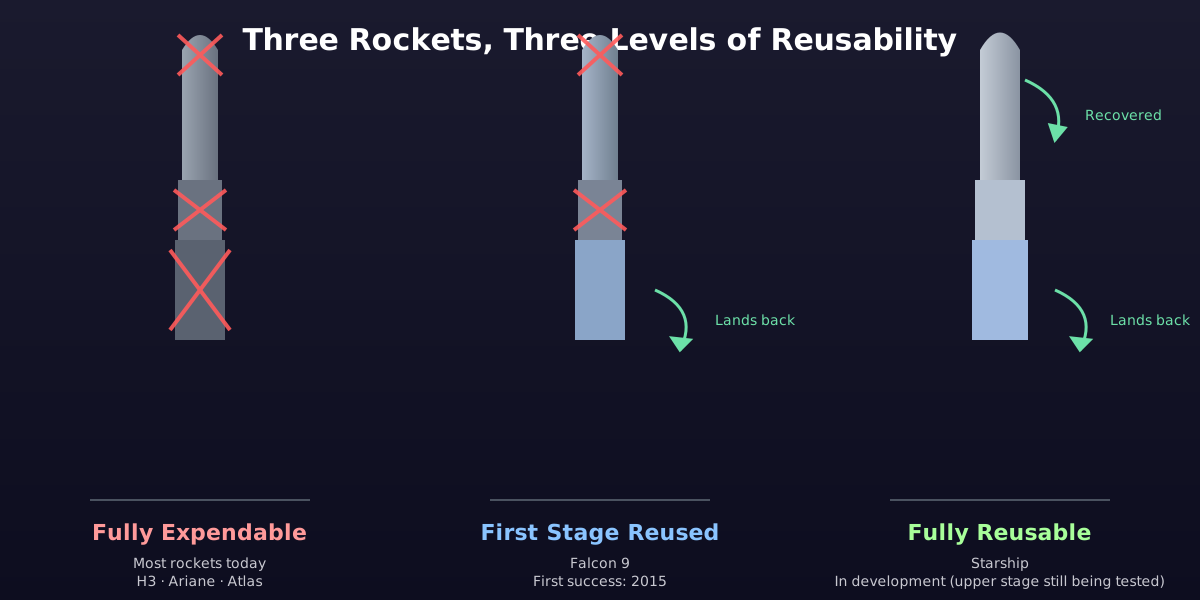
But Falcon 9 still throws away its upper stage every flight. And while it handles low Earth orbit efficiently, it lacks the raw capacity to move serious mass to the Moon or Mars. That’s where Starship comes in: a fully reusable vehicle, much bigger, designed to do both.
Just How Big Is This Thing?
The first thing that strikes you about Starship is its sheer scale.
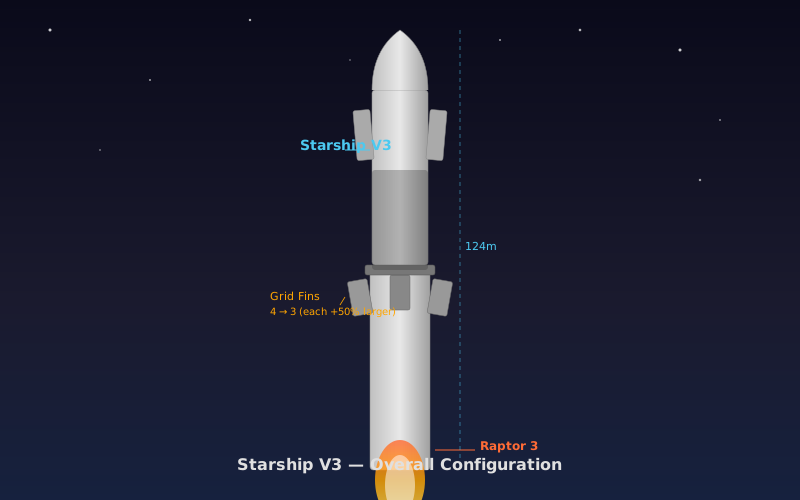
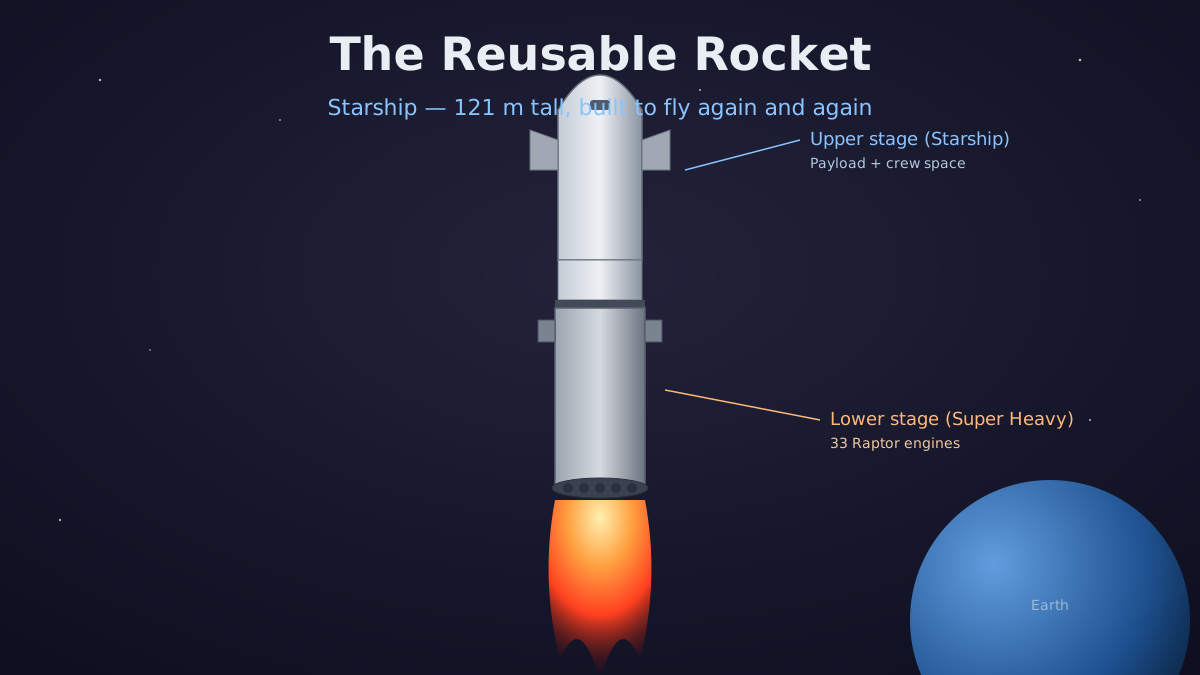
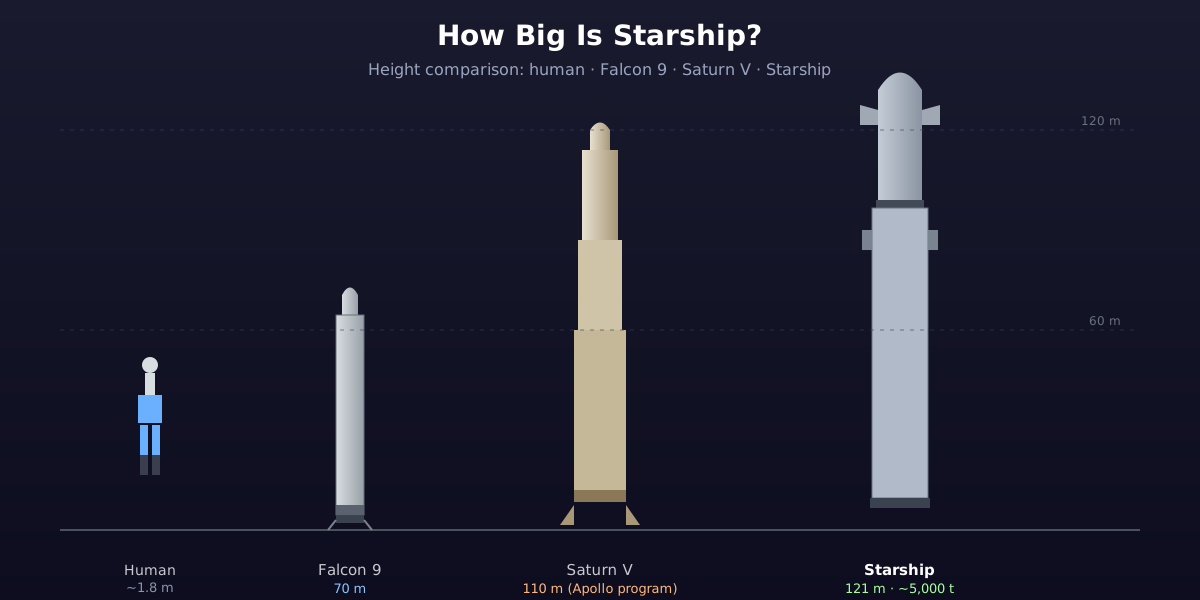
Stacked together, the Super Heavy booster and the Starship upper stage reach about 121 meters tall. That’s taller than the Saturn V (110 m), the rocket that carried Apollo astronauts to the Moon. The diameter is 9 meters, and the launch mass is roughly 5,000 metric tons. It’s the largest operational rocket ever built, and the most powerful crewed launch vehicle in history.
The propulsion numbers are equally staggering. Super Heavy carries 33 Raptor engines. At liftoff, combined thrust is approximately 7,600 tf — about twice the Saturn V, more than ten times a Falcon 9.
Why does it need to be so enormous? The answer is almost painfully simple: adding reusability means adding weight, and the only way to still carry a useful payload is to make the vehicle bigger. Landing fuel, heat shield tiles, guidance hardware, structural reinforcement — all of it has to ride along. Scale up enough, and there’s still room for real cargo.
In expendable mode, Starship can carry up to 250 metric tons to low Earth orbit. In fully reusable mode, estimates land between 100 and 150 tons. For reference, the International Space Station weighs about 420 tons — you could theoretically ferry the entire thing up in three Starship flights.
The “Chopstick” Catch
Of all the things Starship does that defy conventional thinking, the booster recovery method gets the most attention.
A typical reusable rocket — Falcon 9 — deploys landing legs and touches down on a pad. Starship’s Super Heavy does neither. Instead, it flies back to the launch tower, and two enormous mechanical arms called “Mechazilla” reach out and grab it right out of the air.
When I first watched footage of this, my reaction was genuine disbelief that anyone would actually attempt it in operational hardware. A 70-meter structure descending at nearly 1,000 km/h, snatched by a pair of arms with the precision of tweezers — it looks more like a sci-fi stunt than engineering practice.
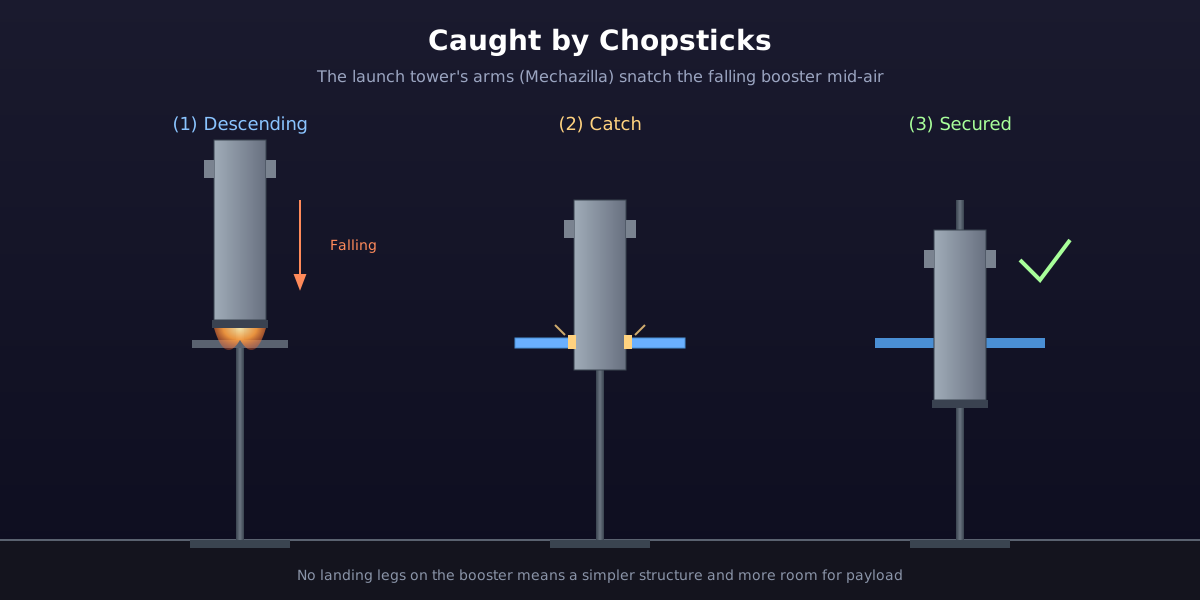
But there’s a cold logic behind it. Landing legs on the booster add weight and mechanical complexity, reducing payload capacity on every flight. Move the catching mechanism to the tower instead, and the booster itself stays simpler. It also means the same launch mount can turn around for the next flight quickly, without the booster needing to be transported elsewhere.
In Starship’s fifth integrated flight test in late 2024, the chopstick catch worked. It was, honestly, one of the most visually alien moments in the history of rocket development.
What Block 3 Is Aiming For
Over the course of 2025, SpaceX conducted five full Starship integrated flight tests. Two vehicles successfully made it to a splashdown. Three were lost. The development philosophy is deliberate: build, fly, break, learn, repeat — on a cycle measured in months rather than years.
Block 3, the second-generation design, begins flying in 2026. The upper stage is slightly taller, the Raptor engines produce more thrust, and the heat shield tiles have been redesigned. The first Block 3 flight was targeting around March 2026.
Further into the year comes a milestone that goes beyond SpaceX’s internal program: Starship HLS, the lunar lander variant built for NASA’s Artemis program. NASA contracted SpaceX to land astronauts on the Moon using HLS as part of Artemis III. That’s not a demonstration mission — it’s the actual crewed lunar landing.
This matters because Starship isn’t just a new rocket type. It’s been woven into the center of human spaceflight planning at a national level. The same design serves as a cargo hauler, an orbital propellant depot (refueled by tanker variants), and a crewed lunar lander. One platform, many missions. That flexibility is itself a new idea.
What “Not Throwing It Away” Actually Means
At this point you might be wondering: okay, but why does reusability matter so much? Can’t we just build better conventional rockets?
The answer comes down to cost and cadence.
Today, launching 100 kilograms to low Earth orbit on a standard rocket costs roughly $20,000 USD. If Starship achieves its full reusable operations, that same 100 kg could eventually cost a few hundred dollars — one or two orders of magnitude cheaper.
When launch costs fall that far, the whole concept of what you can send to space changes. Right now, every satellite is a bespoke machine, designed for years, tested meticulously, launched with fingers crossed. A world with cheap, high-volume access to orbit looks more like container shipping: mass-produce the hardware and send it up in regular batches.
The Moon and Mars are even more stark cases. Today, getting meaningful cargo to the lunar surface is a budget-of-nations problem. A reliable, frequently flying Starship makes lunar base logistics genuinely feasible. The Lunar Gateway, Artemis surface operations, long-duration Mars missions — the timelines for all of these are built on the assumption that transport costs come down. Starship is the mechanism those assumptions depend on.
Reusability, in other words, isn’t just about treating a single rocket with more care. It’s about moving the ceiling on how often humanity can send things — and eventually people — into space.
Nobody Has Done This Yet
After everything above, it’s worth being honest about where things actually stand: Starship has not yet completed a full reuse cycle. The booster recovery is coming together. The upper stage? Still a work in progress.
Returning the upper stage is considerably harder than the booster. It comes in from orbital velocity — the heat loads and structural stresses are in a completely different league. Hundreds of heat shield tiles have peeled off during testing. The vehicle has needed significant structural reinforcement between flights. Progress is real, but it’s incremental.
What’s unusual is the pace. Conventional aerospace development moves in ten-year arcs, with extensive analysis at every step. SpaceX builds test articles, flies them to failure, studies the wreckage, and starts the next iteration within months. Block 3 is the latest iteration in that chain.
Whether upper-stage recovery and reflight happen within the next two or three years is genuinely open. If it does happen, it will be the first time in history that an entire rocket — both stages — becomes a reusable vehicle. At that point, launching something into space won’t feel like an expedition anymore. It’ll start feeling like catching a connection.
Some evening in the not-too-distant future, someone will glance up at the sky and think: that’s probably the next flight heading out. The moment when that feels ordinary may be closer than it seems.