The Moon Is Close. Living There Is Another Story.
The Moon sits just 384,000 km away — light crosses that gap in 1.3 seconds. By cosmic standards, it’s practically next door.
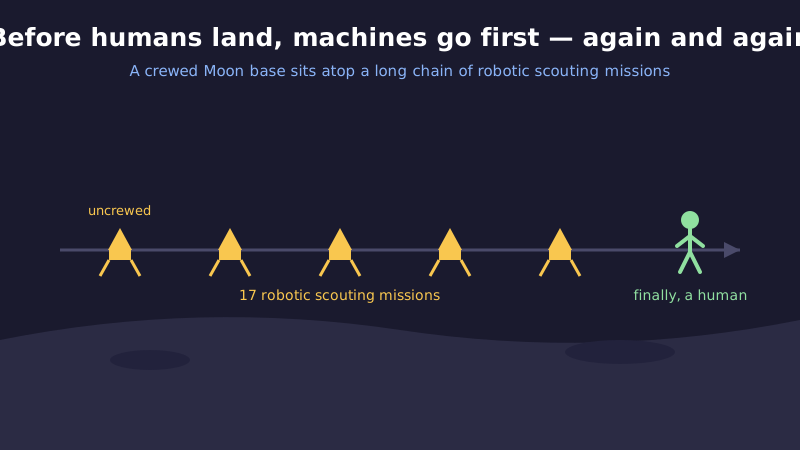
And yet, humans have set foot on it only six times. The last visit was Apollo 17, in December 1972. More than half a century ago. The reason is simple: there’s a vast difference between going somewhere and living there.
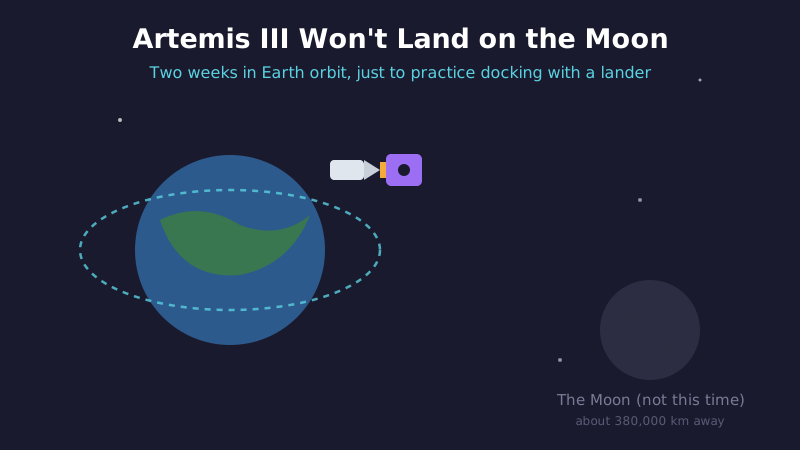
In April 2026, NASA’s Artemis 2 mission completed a crewed lunar flyby. Artemis 3 will aim for a landing, and beyond that sits the Artemis Base Camp concept — a plan for extended stays rather than brief visits. For the first time, humanity has a serious roadmap for actually inhabiting the Moon.
So it’s worth asking: just how hostile is that place, really?
An Environment Unlike Anything on Earth
Lay the Moon’s conditions next to Earth’s, and the comparison gets uncomfortable fast.
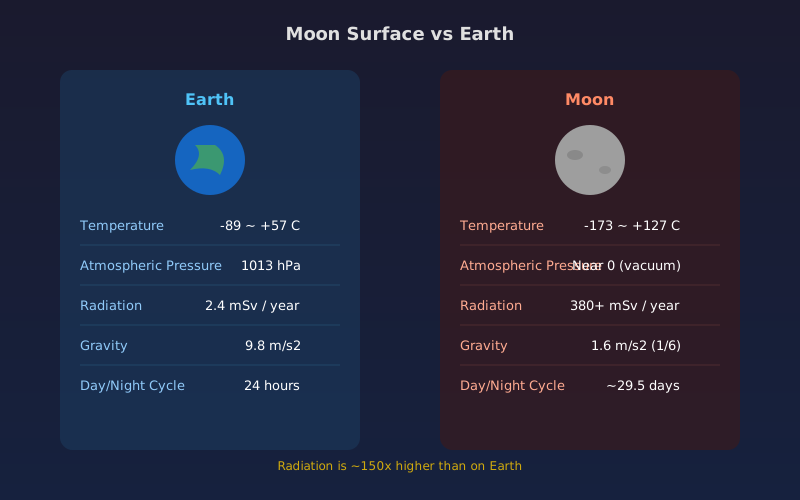
Start with temperature. The sunlit lunar surface reaches around 127°C — hotter than a frying pan left on a burner. Once the Sun sets, it plunges to –173°C, colder than any recorded temperature in Antarctica. And this cycle runs on lunar time: roughly 14 days of scorching heat followed by 14 days of bitter darkness, repeating every 29.5 days.
The atmosphere? Essentially nonexistent. Not thin — absent. The lunar surface pressure is about one-trillionth of Earth’s. Exposed to that vacuum without a suit, a person loses consciousness in roughly 15 seconds.
Gravity is one-sixth of Earth’s. A 60 kg person on the Moon weighs the equivalent of 10 kg here. Jumping would send you six times as high. That sounds fun — but prolonged exposure to low gravity steadily erodes muscle mass and bone density. It’s exactly why ISS crew members spend two hours every single day exercising.
The Invisible Threat: Radiation
Of all the hazards on the Moon, radiation is the most dangerous. Not the cold. Not the vacuum. Radiation.
Earth has two shields working in its favor. The first is its magnetic field, which deflects the solar wind — the continuous stream of charged particles from the Sun. The second is the atmosphere, which absorbs cosmic rays. Together, these layers keep the average annual radiation dose on Earth’s surface to around 2.4 millisieverts (mSv).
The Moon has neither. NASA measurements put the annual radiation exposure on the lunar surface at 380 mSv or more — roughly 150 times what we receive on Earth. To put that in perspective, NASA’s career limit for astronaut radiation exposure is around 500 mSv per year. A year on the Moon would consume more than 70% of that budget.
Solar flares make things even more alarming. When the Sun erupts, it can unleash a torrent of high-energy particles in a matter of hours. A solar particle event (SPE) that struck between the Apollo 16 and Apollo 17 missions in 1972 would have delivered a potentially lethal dose to anyone standing on the lunar surface at the time. The astronauts were lucky — they were between missions.
Radiation shielding, then, sits at the top of every lunar habitat design discussion.
Regolith: Dirt as Your Best Defense
Here’s where lunar soil enters the picture. The Moon’s surface is blanketed in regolith — a layer of fine, fragmented rock particles — and it turns out to be a surprisingly capable radiation shield.

According to NASA research, just 5 cm of regolith is enough to block 100 MeV protons. Eighteen centimeters handles 200 MeV protons. For meaningful long-term protection, a layer around 30 cm thick (roughly 50 g/cm² at a density of 1.9 g/cm³) could reduce the annual effective dose to approximately 310 mSv. Still around 130 times Earth levels, but within a survivable range for shorter stays.
Solar flares are actually easier to address. A shielding depth of at least 10 g/cm² of regolith keeps SPE exposure below the 30-day allowable limit. Want a safety margin? Just pile on more. The supply is essentially limitless.
Two construction approaches are under serious consideration: mounding regolith over habitat modules like sandbags, or using 3D printers to sinter the material into structural blocks. Building a lunar home from lunar materials. This strategy — known as ISRU, or In-Situ Resource Utilization — may be the single most important concept in making permanent lunar habitation work.
Breathing and Drinking on the Moon
After radiation, the next challenge is keeping people supplied with air and water.
Without an atmosphere, any habitable space on the Moon must be fully sealed and pressurized — maintained at roughly 1 atmosphere (about 1013 hPa), similar to an ISS module. That part is well-understood. The harder question is where the oxygen comes from.
Shipping it from Earth isn’t a viable long-term solution. Getting one kilogram of cargo to the Moon costs millions of dollars. Local production is the only realistic path.
As it turns out, about 45% of lunar regolith by mass is oxygen — locked up inside oxides like silica (SiO₂) and ilmenite (FeTiO₃). Electrolyzing these compounds releases the oxygen. ESA has already demonstrated this in the lab, and future plans call for a lunar surface plant capable of producing oxygen at scale.
Water is where the story gets genuinely exciting. Near the Moon’s south pole, certain crater floors have never seen sunlight — what scientists call permanently shadowed regions. Ice is thought to have accumulated there over billions of years. NASA’s VIPER rover and several other missions are designed to map these deposits and assess how much is actually usable.
If that ice pans out, it unlocks far more than drinking water. Electrolysis can split it into hydrogen and oxygen — the latter for breathing, the former for rocket propellant. A lunar base near the south pole could effectively function as a water mine and a fuel depot rolled into one.
Food, Power, and the Mind
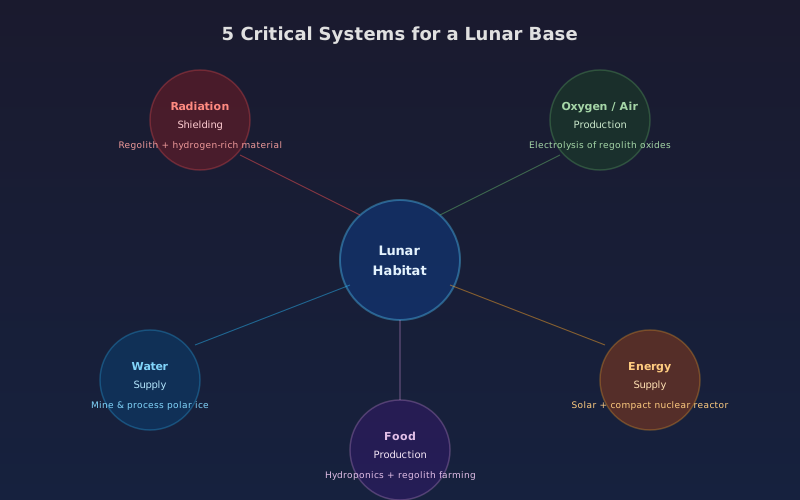
Staying alive also requires food and energy — and a bit of attention to the psychological toll.
On the food front, ISS experiments offer some useful data. NASA’s Veggie project successfully grew lettuce and radishes in microgravity. On the Moon, where gravity is one-sixth of Earth’s rather than zero, managing hydroponic systems may actually be easier. Still, fully self-sufficient food production is a distant goal. Early missions will depend heavily on freeze-dried rations, with fresh greens serving more as a psychological boost than a nutritional cornerstone. Eating something you grew, seeing something green — in a sealed metal can far from Earth, that matters more than it sounds.
For energy, solar panels are the first choice. Without an atmosphere blocking the Sun, the Moon’s surface receives direct, unfiltered sunlight. The problem is the two-week lunar night, during which panels go dark entirely. One solution is to build near the south pole, where certain ridge lines catch nearly continuous sunlight — lunar “peaks of eternal light.” Another is the small nuclear reactor. NASA’s Kilopower project developed a 10-kilowatt-class fission reactor designed for use on the Moon or Mars. The likely answer is a hybrid of both.
Then there’s the psychological dimension, which is easy to overlook. A lunar base will be a small, closed community, weeks from any meaningful rescue, separated from Earth by a 1.3-second communication delay. Video calls work, but conversations have an odd, fractured rhythm. Antarctic winter-over crews and long-duration ISS astronauts have made it clear that managing mental health in isolated environments is as critical as any engineering problem. A window with a view of Earth would probably do more good than any amount of medication.
Could the Moon Have Permanent Residents by the 2030s?
NASA’s Artemis roadmap calls for a Foundational Surface Habitat — a long-duration living module — to be in place sometime in the 2030s, potentially around the Artemis 8 mission. Until then, each landing is a short visit followed by a trip home.
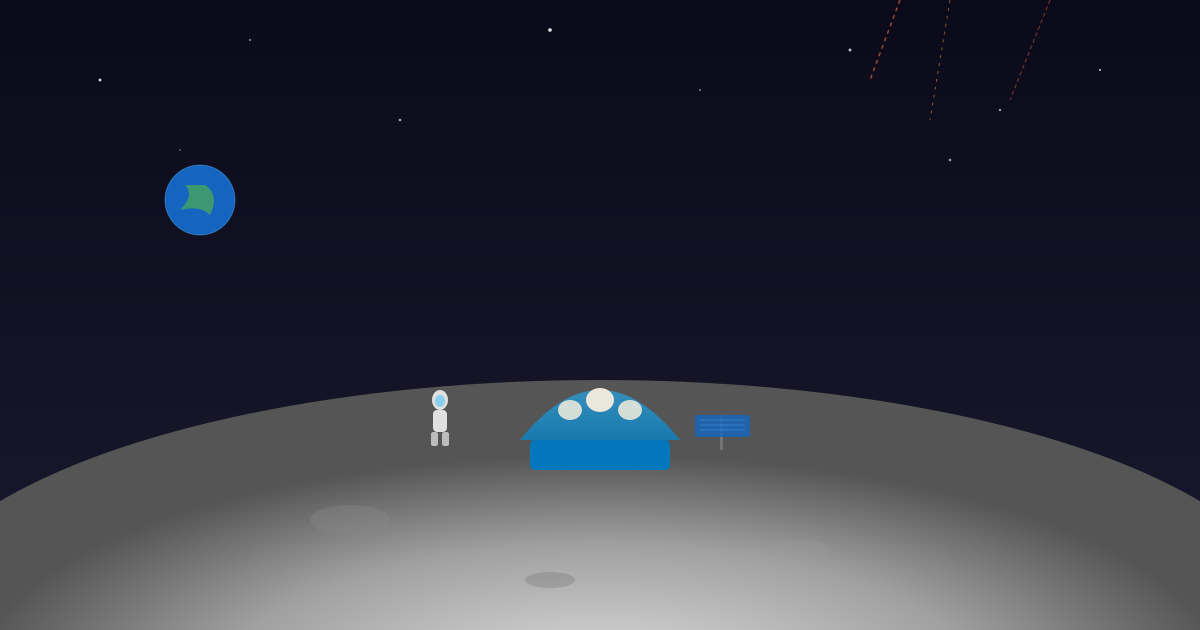
A full “city” is still science fiction. But a small, permanently crewed outpost is not. The pieces are in place: ISRU to extract oxygen from regolith, south polar ice as a water and fuel source, solar and nuclear power to ride out the long nights. The individual technologies exist. What remains is proving them on the lunar surface itself.
The leading site for all of this is near Shackleton Crater at the south pole — permanently shadowed ice in the crater floor, near-continuous sunlight on the rim. Excellent real estate by any practical measure. Though any honest listing would have to note: no atmosphere, no transit links, 384,000 km from the nearest amenities.
The Moon is close. Making it livable is hard, and a lot of the hardest problems are still unsolved. But the tools to solve them are taking shape right now. The next time Artemis astronauts leave bootprints on the lunar surface, it might not be a visit — it might be the start of a move.