Jupiter and Saturn. The two giants at the top of the solar system’s size chart look similar at a glance — both made of gas, both trailing dozens of moons.
But the number of large moons couldn’t be more different.
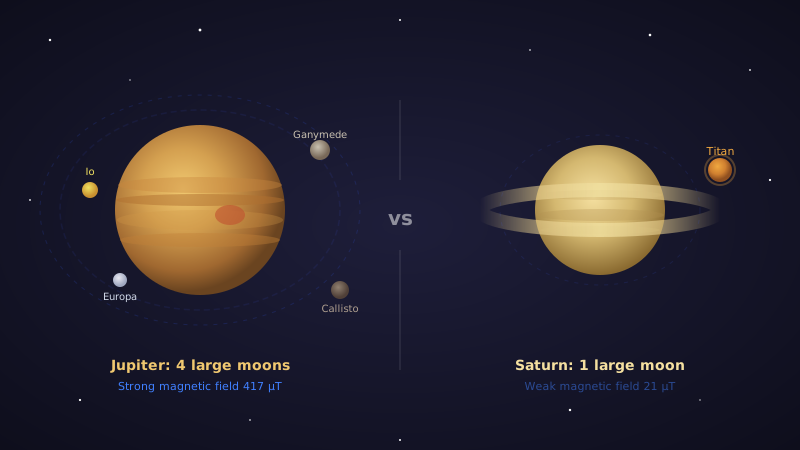
Jupiter has four: Io, Europa, Ganymede, and Callisto, spotted by Galileo through a telescope in 1610. Saturn, by contrast, has just one moon worth calling large — Titan. Everything else is orders of magnitude smaller.
Why the gap? For a long time, no one had a good answer. “Coincidence” was often how the conversation ended.
Then, in April 2026, a joint study from Kyoto University and Shanghai Jiao Tong University offered something better than coincidence. The culprit, it turned out, was magnetic fields.
How Large Moons Are Born
Large moons don’t appear out of nowhere. They form the same way planets do — from a rotating disk of gas and dust, but this time orbiting a planet rather than a star. Astronomers call it a circumplanetary disk.
Dust grains clump together, rocks grow, and eventually a moon takes shape. It’s a miniature replay of the process that built the planets themselves.
The trouble is what happens next: migration.
A newborn moon doesn’t just sit still. Friction with the gas in the disk drags it steadily inward, toward the planet. Left unchecked, the moon spirals all the way in and gets swallowed. This is called Type I migration, and it’s essentially a death march for young moons.
Simulations show that under the right conditions, a moon can reach the planet in just a few hundred thousand years — a blink compared to the solar system’s 4.6-billion-year age. The graveyard is closer than you’d think.
The Invisible Wall
Enter the magnetic field.
Jupiter has the strongest magnetic field in the solar system — about 417 microteslas at the surface. Earth’s field runs between 25 and 65 microteslas, so Jupiter’s is in a different league entirely.
That enormous magnetic field punches a hole in the circumplanetary disk. Magnetic field lines blast the gas outward, leaving a gap near the center of the disk. Astronomers call this the magnetospheric cavity.
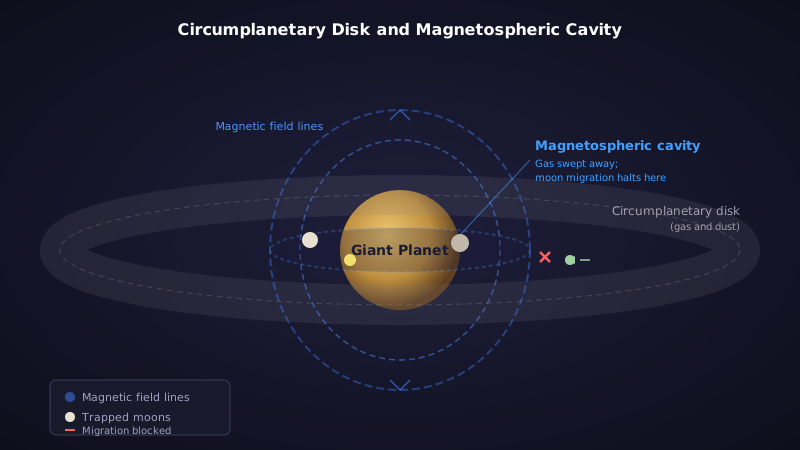
Inside the cavity, there’s almost no gas. No gas means no friction. No friction means no inward drag.
The cavity acts as a wall. A moon migrating inward reaches the cavity’s edge and stops — it has nowhere left to go.
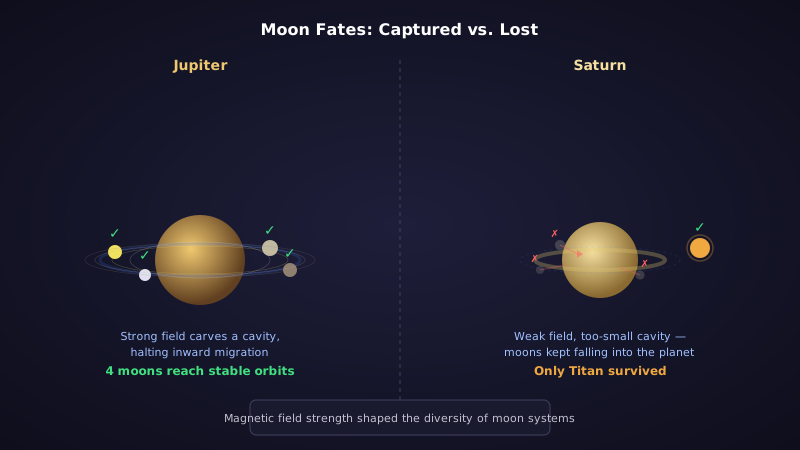
For Jupiter, that wall was large enough to matter. Io, Europa, and Ganymede each migrated inward and got caught at the cavity’s edge, locking into stable orbits. Callisto, the outermost of the four, formed far enough out that it barely felt the disk’s pull in the first place.
The result: four large moons, neatly arranged.
Saturn’s Field Was Too Weak
Saturn’s magnetic field measures about 21 microteslas — roughly one-twentieth of Jupiter’s.
That weaker field couldn’t carve a big enough cavity. A small cavity is too shallow to stop an incoming moon. So Saturn’s large moons migrated inward and kept going, falling into the planet one after another.
Born, spiraled in, gone. Repeat.
The only survivor was Titan. It formed far enough from Saturn that by the time it would have migrated all the way in, the disk itself had already dissipated. Titan made it by a hair — a last-second safe call.
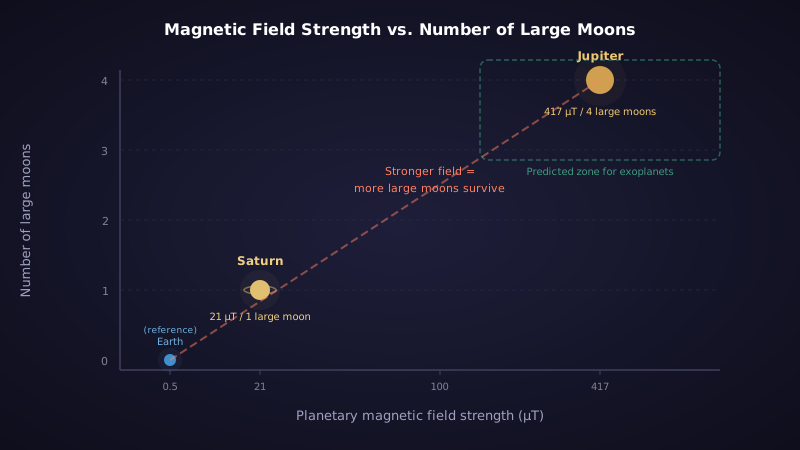
Seen this way, the difference between Jupiter’s four large moons and Saturn’s lone Titan isn’t random. The magnetic field each planet was born with determined which moons got to stay.
The Numbers in Perspective
Here’s something worth noting: Saturn actually has more moons than Jupiter. Jupiter tops 100 confirmed moons; Saturn has over 280. By raw count, Saturn wins easily.
But filter for size — say, diameter over 1,000 km — and the picture flips. Jupiter: four (Io, Europa, Ganymede, Callisto). Saturn: one (Titan).
Ganymede is the largest moon in the solar system, at 5,268 km across. That’s bigger than Mercury. Titan runs a close second at 5,150 km, also beating Mercury. Two giants, two very different hosts.
What’s remarkable about the Galilean moons is their spacing. Io orbits at 420,000 km from Jupiter; Europa at 670,000 km; Ganymede at 1,070,000 km; Callisto at 1,880,000 km. The inner three are locked in a 1:2:4 orbital resonance — for every one orbit Ganymede completes, Europa completes two and Io completes four.
That elegant arrangement isn’t luck either. Each moon was caught at the cavity’s edge in turn, and the physics of orbital resonance did the rest. The magnetic field set the parking spots; gravity handled the choreography.
What Titan Gained by Being Alone
There’s an interesting flip side to Titan’s isolation.
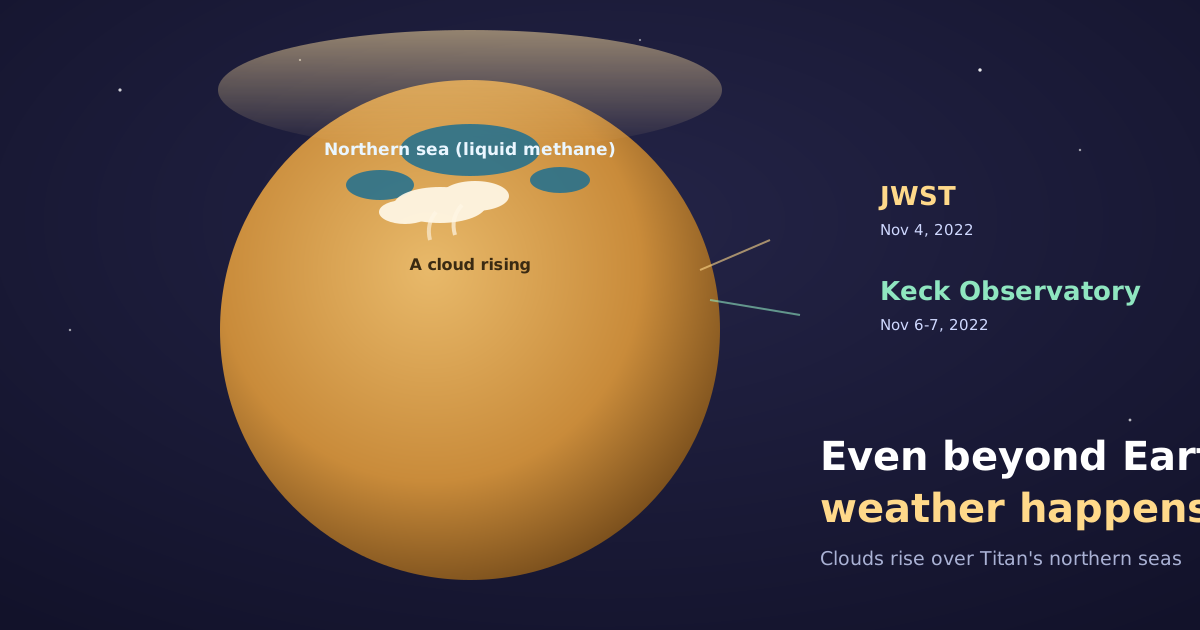
Titan is the only moon in the solar system with a thick atmosphere — mostly nitrogen, about 1.5 times denser than Earth’s. Its surface has lakes and rivers of liquid methane. It’s less like a moon and more like a small planet wearing a moon’s name tag.
Would Titan look the same if Saturn had three more large moons? Almost certainly not. Competing gravitational tugs would have altered Titan’s internal heating, its orbital evolution, and the way its atmosphere developed over billions of years.
Being the sole large moon meant Titan had Saturn’s gravity almost entirely to itself. That may be exactly why it grew into the extraordinary world it is today. The loneliness wasn’t a misfortune — it was the condition that made Titan, Titan.
What This Means Beyond the Solar System
The deeper implication of this research is a predictive one: if you know a planet’s magnetic field strength, you can estimate what its moon system looks like.
A Jupiter-mass planet tends to generate a Jupiter-scale magnetic field, which means it probably has multiple large moons. A Saturn-mass planet probably has just one. The pattern should repeat throughout the galaxy.
That matters for exoplanet research. As of 2026, astronomers have confirmed more than 6,000 planets beyond our solar system, but confirmed exomoons — moons orbiting those planets — are essentially nonexistent in the catalog. They’re too small and too far away to detect directly.
But if the magnetic field connection holds, the planet’s mass and field can serve as a proxy. “That gas giant probably has a few large moons” becomes a reasonable inference rather than a guess. And moons matter: a large moon can stabilize a planet’s axial tilt, regulate its seasons, and make the surface environment more hospitable. Wherever scientists are searching for signs of life, moons are part of the equation.
The lesson keeps repeating in planetary science: understanding our own backyard opens windows onto everywhere else.
One Variable, Two Completely Different Solar Systems
Here’s a thought experiment to close on.
If Jupiter’s magnetic field had been as weak as Saturn’s, Io, Europa, and Ganymede would almost certainly be gone — swallowed by the planet before they ever had a chance to settle. The ocean hidden under Europa’s ice wouldn’t exist. NASA’s Europa Clipper would have no destination.
Run it the other way: if Saturn’s field had matched Jupiter’s, three more large moons would orbit alongside Titan, framed against those iconic rings. It would be one of the most spectacular sights in the solar system.
The magnetic field a planet happens to be born with — not a dramatic collision, not a late migration of a rogue planet, just the quiet strength of an invisible field — determined the shape of the solar system we see today.
Four moons on one side, one on the other. The difference was never random. A field you can’t see built the sky you’re looking at.