“Earth-like planet discovered” — that kind of headline barely raises eyebrows anymore. The number of confirmed exoplanets has passed 6,000 and keeps climbing. But here’s the honest truth: most of the “Earth-like” planets found so far are only similar in size. Whether they’re actually rocky worlds like Earth is, in many cases, pretty questionable.
The mission trying to change that is ESA’s exoplanet hunter “PLATO,” currently being prepared for launch around 2027.
Where Did the “26 Cameras” Idea Come From?
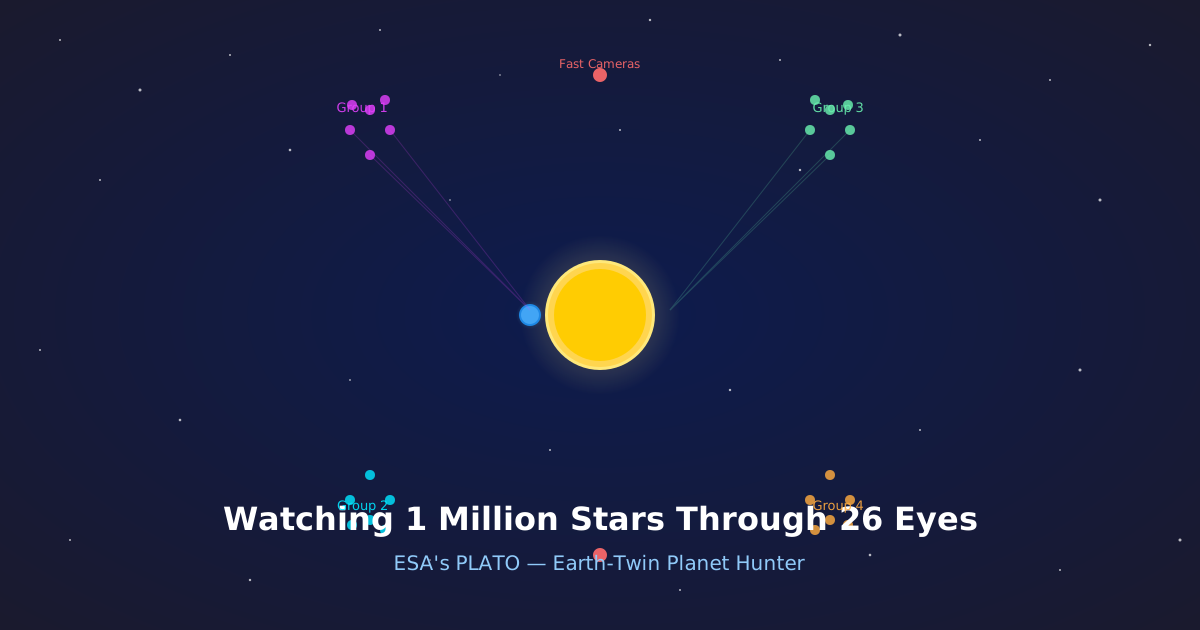
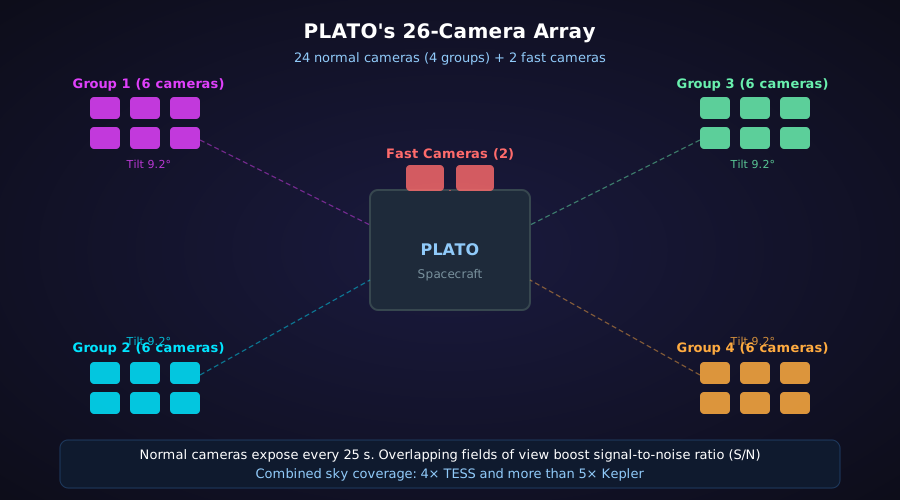
The most distinctive thing about PLATO’s design is the number of cameras: 26. A typical science satellite has one or two. Twenty-six seems like overkill at first glance.
The reason is straightforward — bundling many cameras boosts the signal-to-noise ratio (S/N), making it easier to pull faint signals out of the noise. On top of that, each camera points in a slightly different direction, so the combined field of view is much wider.
The breakdown: 24 “normal cameras” plus 2 “fast cameras,” totaling 26. The normal cameras are split into four groups of six, each tilted 9.2 degrees from the others. The fast cameras target especially bright stars, capturing images every 2.5 seconds. Normal cameras shoot every 25 seconds. This continues for up to four years.
The result: PLATO’s sky coverage is estimated at four times that of TESS (NASA) and more than five times Kepler (NASA). It can observe up to 1 million stars. Not all at the same precision, of course, but around 250,000 stars get detailed tracking.
The Transit Method
PLATO uses an observational technique called the “transit method.” When a planet crosses in front of its host star, the star’s light dims ever so slightly. That dip is what gets detected.

For an Earth-like planet, such a transit happens once per year as seen from our perspective. Since the Kepler era, the rule of thumb has been “observe at least three transits before calling something a planet candidate.” To catch three transits of a planet with Earth’s orbital period (one year), you need to stare at the same star for at least three years straight.
TESS struggled with this. Designed to cover the entire sky quickly, it couldn’t track a single star for long. Its ability to find Earth-sized planets in Earth-like orbits was limited.
PLATO plans to spend two to three years on a single observation field. For the first time, this makes it possible to systematically search for Earth-sized planets orbiting at Earth-like distances.
What “Within 3%” Accuracy Actually Means
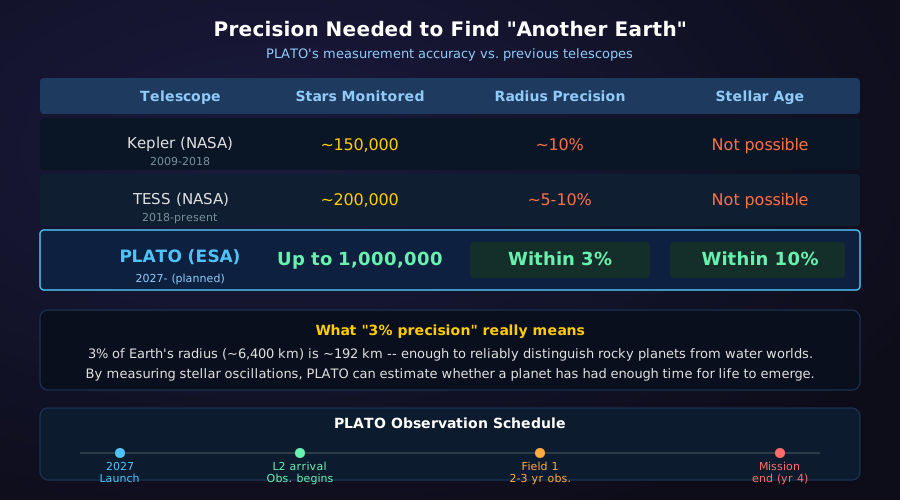
Measuring a planet’s radius to within 3% — that’s PLATO’s target.
Earth’s radius is about 6,400 km, and 3% of that is roughly 192 km. With this level of precision, scientists can reliably distinguish between a rocky planet, a water-rich “ocean world,” and a gas-shrouded “sub-Neptune” (a gaseous planet smaller than Neptune).
Why does this matter? Because a planet’s composition fundamentally changes the odds of it harboring life. A world wrapped in gas and a world with a solid rocky surface are entirely different propositions, even if they look similar in size.
Previous telescopes had accuracy around 10%, good enough only for “maybe similar.” PLATO’s 3% is a step deeper — precise enough to start revealing what’s inside.
The Real Breakthrough: Measuring a Star’s Age
There’s another fundamental way PLATO differs from Kepler and TESS — asteroseismology, the science of measuring a star’s age through its vibrations.
Stars undergo subtle oscillations at their surface. The Sun is no exception; sound-wave-like vibrations propagate through its interior. By precisely measuring these oscillation patterns, scientists can determine a star’s internal structure and, from that, calculate its age to within 10%.
Why does this matter? It directly answers the question: “Has this planet had enough time for life to develop?” The earliest life on Earth appeared roughly 400 million years after the planet formed. If a planetary system is only 500 million years old, complex life might not have had enough time to emerge, even under perfect conditions. If it’s been around for over 10 billion years, the odds of something having happened go up considerably.
Knowing “how old is this star” can completely reshape the search-for-life scenario. Neither Kepler nor TESS could go that far.
Observing from the “Premium Seat” at L2
PLATO will be positioned at the Sun–Earth Lagrange Point 2 (L2), where the gravitational pulls of the Sun and Earth roughly balance out. JWST and Gaia are parked at the same spot.

Located behind Earth (about 1.5% farther from the Sun), this point is, in a word, ideal for observations. The Earth, Moon, and Sun all stay on the same side, so the telescope can keep its instruments pointed permanently toward deep space. Temperature fluctuations are minimal — a gentle environment for precision instruments.
At roughly 1.5 million km from Earth, it’s close enough for fast data transmission. Over the past few years, L2 has become the “go-to parking spot” for space telescopes, precisely because all these conditions come together.
Built to Characterize, Not Just to Find
PLATO puts more emphasis on characterizing discovered planets in detail than on simply finding new ones.
Many of the planet candidates TESS discovered needed ground-based follow-up observations to pin down their mass and composition. PLATO is designed to focus on bright stars (stars that appear bright as seen from Earth), making it much easier to use radial velocity measurements (detecting the wobble a planet’s gravity induces in its star) with large ground-based telescopes after discovery.
When you know both size and mass, you can calculate density. And once you know density, you can tell whether a planet is rock, water, or gas. Only then can you legitimately call something an “Earth-like planet.”
The Real Work Starts Now
PLATO is scheduled for launch in late 2026 or early 2027. It won’t start producing results from its first observation field until 2028–2029 at the earliest. Since confirming a single planet requires at least three years of data, the big headline — “Earth’s true twin discovered” — might not arrive until the 2030s.
That’s how space exploration usually works. The preparation takes time, and the fruit ripens much later. But right now, the groundwork is being laid. The era of watching 1 million stars through 26 tireless eyes is about to begin.
References
- ESA PLATO Mission: https://www.esa.int/Science_Exploration/Space_Science/Plato
- PLATO (spacecraft) - Wikipedia: https://en.wikipedia.org/wiki/PLATO_(spacecraft)