The solar system’s largest canyon is on Mars.
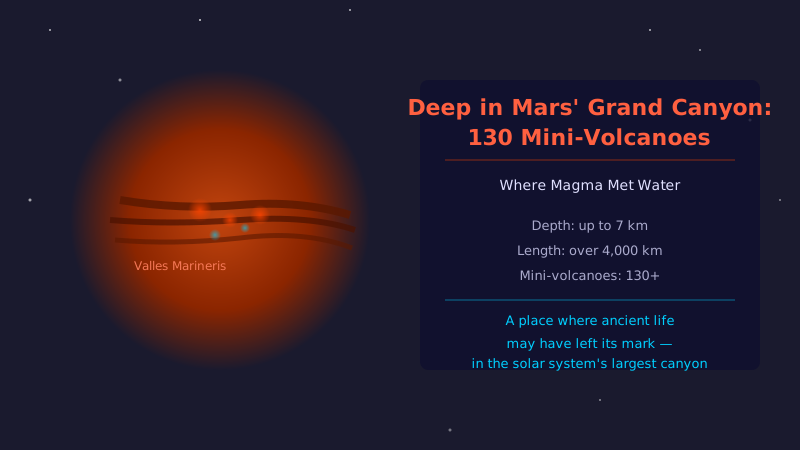
It’s called Valles Marineris. Stretching over 4,000 km long, up to 7 km deep, and as wide as 600 km, it dwarfs anything on Earth. The Grand Canyon — iconic as it is — runs about 446 km and drops a mere 1.8 km at its deepest. If Valles Marineris were placed on Earth, it would cut nearly across the entire width of North America.
Researchers have now found that the floor of this canyon holds more than 130 clustered mini-volcanoes — and the same region shows signs that water once flowed there. Magma and water meeting in one place: on Earth, that combination has repeatedly turned out to be a cradle for life.

What Hides at the Bottom of the Solar System’s Largest Canyon
Valles Marineris runs east-west along Mars’ equator, but its origin is nothing like the Grand Canyon’s. While the Grand Canyon was carved by river erosion over millions of years, Valles Marineris formed when the Martian crust was stretched and pulled apart, causing massive sections to collapse. It was born as a fracture — a tear in the planet.
Detailed satellite surveys of the canyon floor revealed it isn’t simply bare bedrock. In certain zones, researchers found clusters of small, dome-like structures with well-defined shapes. By combining high-resolution topographic data with thermal emission readings, scientists concluded these formations are likely cinder cones — the classic product of small-scale volcanic eruptions.
More than 130 of these features are packed into one region, and the surface composition there differs noticeably from the surrounding terrain. The minerals present point to a transformation process involving hydrothermal water — water heated by magma — having passed through the rock.
I’ll admit, when I first read this, I found it genuinely surprising. Valles Marineris has been studied for decades, yet such dramatic terrain was hiding at its bottom all along. The sheer depth of the canyon may have kept it out of view.
What Happens When Magma Meets Water
On Earth, places where magma and water intersect have a track record of supporting life.
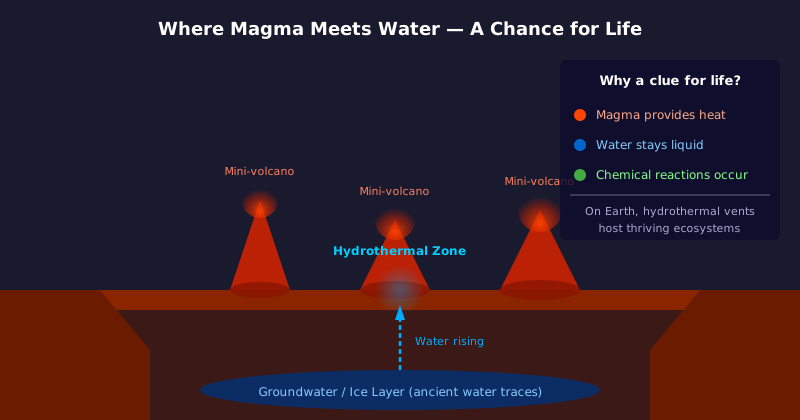
Hydrothermal vents on the deep ocean floor spew superheated water at temperatures that can exceed several hundred degrees Celsius. No sunlight reaches them. The pressure is crushing. And yet, tube worms, thermophilic bacteria, and a surprising variety of other organisms make their homes there — thriving entirely on chemical energy rather than sunlight.
The signs found at the bottom of Valles Marineris suggest that a similar hydrothermal environment once existed on Mars. Subsurface magma warming groundwater, which then rose to the surface as hydrothermal fluid: in that process, the kinds of chemical reactions that could give rise to life — or at least its precursors — have a chance to occur. Even if life never actually got started, the organic molecules and mineral patterns that such an environment produces might still be locked in the rock.
That said, one thing is worth keeping clear: “signs of the right conditions” is not the same as “signs of life.” This is a story about a place where the pieces were in place — nothing more, not yet.
Ancient Mars and the Origin of Life: A Remarkable Overlap in Time
Let’s step back and look at the timeline of Mars as a whole.
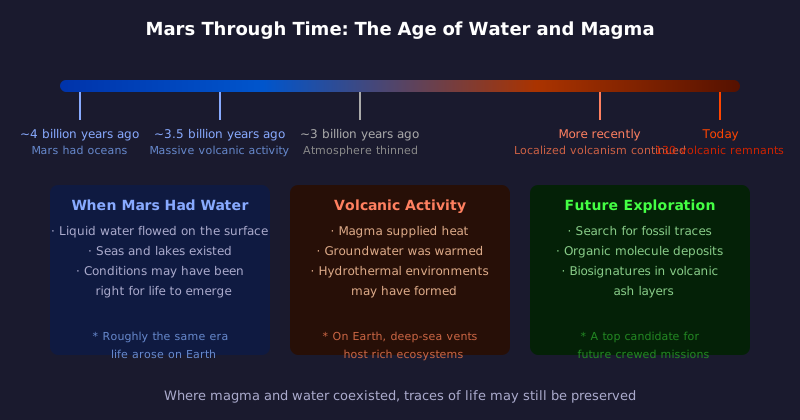
Around 4 billion years ago, Mars was warmer and wetter than it is today. Liquid water likely flowed across its surface, and seas or lakes probably existed. The atmosphere was probably much denser than the wisp of CO₂ that surrounds Mars today.
At roughly the same time, large-scale volcanism was in full swing. Olympus Mons — Mars’ shield volcano and the tallest known mountain in the solar system at about 25 km high, nearly three times the height of Everest — reached its peak activity during this era. Valles Marineris itself is a product of the crustal stresses from that same period.
Then, somewhere between 3.5 and 3 billion years ago, Mars lost its global magnetic field. Without it, the solar wind gradually stripped the atmosphere away. Water evaporated or retreated underground. The Mars we see today — a cold, desiccated desert — is what remained.
Here’s the part that’s hard to shake: Earth’s first life is thought to have appeared roughly 4 billion years ago, too. Ancient Mars and early Earth shared a similar window of conditions at almost the same moment in cosmic history. Life took hold on Earth; on Mars, so far, we’ve found nothing. One major factor separating their fates was likely Mars’ loss of its magnetic field and atmosphere.
But if life — or something approaching it — ever stirred on Mars, Valles Marineris and places like it are exactly where the evidence would be buried.
How Do You Spot a Volcano from Orbit?
Identifying small volcanoes you can’t physically visit takes some explaining.
Topographic data is the starting point. The Mars Orbiter Laser Altimeter (MOLA) maps the Martian surface to within a few meters of accuracy. Cinder cones have a distinctive shape — like an upside-down bowl with a sunken summit crater — that shows up clearly in elevation maps.
Thermal inertia data adds another layer. Rock holds heat differently from sand. Volcanic rock (lava) has a characteristic thermal signature, so measuring the temperature difference between day and night with an infrared camera gives scientists a way to read what kind of material covers the surface.
Then there’s spectral data. The Compact Reconnaissance Imaging Spectrometer for Mars (CRISM) detects minerals by the wavelengths of light they reflect. Hydrated minerals — those chemically altered by contact with water — and sulfates associated with volcanic activity can be mapped across the surface in detail.
The discovery in Valles Marineris came from layering all of this together. Subtle differences that would be invisible to the naked eye became clear when multiple sensor datasets were stacked on top of one another.
Why the Floor of Valles Marineris Is Special
Mars has volcanic features all over the place. So why does the canyon floor stand out?
Two reasons. First, depth. The bottom of Valles Marineris sits at lower elevation than the surrounding terrain, which means slightly higher atmospheric pressure — not much, but enough to marginally improve the conditions under which liquid water could persist. On a planet where the atmosphere is razor-thin, that small difference matters.
Second, preservation. The walls of the canyon act like the pages of a book, stacking and preserving ancient layers of rock in sequence. Just as geologists read the history of Earth’s environment from canyon walls, Valles Marineris holds a layered record of Mars’ past. If hydrothermal water once flowed across the canyon floor, the chemical record of that interaction could still be sitting at those contact zones, waiting to be read.
If a rover ever crossed that floor, who knows what it might find. Today’s Mars rovers — including Perseverance — are working Jezero Crater. No surface mission has yet targeted Valles Marineris directly.
Getting There Is the Hard Part
Landing at the bottom of Valles Marineris is not a simple proposition with current technology.
Deep canyons create real problems for spacecraft. Solar panels at the canyon floor receive less sunlight than they would on open plains, constraining power budgets. The canyon walls can interfere with communications between a lander and the relay satellites orbiting overhead. And the complex, irregular terrain makes identifying a safe landing site far more difficult.
Despite all that, the scientific case is strong. As a place to look for biosignatures, a site with confirmed hydrothermal activity holds at least as much promise as Jezero Crater — arguably more.
When human Mars exploration eventually becomes reality, Valles Marineris may be one of the places people walk. The view from the canyon floor would be unlike anything on the Martian surface: a little more air pressure, rock walls rising kilometers on either side. Standing there, searching the rock for traces of life that may have existed three to four billion years ago — it’s a strange thing to try to picture.
A Top Candidate in the Search for Ancient Life
The 130-plus mini-volcanoes and water traces found at the floor of Valles Marineris add a significant new location to Mars’ roster of astrobiologically interesting sites. An environment where both magma and liquid water were present mirrors exactly the kind of setting — hydrothermal vents — where life flourishes in Earth’s deep oceans.
That doesn’t mean life is there. Confirming it would require collecting and analyzing samples on the ground, something no mission has yet done at this site. Remote sensing from orbit has its limits.
But the search for life begins with deciding where to look. Valles Marineris has just moved up that list. The fact that ancient Mars had conditions strikingly similar to early Earth — at almost the same point in time, when life was just getting started here — is enough to make you stop and think.