Saturday night, April 13, 2029.
Across the night skies of Africa and Europe, an unfamiliar dot is on the move. It glows at about third magnitude — not dazzling, but unmistakably there. Watch for five minutes and you’ll notice it has shifted against the background stars. That moving point is the asteroid Apophis.
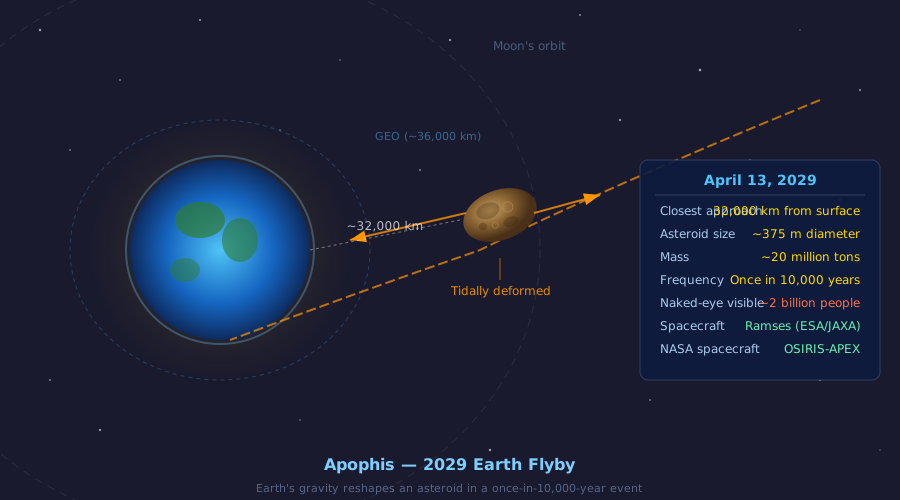
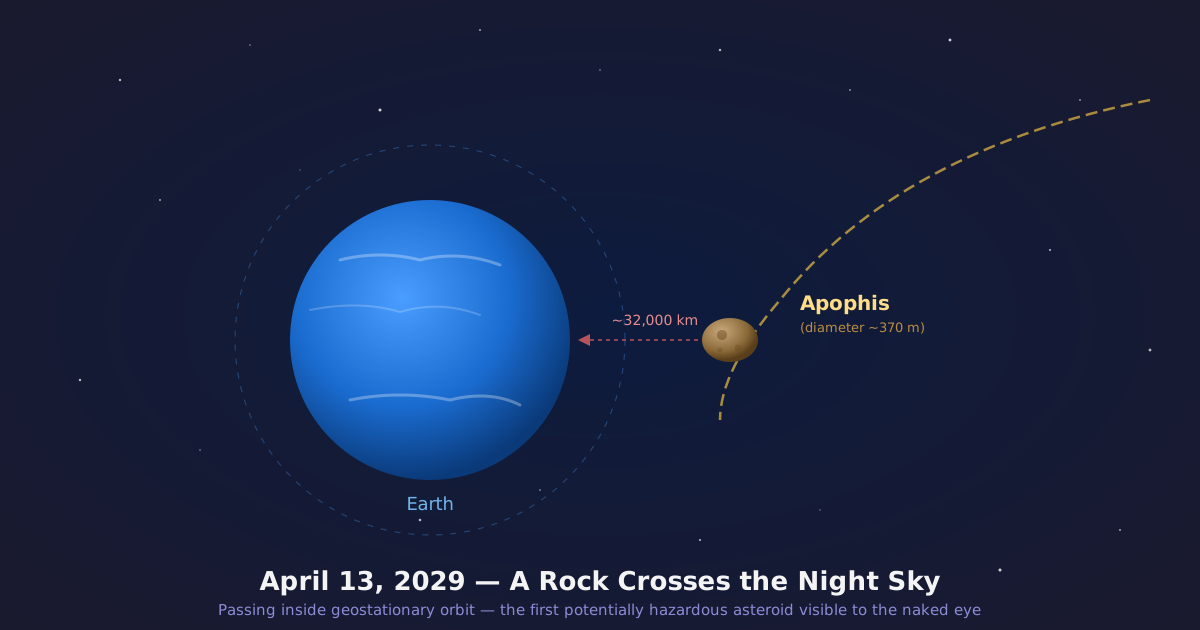
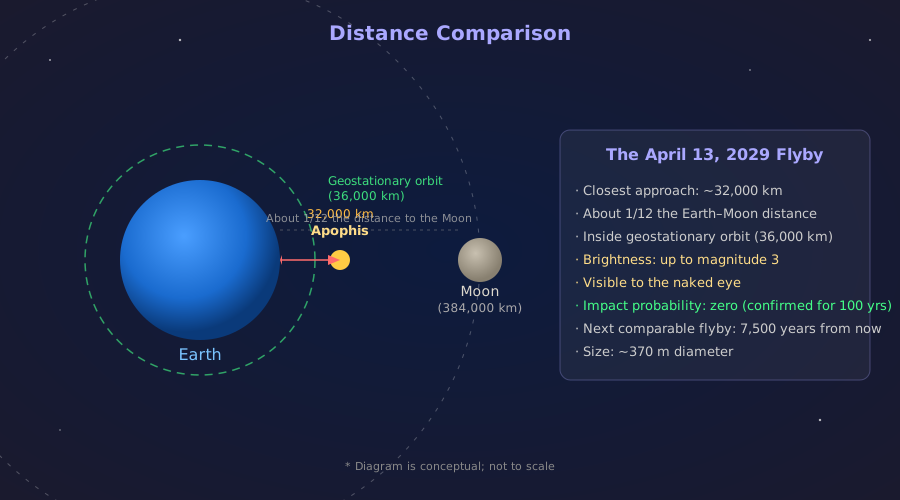
A boulder roughly 370 meters across will pass just 32,000 kilometers from Earth. That’s one-twelfth the distance to the Moon — and less than the altitude of geostationary satellites, which orbit at around 36,000 km. According to observers, no rock this size has ever passed this close within recorded history.
Why It Earned the Name “Hazardous”
For a long time, Apophis carried the official label “potentially hazardous asteroid.” When it was discovered in 2004, early orbital calculations put the probability of a 2029 impact at 2.7 percent. That might sound modest, but in the world of near-Earth objects, it’s extraordinarily high — most entries on hazard watchlists sit at 0.001 percent or lower.
Astronomers scrambled for follow-up observations. By 2006 the 2029 impact scenario had been ruled out, but a new concern surfaced: if the 2029 flyby altered Apophis’s orbit, could it be nudged onto a collision course for 2036? That worry was put to rest in 2013. Today, scientists have confirmed zero collision risk for at least the next century.
Even so, the “dangerous rock” reputation stuck — partly because the name feeds it. Apophis is drawn from Egyptian mythology as a god of chaos, sometimes rendered in English as the “God of Chaos.” Researchers themselves kept double-checking every new dataset, almost unable to believe the numbers kept clearing. It took years before the community fully relaxed.
What Will Actually Happen on April 13, 2029
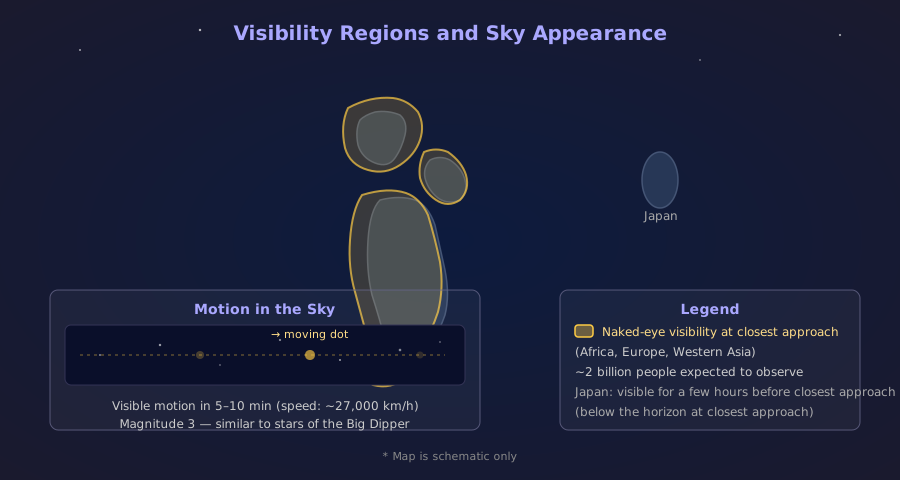
For observers in Japan, the moment of closest approach falls around 6:46 a.m. on April 14 (JST) — just as dawn breaks. That means Japan gets a viewing window in the hours before closest approach, but loses Apophis below the horizon at the critical moment. Europe and Africa get the front-row seats.
From those regions, Apophis will appear as a stellar point drifting across the sky at roughly 27,000 km/h. That speed is key. Watch for five to ten minutes and you can see it move — no tracking mount needed. Compare that to meteors, which vanish in under a second, or planets, which require days of observation to register any shift. A naked-eye asteroid moving visibly in real time is something no living person has witnessed before.
Peak brightness reaches around magnitude 3, comparable to the stars of the Big Dipper. Even from moderately light-polluted cities, a clear night should be enough. Estimates suggest roughly 2 billion people could step outside and see it.
Why Researchers Are Even More Excited Than Tourists
The public-facing appeal is obvious, but scientists have a completely different reason to pay attention.
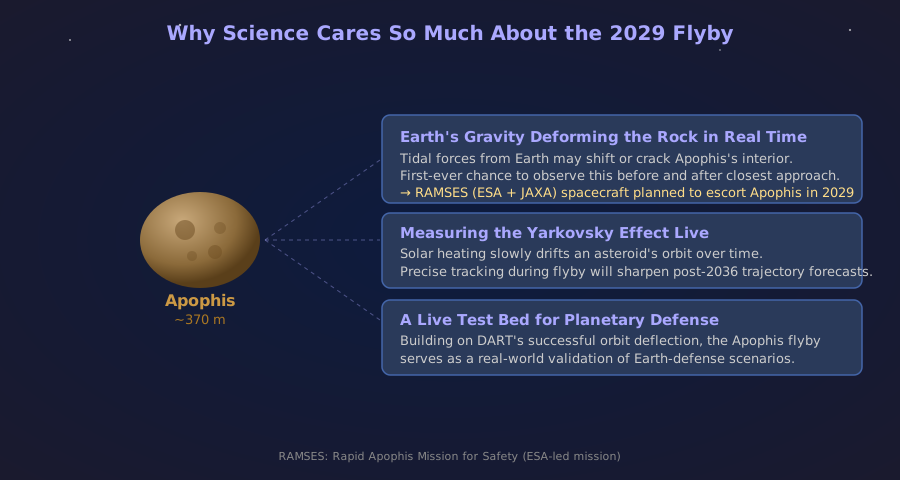
When a body this large passes this close to Earth, our planet’s gravity doesn’t just bend its path — it physically stresses the rock. Tidal forces can shift, fracture, or partially collapse the internal structure of an asteroid during a close flyby. We’ve never had the chance to monitor that process on a large object, before and after, with modern instruments. The 2029 pass gives us exactly that window.
The second scientific prize is the Yarkovsky effect. As sunlight warms an asteroid and heat radiates away, the uneven emission acts as a tiny thruster, slowly drifting the orbit over time. Precisely measuring how much the Yarkovsky effect is nudging Apophis during this flyby will dramatically sharpen predictions for its orbit beyond 2036.
ESA and JAXA have jointly conceived a spacecraft called RAMSES — Rapid Apophis Mission for Safety — aimed at reaching Apophis before the 2029 encounter and riding alongside it through the flyby. The goal includes close observation of the surface and potentially a landing. A spacecraft accompanying an asteroid while Earth’s gravity reshapes it would be, in the words of mission planners, essentially unprecedented.
Just How Big Is 370 Meters?
The number can feel abstract. Here’s a frame of reference: Tokyo Tower stands 333 meters tall. Apophis is a bit bigger than that, traveling at 7.4 km per second — more than 80 times the top speed of a bullet train.
Scientists have naturally run the impact calculation, even though impact is off the table. If this rock were to hit Earth, it would release energy equivalent to roughly 1.1 billion tonnes of TNT — about 70,000 times the Hiroshima bomb. Within a radius of several tens of kilometers, destruction would be total. Atmospheric dust would affect the climate for years. It’s nowhere near the scale of the Chicxulub impactor that ended the dinosaurs (roughly 10 km across), but it falls squarely in the “regional catastrophe” category.
Knowing all that, and knowing it won’t hit, changes how you look at it. There’s a meaningful difference between watching an anonymous light move across the sky and watching it knowing: that’s a rock the size of Tokyo Tower, doing 80 times bullet-train speed, close enough that satellites are farther away. The experience becomes something else entirely.
Because It Won’t Hit, We Can Actually Enjoy It
When Apophis was first discovered, headlines worldwide went straight to panic. 2004 was still the early era of internet news cycles, and “asteroid may hit Earth” traveled fast. Once the all-clear came, the story quietly flipped: what had been a source of dread became one of the most anticipated astronomical events of the century.
That reversal matters. Because there’s no danger, people can travel to see it. Researchers can send spacecraft. The entire encounter — approach, flyby, departure — becomes a scientific festival rather than an emergency. A threat that became a spectacle is, in planetary defense terms, about as textbook an outcome as you could hope for.
According to current orbital models, the next time an asteroid of comparable size passes this close to Earth will be roughly 7,500 years from now. Seven and a half millennia ago, humans were only just beginning to farm. That’s the scale of rarity we’re talking about — and it’s happening on a Saturday night in April 2029.
Viewing from Japan
The closest-approach moment itself will occur below Japan’s horizon, but Apophis should be trackable for several hours before that — from late on April 13 into the pre-dawn hours of April 14. Look to the eastern sky. With a clear night and binoculars, you have a real shot at finding it.
The catch is timing. Apophis brightens sharply as it approaches and then fades just as quickly. Peak naked-eye brightness lasts only a few hours; before and after that window, you’ll need a telescope. If you want the most dramatic view, the honest answer is: go to Europe or Africa. Travel companies have reportedly started packaging “asteroid-watching” tours — which is simultaneously the most extravagant and most quietly strange reason to book a flight.
JAXA and the National Astronomical Observatory of Japan will release detailed finder charts and coordinates as 2029 approaches. Three years is plenty of time to put it on the calendar.
I’ll be honest about what interests me most personally: I want to know what it feels like to actually see it move. Not a meteor, not a planet — a 370-meter rock, visibly drifting across a sky shared by 2 billion other people watching the same thing. That’s going to be a strange, hard-to-describe night.
Further reading
ESA continues to publish updated details on the Apophis flyby and the RAMSES mission concept. The latest on planetary defense planning is available through ESA’s Planetary Defence Office.