Honestly, when I first heard this, my reaction was: “Wait — those boring little stars?”
Red dwarfs are the most common stars in the universe. Small, dim, invisible without a telescope. And yet they’ve been quietly devouring their own planets. The evidence? An unremarkable element called lithium.
In May 2026, a research team from Keele University and the University of Exeter published a study in a Royal Astronomical Society journal that is reshaping our understanding of planet formation.
What Are Red Dwarfs, and Why Should You Care?
More than 75% of all stars in the night sky are red dwarfs.
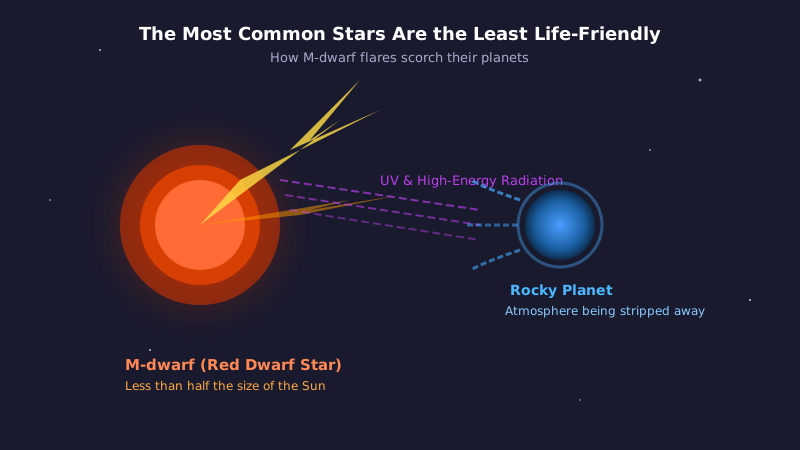
They weigh between 8% and 60% of our Sun’s mass, with surface temperatures below 3,700 K. They look like faint, orange-red dots — never bright enough to see with the naked eye. But “boring” doesn’t mean “uninteresting.” Their internal structure is actually fascinating.
Ordinary stars have a core and an outer envelope that don’t mix much. The Sun works this way. Red dwarfs, however, are fully convective — their entire interior churns like a pot of boiling water, with material from the inside constantly cycling up to the surface.
This turns out to be the key to the whole discovery.
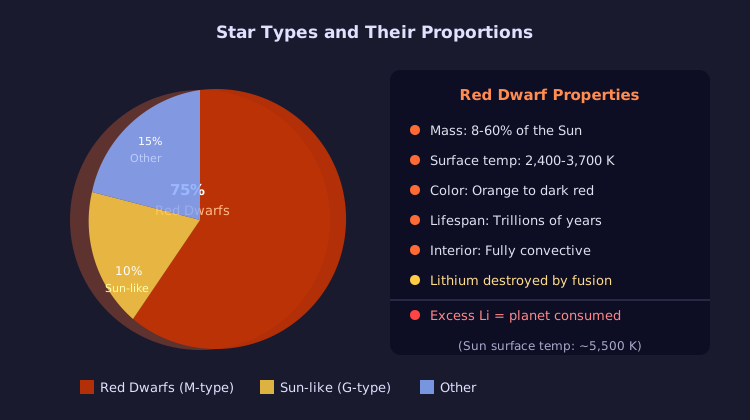
Red dwarfs also live for an absurdly long time. While the Sun will burn out in about 10 billion years, some red dwarfs can keep going for trillions. The universe is roughly 13.8 billion years old — meaning not a single red dwarf born since the Big Bang has died of old age yet.
How Lithium Becomes Evidence of a Meal
Here’s where lithium enters the picture.
Lithium is a light element, created in small amounts during the Big Bang alongside hydrogen and helium. When a star forms, it pulls in some of this primordial lithium. But here’s the critical point: inside red dwarfs, temperatures are high enough that lithium gets destroyed rapidly through nuclear fusion.
In a fully convective red dwarf, even lithium on the surface eventually gets dragged into the core and consumed. So when you look at a normal red dwarf’s spectrum, lithium lines are either absent or extremely weak.
“And yet, red dwarfs with too much lithium were found.”
That’s what the research team discovered.
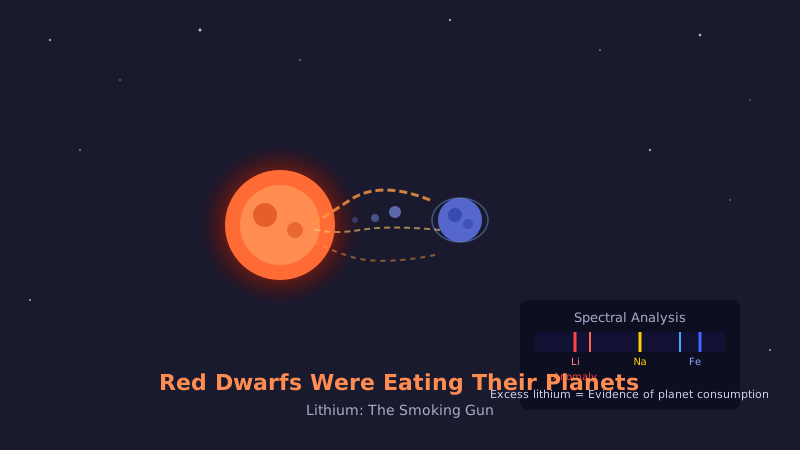
Using the Gaia-ESO Survey (GES), they analyzed the spectra of thousands of stars. In three young star clusters, they found six red dwarfs with abnormally strong lithium signatures — concentrations that shouldn’t exist under normal circumstances.
The explanation is straightforward: lithium was replenished from outside. Planetary material contains lithium along with rock and metal. If a star swallows a planet, that lithium gets mixed into the star. In a fully convective red dwarf, it quickly rises to the surface — detectable through spectroscopy.
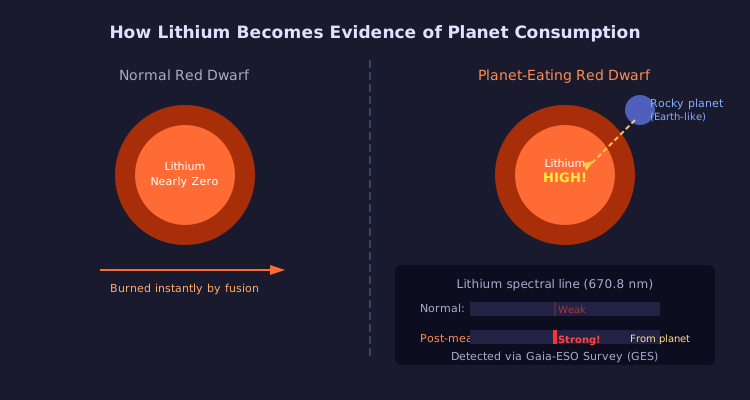
The team’s calculations suggest each of the six red dwarfs absorbed planetary material equivalent to 3 to 10 Earth masses. That’s 3 to 10 Earths, swallowed whole.
Why Do Planets Fall Into Their Stars?
It’s tempting to think planets orbit stably by default, but “not falling in” is actually the result of specific conditions being met.
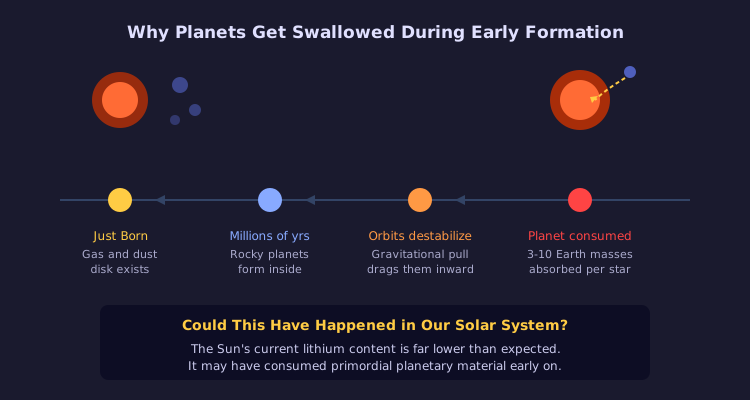
In the early days of a planetary system, plenty of gas and dust is still floating around. Planets forming in this environment can enter periods of orbital instability. Rocky planets on inner orbits are particularly vulnerable — gravitational perturbations and tidal forces can gradually shrink their orbits.
This is called “orbital migration.” A planet slowly spirals inward, gets its atmosphere stripped away as it approaches too close, and is eventually absorbed entirely. Theorists predicted this long ago, but direct evidence in red dwarfs had been elusive until now.
Notably, the six stars in this study aren’t in any special situation — they’re ordinary red dwarfs that simply happen to have extra lithium. The researchers suggest this may be a standard process. In other words, eating planets might be a routine part of a red dwarf’s life.
Our Sun May Have Done the Same Thing
Here’s where it gets personal.
The Sun’s current lithium content is roughly one-hundredth of what it had at birth. Some of this drop is explained by nuclear fusion, but not all of it — a gap that astronomers have noted for years.
The red dwarf discovery lends indirect support to the hypothesis that the Sun also consumed planetary material early in its history. The Sun isn’t fully convective like a red dwarf, so the evidence wouldn’t be as clean. But if some primordial planets in the inner solar system fell into the Sun, it could help solve the lithium puzzle.
For the record, Earth and Mars are safe. Their stable orbits are no accident — Jupiter acts as a gravitational shield, keeping disruptive objects at bay.
Reading a Star’s “Dining History” — A New Kind of Astronomy
Reading elemental compositions from stellar spectra isn’t new — the technique dates back to the 19th century. But systematically confirming “excess lithium = evidence of planet consumption” across this many stars is essentially a first.
The Gaia-ESO Survey used the European Southern Observatory’s large telescopes to collect spectra from tens of thousands of stars. Individually, each data point looks like routine elemental bookkeeping. Analyzed together, they reveal which stars have eaten planets.
As one team member put it: “We’re essentially reading the ledger of a star’s past meals.” That’s a good way to put it.
As larger surveys follow, we’ll eventually have statistics on how frequently different types of stars consume planets. That feeds directly into a bigger question: how common are planetary systems where life could survive?
The Quiet Stars Had the Biggest Drama All Along
Red dwarfs are small, dim, and unremarkable. You can’t see them with the naked eye, and even through a telescope they lack the Sun’s dramatic flair. But they outnumber every other type of star, and inside each one, a quiet drama over the fate of planets plays out.
“Common and unremarkable” often turns out to be central to how the universe works. What lithium in red dwarfs taught us is that the relationship between a star and its planets isn’t “stable by default.”
The fact that Earth is still in its orbit is, when you think about it, a pretty remarkable thing.