On May 26, 2026, NASA held a press conference and said it plainly: “The lunar base will be humanity’s first outpost on another world.”
The conference wrapped up in about thirty minutes. But what was announced was more concrete than many expected. This wasn’t some vague “we’ll get to it eventually” statement — NASA said the first payload would be delivered to the Moon this coming fall. It’s been more than fifty years since Apollo ended. And finally, the conversation has shifted from “going back to the Moon” to “living there.”
What’s Happening This Fall
Let’s start with what’s actually planned for 2026.
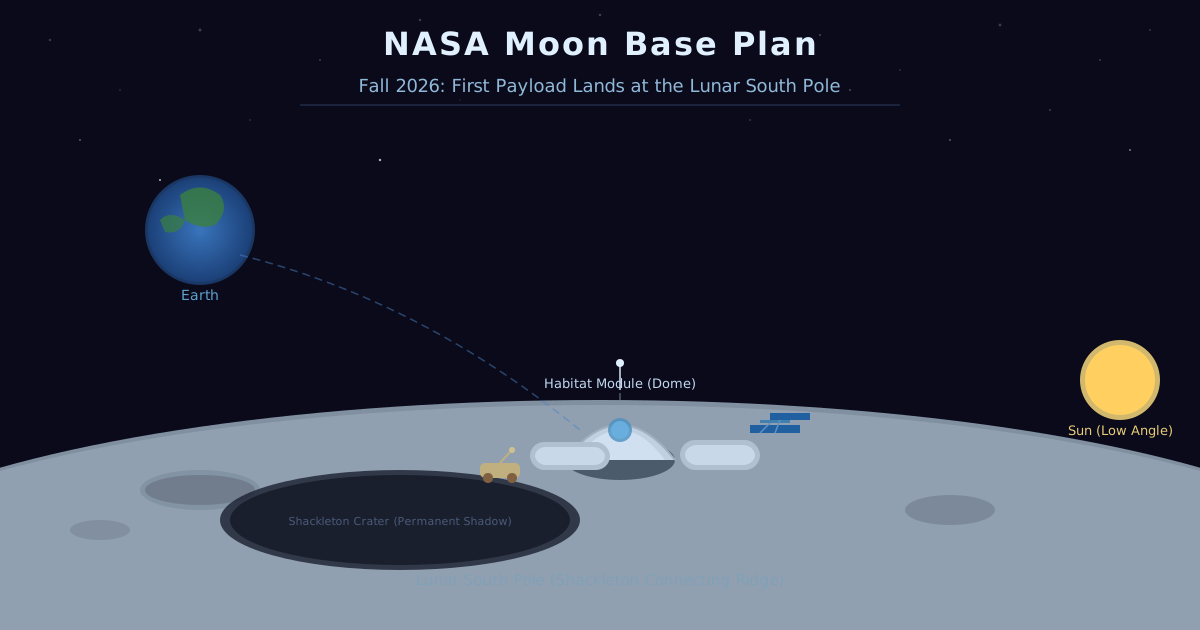
NASA intends to use Blue Origin’s Blue Moon Mk1 Endurance lander to deliver the first payload to the lunar south pole in what it’s calling the Moon Base I mission. This one will be uncrewed — robots go first. The lander can carry roughly three metric tons of cargo, about the same as a typical resupply run to the International Space Station, which gives you a sense of the scale.
What’s in that first delivery? Solar panels, a communications relay, and an array of sensors to study the soil and local environment. In other words: establish power, set up communications, and survey the terrain. Think of it like moving into a new place — first you get the electricity switched on and figure out the layout.
The landing site is a location called Shackleton Connecting Ridge — a rim area on the edge of a famous crater. The name isn’t widely known outside space circles, but it’s been a prime candidate for a lunar base for years.
A look at the map makes it obvious why.
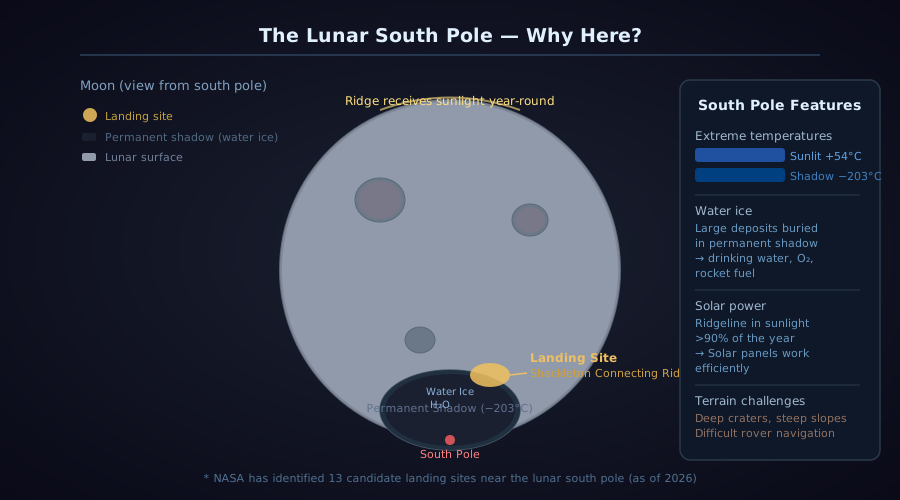
Close to the lunar south pole, there are regions called permanently shadowed areas — zones where sunlight has never reached. The temperature at the bottom of these craters sits around −203°C. For reference, the coldest temperature ever recorded on Earth was −89°C in Antarctica. These shadowed craters make that look balmy. But beneath that frozen surface, enormous deposits of water ice are waiting.
Meanwhile, the ridgelines above the craters receive sunlight more than 90% of the year — ideal real estate for solar panels. The dark, frigid crater floor holds the water ice; the bright ridge above it holds the energy. Shackleton Connecting Ridge sits right at the intersection of both.
That’s the moment when a space plan stops feeling arbitrary and starts feeling almost elegant.
A Seven-Year Build
Moon Base I this fall is just the opening move. In 2027, Astrolatic’s Griffin lander is scheduled to make a follow-up delivery run under Moon Base II. Then in 2028, a mission called MoonFall plans to deploy four drones. These uncrewed missions stack up one after another, building toward a crewed Artemis landing around 2028 — and then a first long-term stay by 2032.
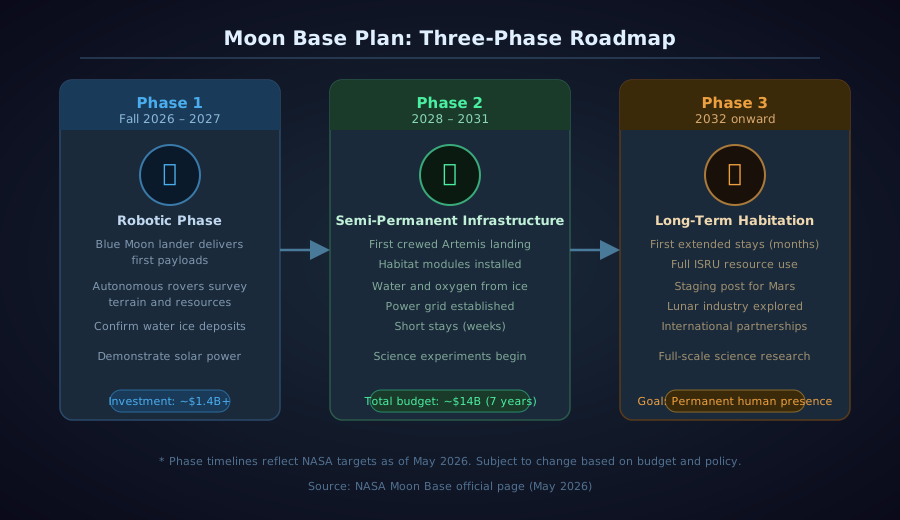
The total investment runs to something like $14 billion over seven years — a number that sounds enormous until you compare it to something else. The ISS costs around $3 billion a year just to operate, and the broader Artemis program has already run into the hundreds of billions. Seen in that context, the moon base budget is almost surprisingly modest.
”If You Can Make It There, You Don’t Have to Haul It from Earth”
At the heart of this plan is a concept called ISRU — In-Situ Resource Utilization. The idea is straightforward: use what’s already on the Moon.
Shipping a single metric ton of supplies from Earth to the Moon costs several billion dollars. Food, water, air, fuel, building materials — if everything has to come from Earth, the cost becomes genuinely astronomical (in every sense of the word). So NASA’s vision for the lunar base is one that grows progressively less dependent on Earth.
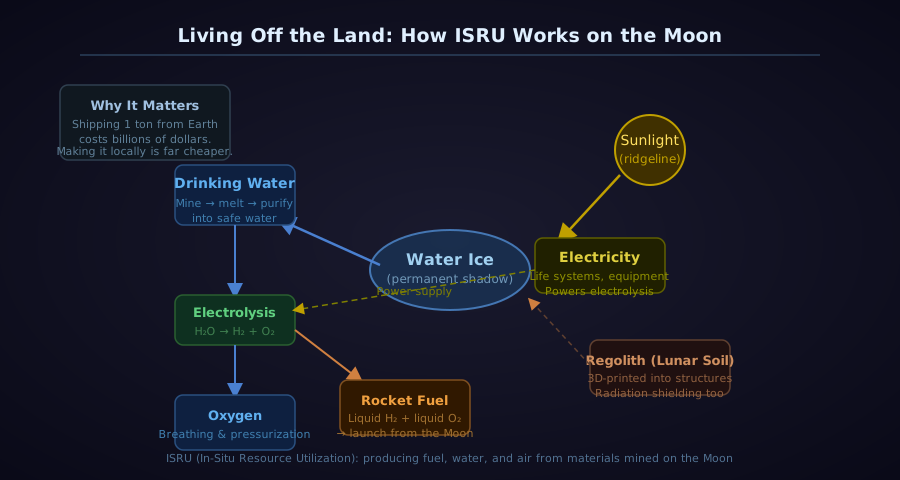
Mine the water ice from the permanently shadowed craters and melt it, and you have drinking water. Electrolyze that water and it splits into oxygen and hydrogen — oxygen for breathing, hydrogen for rocket fuel. Lunar regolith, the fine soil covering the Moon’s surface, can be fed into 3D printers to produce structural materials, and piled up as radiation shielding. Everything connects.
That said, honesty is warranted here: all of this is still in the planning stage. Nobody has actually mined water ice on the Moon, purified it into drinking water, or electrolyze it in that environment. The Moon is nothing like Earth — gravity is one-sixth, there’s no atmosphere, and temperatures swing more than 300°C between day and night. Technology that works fine in a factory on Earth isn’t guaranteed to work on the lunar surface. That’s exactly what the uncrewed missions of the 2020s are designed to test, one step at a time.
The Geopolitical Side No One Likes to Talk About
Any serious discussion of a moon base has to include the bigger strategic picture.
China and Russia are jointly developing the International Lunar Research Station (ILRS), with plans for a crewed mission to the lunar south pole in the 2030s. China’s Chang’e 7 is expected to head to the south pole sometime around 2026 or 2027 to search for water. Chang’e 6 brought back samples from the lunar far side in 2024 — something no mission had done before — and China’s lunar program has been building a steady track record.
Some researchers point out that one of NASA’s reasons for accelerating the Artemis program is a fairly pragmatic calculation: the best spots on the Moon may go to whoever gets there first. International space law prohibits any nation from owning the Moon, but the physical fact of having landed and built something carries its own kind of influence.
“There are no borders in space” is technically true. But “therefore there’s no competition” is not. The moon base plan carries real geopolitical weight alongside its scientific ambitions.
Visiting Versus Staying
The simplest way to describe the difference from Apollo: Apollo planted flags and came home. This plan is about building infrastructure and remaining.
Apollo 17’s final moonwalk was in 1972. For more than fifty years after that, no human set foot on the Moon. The Artemis program was conceived as an attempt to end that silence — but what NASA announced in May 2026 goes a step further. By using the term “lunar base” and committing to long-term habitation, it’s pointing in a specific direction.
If the first extended stay happens in 2032 as planned, it would likely be recorded as the moment humanity began living in space. But between now and then, multiple uncrewed missions have to succeed. The Moon Base I payload this fall is just the first move.
Plans rarely go exactly as scheduled. Budgets get cut. Administrations change priorities. But when the Blue Moon lander touches down at the lunar south pole this autumn, there’s a decent chance it will feel like the beginning of something — the first foundation of what might one day be humanity’s second home.
The moon base is not science fiction. It starts in 2026.
For a short story set on the Moon in that future, check out “First Day at the Lunar Base”