Say the name “Artemis III” out loud, and most people picture the same thing: boots on the Moon. The first human footprints there since Apollo, half a century ago.
But the mission NASA announced on June 9, 2026, doesn’t work that way. The four astronauts selected for Artemis III won’t land on the Moon.
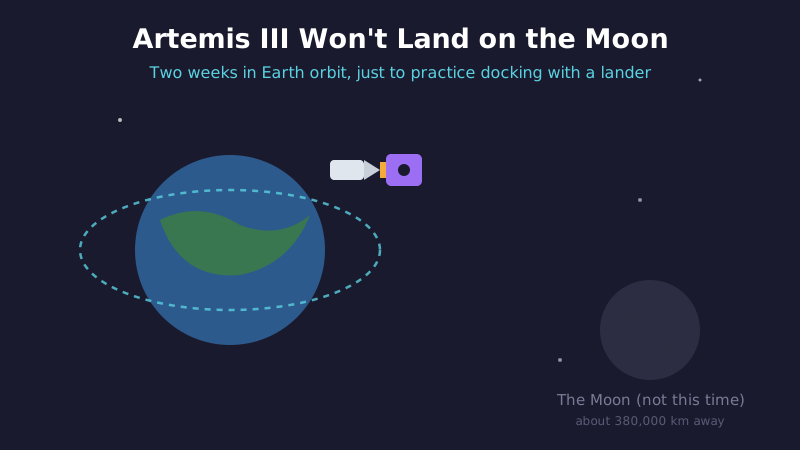
They won’t even get close to it. What they’ll actually do is circle Earth, practicing docking maneuvers with another spacecraft. That’s it. A mission branded as a Moon landing turns out, on closer inspection, to be an Earth-orbit mission.
So how did things end up this way? The answer says a lot about what spaceflight actually looks like behind the scenes — unglamorous, but essential.
Four astronauts, and none of them are landing on the Moon
Let’s start with what was actually announced.
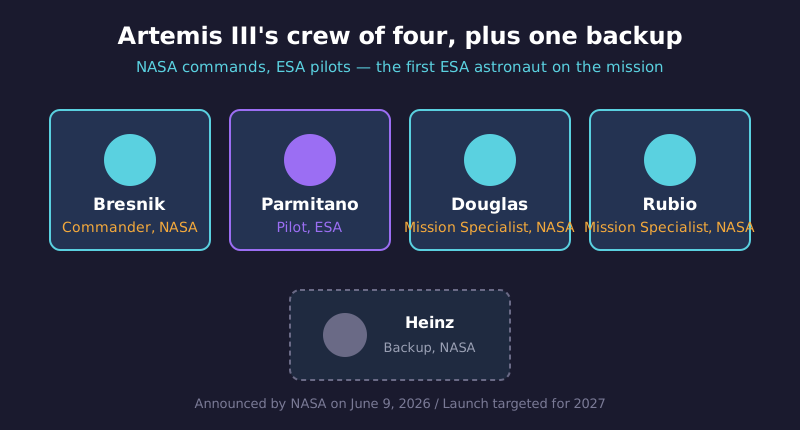
On June 9, NASA revealed the four crew members for Artemis III. Randy Bresnik of NASA will command the mission, with Luca Parmitano of the European Space Agency (ESA) as pilot. The remaining two seats go to NASA’s Andre Douglas and Frank Rubio. Bob Hines will serve as backup.
One detail stands out immediately: an ESA astronaut is on the crew. According to NASA, this marks the first time the agency has assigned an ESA astronaut to an Artemis mission. Europe builds the European Service Module, which powers the Orion spacecraft — and that contribution has finally translated into a seat on board.
Here’s where it gets strange, though. These four astronauts have the honor of flying toward the Moon, yet none of them will ever touch it.
Launch is targeted for 2027. Once aboard Orion, the crew will orbit Earth for roughly two weeks before splashing down in the Pacific Ocean. The Moon sits about 380,000 kilometers away — far enough that a bullet train running nonstop would take more than a month to cover the distance one way. The crew won’t get anywhere near that journey’s starting line. They’ll stay roughly nine Earth-circumferences away from where the action eventually happens, in a spot where the Moon is nothing more than a pale dot in the sky.
So what exactly will they be doing for those two weeks? That’s the real story here.
The entire mission is a docking test
Artemis III’s primary job is to prove that two spacecraft can connect in space.
Landing humans on the Moon takes more than Orion, the capsule that carries the crew. You also need a separate lander built specifically to touch down on the surface. Apollo solved this by launching the lander attached to the main spacecraft. This time, NASA is doing it differently: Orion and the lander launch separately, then meet and dock in space.
The catch is that NASA isn’t building the lander itself.
That job has been handed to two private companies, Blue Origin and SpaceX. Blue Origin is developing a lander called Blue Moon, while SpaceX is adapting its Starship for lunar touchdowns. Before trusting either vehicle near the actual Moon, NASA wants to put it through its paces first.
Splitting the work between two companies is also a hedge. If one falls behind schedule, the other can pick up the slack and keep the program moving. Running two competing landers in parallel costs NASA more money, but it’s a bet designed to make sure something — anything — actually gets the agency to the Moon.
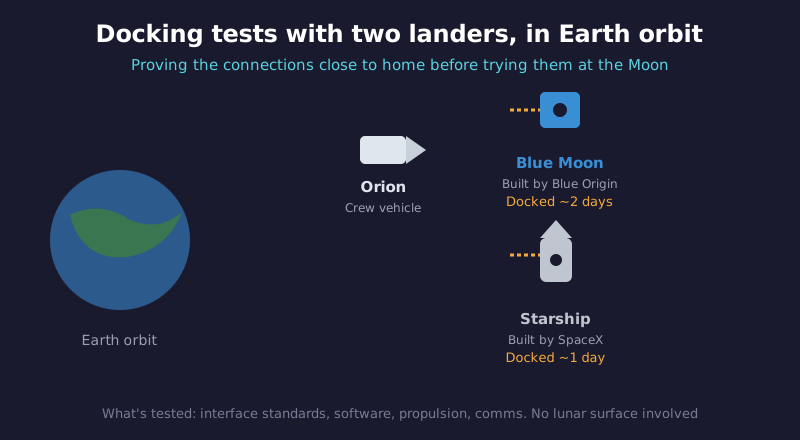
That’s why the test happens in Earth orbit. NASA’s plan has Orion rendezvous with test versions of both companies’ landers while still circling our planet, demonstrating docking along the way. The Blue Origin lander stays connected for about two days of testing, while the SpaceX Starship gets roughly a day of checkout.
Nothing about this is flashy. NASA is essentially checking whether the connecting hardware lines up correctly, whether the software talks to itself properly, and whether propulsion and communication systems behave as designed. In NASA’s own words, the goal is to integrate and test the Orion and lander hardware together — bolting together products from two completely different manufacturers in the harshest environment imaginable. If a mismatched phone charger cable is annoying on Earth, imagine trying to solve that problem in orbit.
Unglamorous. Almost aggressively so.
But think about the alternative. Imagine attempting this docking for the very first time 380,000 kilometers from home, only to discover the interfaces are off by a millimeter. There’s no redo out there. And there are people on board.
The idea of “one more dress rehearsal before the real thing”
This is the part of the plan I find most interesting.
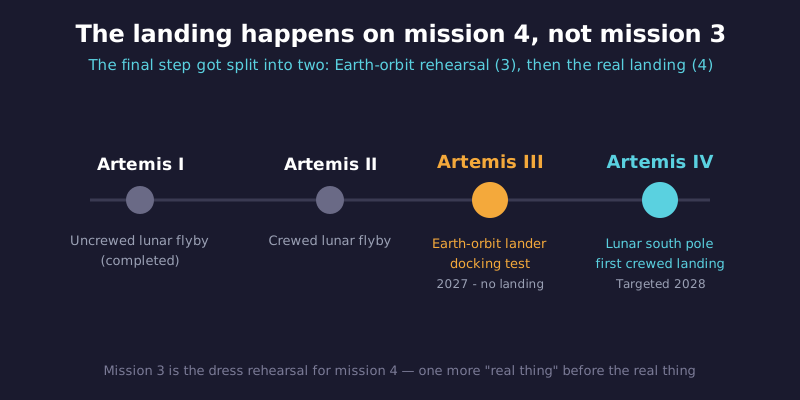
Intuitively, you’d expect Artemis III to be the big finale — the landing — with Artemis I and II serving as warm-ups. And that tracks with what actually happened: Artemis I flew uncrewed around the Moon, and Artemis II carried a crew on a lunar flyby. Each step raised the difficulty a notch, in a logical sequence anyone could follow.
Except NASA split that final, hardest step into two separate missions.
First comes the lander docking test, conducted safely near Earth (Artemis III). Then comes the actual version of that same maneuver, performed near the Moon (Artemis IV). It’s as if NASA inserted one more “real mission” right before the real mission.
Why test in Earth orbit specifically? Because it’s close. If something goes wrong, the crew can be back on the ground within hours. Run the same experiment near the Moon and a failure could mean a return trip lasting days. Given the stakes, it makes sense to keep the riskiest “first time” close enough to home that help is never far away.
NASA itself describes this flight as essential groundwork for Artemis IV — the mission slated for 2028 that will put humans on the lunar south pole for the first time. In other words, Artemis III exists purely as a dress rehearsal for the actual landing.
I’ll admit that when I first learned about this sequencing, the numbering felt off. Shouldn’t the landing be mission three, not four? But as a matter of engineering discipline, it actually makes perfect sense.
Aircraft mechanics tear an engine apart and rebuild it before trusting it to fly. Chefs taste a dish before sending it to the table. The higher the stakes, the more layers of small rehearsals come before the real performance. Artemis III is essentially that taste test, conducted on the scale of an entire space program.
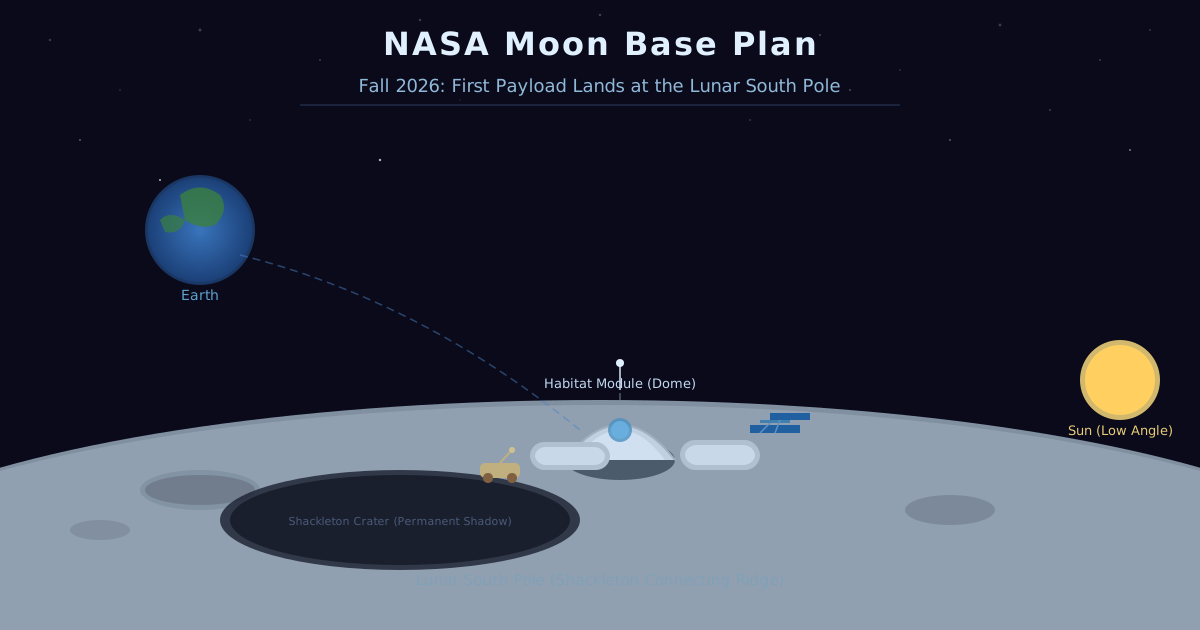
There’s also a reason behind targeting the south pole specifically. Scientists believe ice sits frozen at the bottom of permanently shadowed craters there — water that could become drinking supplies, or be split into oxygen and fuel. Precisely because that resource matters so much, the docking rehearsal leading up to it can’t afford a single failure. Artemis III’s unglamorous checklist is, in its own way, laying the groundwork for the day humans go looking for water on the Moon.
Maybe rehearsal is what spaceflight actually is
Let’s zoom out for a second.
We mostly encounter space exploration through headlines: “Moon landing succeeds,” “Mars rover arrives.” It’s easy to come away thinking spaceflight is one triumphant moment after another.
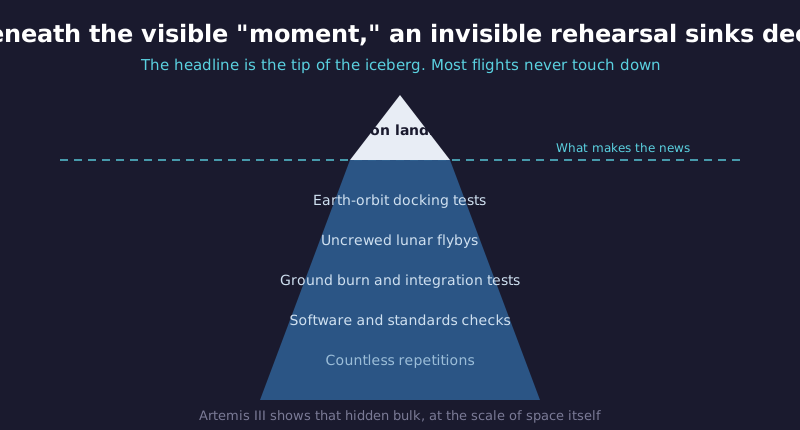
The reality runs in the opposite direction. Those headline moments are the tip of the iceberg, and an enormous mass of rehearsal sits submerged beneath them — ground-based burn tests, uncrewed orbital flights, docking run-throughs. Missions like Artemis III, which exist to prepare for a landing without actually landing, make up most of that hidden bulk.
And honestly, none of this is unique to space.
A play has a dress rehearsal before opening night. Surgeons run through procedures in simulation, sometimes many times over. Behind nearly every “moment that worked” we witness in daily life, there’s usually a pile of unseen repetition holding it up. Artemis III simply makes that structure visible — at the scale of an entire planet.
It’s worth noting, too, that flying the rehearsal mission isn’t a loss for the crew involved. Whatever this team learns from successfully docking with a lander in Earth orbit gets passed directly to the team that eventually lands on the Moon. Someone clears the path first, and someone else walks it afterward. That’s how spaceflight programs actually move forward — one handoff at a time.
It would be understandable if these astronauts felt a pang of frustration. The honor of being first to walk on the Moon in fifty years will belong to whoever flies next, not to them.
Still, what they’re doing is the work that makes that future honor real. Two weeks circling Earth, checking every interface standard one by one. Stack enough of that work up, and by 2028, someone will leave footprints at the lunar south pole.
In 2027, nobody will set foot on the Moon — and yet that’s exactly where the Moon landing begins. The unglamorous checklist these four astronauts run high above Earth is, quietly, the first step toward humanity’s next set of lunar footprints.