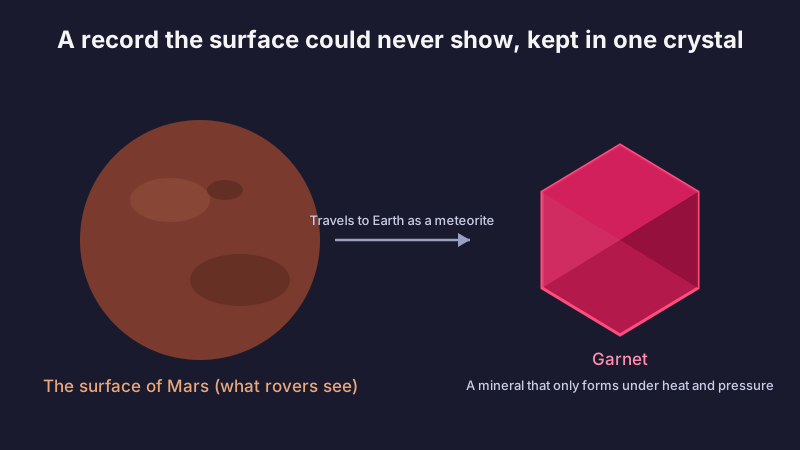
No matter how far a rover drives across the Martian surface, it can never tell you what happened deep underground. Rovers only ever touch the surface.
But in June 2026, scientists managed to read that supposedly invisible underground record anyway, from a rock that had been sitting in a museum drawer on Earth. The key turned out to be a tiny mineral crystal, barely visible to the naked eye.
Inside the Martian meteorite NWA 8171, researchers confirmed the first garnet ever identified in a rock from Mars.
The surface alone can’t tell you how deep a planet’s story goes
When we picture Mars exploration, we usually imagine a rover crawling across red dirt, photographing sand, rocks, and craters. All surface scenery.
But most of a planet’s history isn’t written on its surface. It’s recorded underground, in how much heat built up and how hard the rock got squeezed deep in the crust. No amount of photographing the ground will ever surface that record.
So how do you find out what’s happening at depth? On Earth, you just dig a hole. On Mars, it’s not that simple.
Some rovers carry drills, but they barely scratch beneath the surface. The deep crust remains completely out of reach for any tool humanity has sent there.
So how did scientists learn about Mars’s interior this time? They didn’t dig. Instead, a piece of that interior flew to Earth on its own.

Pieces of Mars have already landed on Earth
The phrase “Mars meteorite” might sound like something out of a special recovery mission. It isn’t.
Long ago, a large object slammed into Mars. The impact blasted rock fragments into space, where they drifted for ages before some of them got caught by Earth’s gravity and fell to the ground. Mars has effectively been shipping us free samples for billions of years.
NWA 8171, the star of this story, is one of those samples. The name comes from “Northwest Africa,” the region where it was found; meteorites discovered there get numbered this way.
The rock now sits in the collection of the Royal Ontario Museum in Canada. The new study, led by Tanya Kizovski and colleagues at Brock University, appeared in the journal Geochemical Perspectives Letters in June 2026. Researchers from the University of Portsmouth in the UK and the University of Trieste in Italy also contributed.
According to the team, this single specimen may currently be the only garnet-bearing Martian rock available for study anywhere on Earth.
Just one. That scarcity is exactly why scientists are handling it so carefully, for reasons we’ll get to shortly.
Garnet acts like a built-in thermometer for depth
Here’s where things get genuinely interesting. Why can a single garnet crystal tell you anything about a planet’s hidden history?
Garnet belongs to a category called metamorphic minerals. “Metamorphic” simply means the original rock got transformed into a different mineral after being exposed to intense heat and pressure.
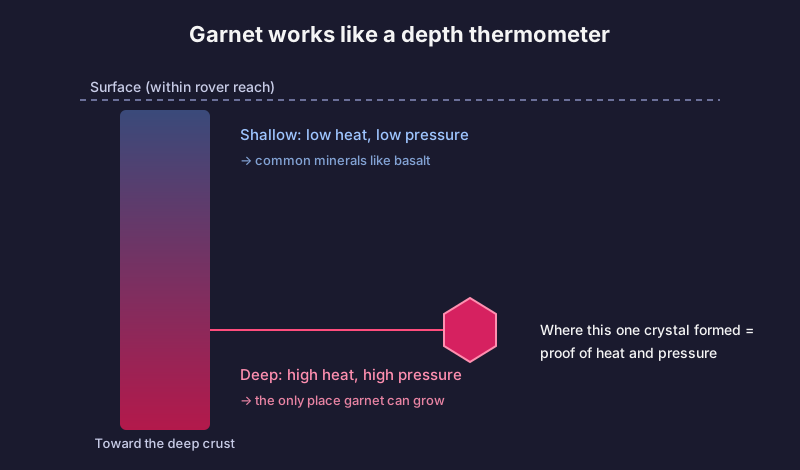
The crucial detail is that garnet only forms under demanding conditions. It can’t grow at low temperatures or low pressures. It needs a deep, thoroughly heated, heavily compressed environment to take shape at all.
That’s why geologists can work backward from finding garnet. If this crystal is here, they reason, then this spot must once have been subjected to extreme heat and pressure. The mineral itself acts as a recording device for conditions that no longer exist.
Think of it this way: if ice is melting in your kitchen, you know the room is warmer than freezing. If bread comes out of the oven golden brown, you know it went through serious heat. Minerals carry their own version of that “doneness” marker, baked in by the temperature and pressure under which they formed. Garnet just happens to wear that marker unusually clearly.
On Earth, garnet is a standard tool in geology. Researchers use it to trace the forces that push continents around, the processes that build ore deposits, and the chemical reactions between rock and fluid deep in the crust.
Now that same depth recorder has turned up in a rock from Mars. You can probably already guess what that implies.
A single grain testifying to Mars’s violent past
The Martian surface today is cold and quiet. But the garnet inside NWA 8171 points to something far more dramatic happening beneath that surface, sometime in the past.
That’s information you’d never get from skimming the ground. Somewhere in Mars’s crust, conditions of extreme heat and pressure genuinely existed, and this tiny crystal is the proof.
It’s worth pausing on the scale here. A rock small enough to fit in your hand contains a crystal smaller still, and that crystal is telling us about the history of an entire planet. The mismatch in scale is almost dizzying.
Mars measures thousands of kilometers across. The evidence is a crystal you can just barely see without a magnifying glass. It’s a bit like reconstructing an entire city’s old weather patterns from a single grain of sand in the corner of a soccer field.
If you’d somehow been standing inside that patch of Martian crust as it formed, you’d have been surrounded by scorching heat and crushing pressure. That moment is preserved now, frozen into the shape of a cooled, hardened mineral.
And that moment likely happened billions of years ago, when Mars was young and far more geologically active, inside and out, than it is today. The crystal froze a single instant of that ancient chaos in time, like the lone witness to an event nobody else was around to see.
So what actually caused that heat and pressure in the first place? Here, the story splits in two.
Impact or magma? The case isn’t closed yet
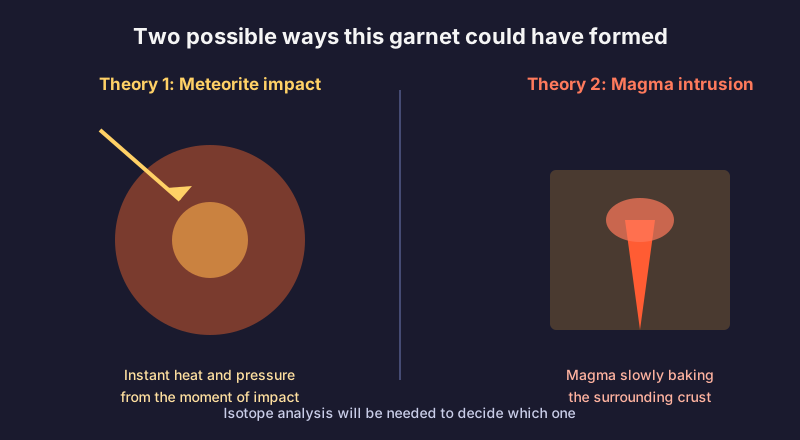
The research team has identified two leading candidates for whatever produced enough heat and pressure to grow garnet on Mars.
The first is a meteorite impact. The instant another object slams into a planet, the impact site generates extraordinary heat and pressure. Under this scenario, that single violent moment transformed the crustal rock and produced the garnet.
The second possibility is magma intrusion. Underground magma could have pushed into the crust, slowly cooking and compressing the surrounding rock over a much longer stretch of time.
An impact would mean this happened in an instant. Magma would mean it played out gradually. Which explanation turns out to be correct changes how scientists read the entire history of Mars’s crust.
This is also where that earlier mention of careful handling comes back into play.
Pinning down exactly how the garnet formed requires isotope analysis, which means studying atoms of the same element with different weights. The problem is that this kind of analysis partially destroys the sample.
The research team is understandably hesitant to damage their only specimen. If this really is the only Martian garnet currently available for study, you don’t get to cut corners. Right now, caution is locked in a quiet standoff with curiosity.
A small piece of evidence reshaping how we see a planet
When people think about Mars, the big questions usually come first: Was there ever life? Was there ever water? This discovery points to something quieter, and arguably more solid.
A history that no amount of surface observation could ever reveal turned out to be preserved inside a single rock that had already made it to Earth. Not a telescope, not a rover, but a museum drawer delivered the story of temperature and pressure deep inside Mars.
The research is far from finished. Whether an impact or magma created this garnet is still an open question scientists need to verify. But the fact that we already have a piece of Mars in our hands, and that it keeps teaching us new things every time someone looks closely, is honestly pretty thrilling.
Next time you come across a photo of a Mars meteorite, remember this: inside that unremarkable dark rock, a crystal might be holding onto a memory of depths no rover will reach in its entire working life.