The universe was barely 600 million years old — practically newborn — and already it was scattered with strange little red dots. Soon after JWST (the James Webb Space Telescope) began observing in 2022, astronomers noticed them everywhere.
There were a lot of them. And they were too bright.
If each dot really was a full galaxy, the universe would have somehow assembled massive structures at an impossible speed, right out of the gate. That collides head-on with everything we think we know about cosmology. Some researchers went so far as to say these red dots had “broken” cosmology. Now, finally, there’s an answer.
The Problem of Growing Up Too Fast
Let’s start by pinning down exactly what these red dots are.
JWST found a whole population of these objects, now known as “Little Red Dots.” As a group, they showed up in striking numbers remarkably early — around 600 million years after the Big Bang. They were red, small, and oddly bright. That’s about all anyone could say with confidence. What they actually were remained a mystery.
The real puzzle was the brightness.
Normally, an object shines bright because it’s packed with stars. Read these dots as “a huge cluster of stars” — in other words, a galaxy — and you’re saying the young universe already contained fully grown, massive galaxies.
That’s a problem. Building that many stars takes time, and the universe was only 600 million years old. No matter how you run the numbers, there simply wasn’t enough time. Astronomers started warning that galaxies in the early universe were growing too fast, fast enough to threaten cosmology itself. The Little Red Dots, as a population, posed a real challenge.
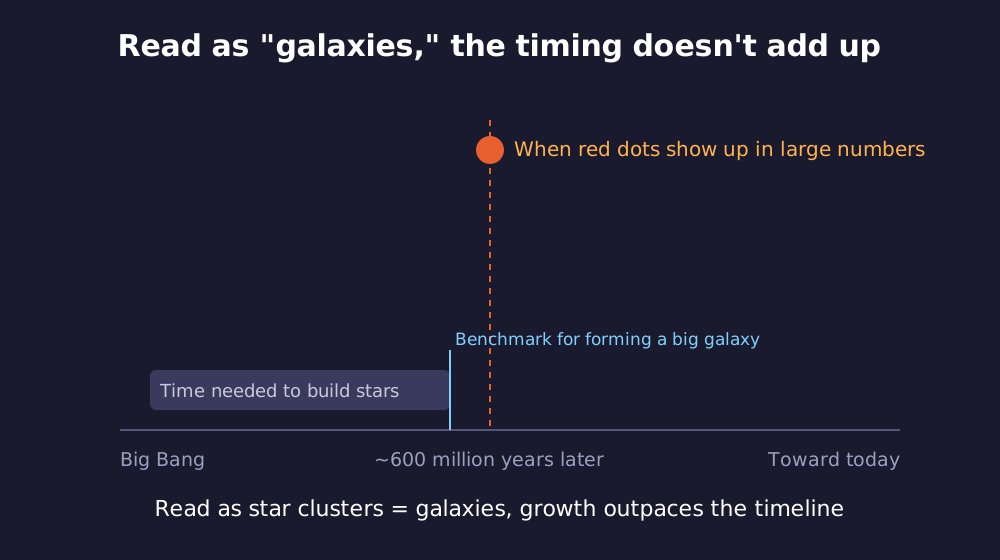
How you interpret what you’re seeing can shake the entire history of the cosmos. These red dots were exactly that kind of trouble.
Thirty Hours of Observing, One Beam of Light at a Time
The key to cracking the mystery was looking at color in much finer detail.
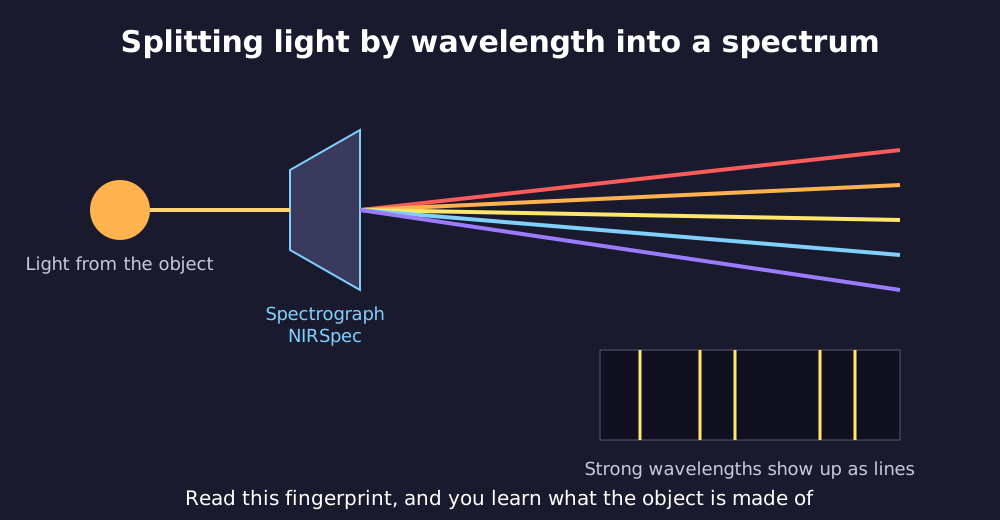
The tool for the job was NIRSpec, the near-infrared spectrograph mounted on JWST. It splits an object’s light apart like a prism, laying out exactly how strong each wavelength is. That breakdown is called a spectrum.
A spectrum is like a fingerprint — it encodes what an object is made of and what state it’s in. Suddenly, instead of two words (“bright” and “red”), you have hundreds of individual clues to work with.
The target was a single Little Red Dot called GLIMPSE-17775. A team led by Vasily Kokorev at the University of Texas at Austin spent roughly 30 hours observing it with JWST. This object sits at redshift 3.5 — about 1.8 billion years after the Big Bang. It’s not quite as ancient as the most extreme Little Red Dots in the wider population, but it’s still distant, and still faint.
Here, nature lent a hand.
In front of this object sits the galaxy cluster Abell S1063, whose gravity bends and focuses the light behind it like a lens — an effect astronomers call gravitational lensing. Thanks to that natural magnifying glass, 30 hours of observing delivered the equivalent of about 80 hours’ worth of data. The universe basically loaned the team its own telescope.
Getting 80 hours of insight out of a 30-hour investment is no small bonus. Without that cosmic magnifying glass, the red dots might still be a mystery today.
An “Iron Forest,” and a Black Hole Wrapped in a Cocoon
What the spectrum revealed defied expectations.
The light from GLIMPSE-17775 contained more than 40 distinct spectral features — both emission and absorption lines. Cleanly producing that many lines from a single object is hard to explain with an ordinary star cluster.
What really caught the team’s attention was a dense cluster of 16 absorption lines, all produced by iron. They nicknamed it the “iron forest” — like trees standing shoulder to shoulder, these thin absorption lines crowd together in tight rows. Producing that dense an iron fingerprint requires an extraordinarily thick layer of gas sitting right in the path of the light.
Iron matters here. It’s an element forged almost exclusively inside stars, or during their deaths — a kind of cosmic marker of age. Finding it in such abundance means several generations of stellar activity had already played out around this object.
And this is where the discovery gets genuinely interesting.
The spectrum also showed helium simultaneously glowing and being absorbed, along with telltale signs of electrons scattering light in every direction.
That electron scattering might sound like a minor detail, but it’s doing a lot of work. For light to bounce around like that, there has to be a thick layer of electron-rich gas wrapped around the light source. And helium glowing and absorbing at the same time hints at a two-layer structure: an intense light source at the center, with gas enveloping it from outside.
Line these clues up one by one, and the scattered pieces snap into a single coherent picture. Here’s what the team concluded.
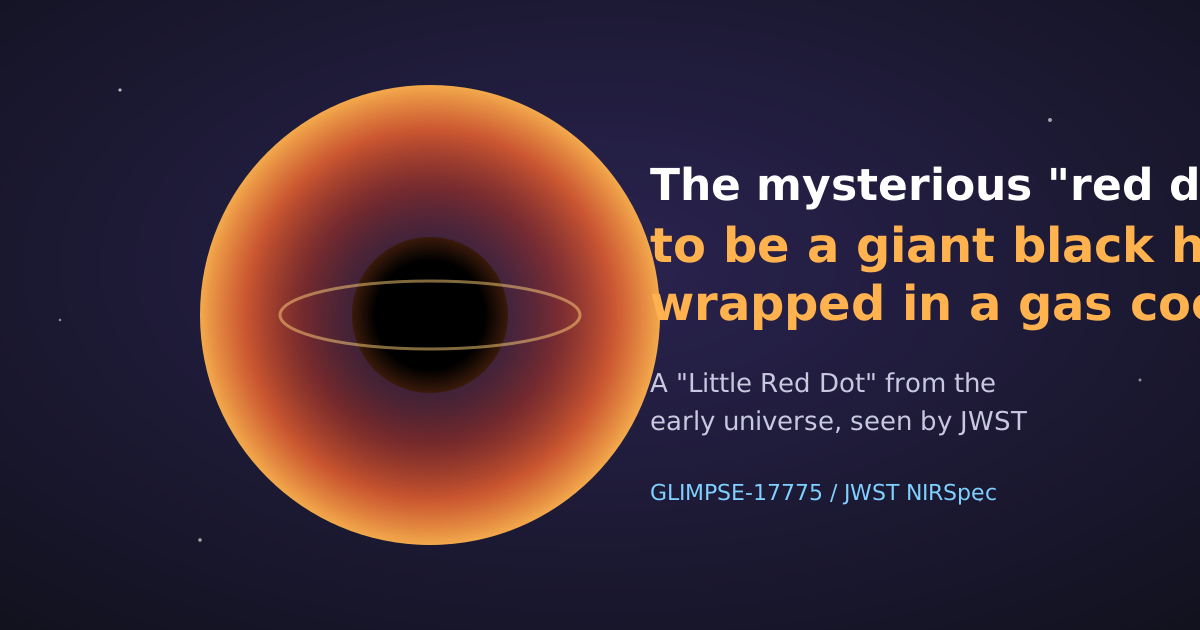
At the center sits a rapidly growing supermassive black hole. Around it, a thick layer of dense, partially ionized gas — a mix of charged and neutral particles — wraps the whole thing like a cocoon.
The team calls this model a “black hole star,” or BH* for short. It isn’t a star at all, but draped in that much gas, it looks like one at a glance.
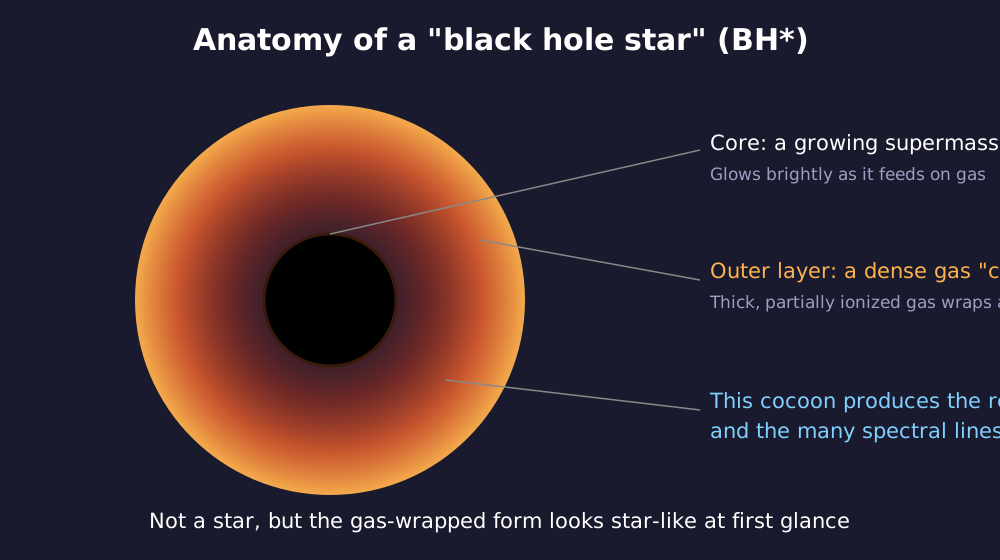
More than 40 spectral lines. Sixteen iron lines forming a forest. Helium glowing and absorbing at once. Electrons scattering light everywhere. Every one of these clues falls neatly into place under a single model: a black hole wrapped in a cocoon of gas. The team is calling it the strongest evidence yet in favor of the BH* scenario.
Change the Interpretation, and Cosmology Stops Colliding
If these objects turn out to be black holes, what happens to the original “growing too fast” problem?
This, I think, is the real heart of the discovery.
Read the red dots as massive star clusters, and you need an enormous number of stars to produce that brightness — more than the early universe had time to make. But swap in a black hole as the light source, and the whole calculation changes.
A black hole unleashes tremendous energy as it swallows surrounding gas. It can shine far brighter than its size would suggest, with a fraction of the material. So explaining the observed brightness doesn’t require a giant population of stars after all. According to the research team, the black hole’s mass doesn’t need to be enormous to produce the light we’re seeing.
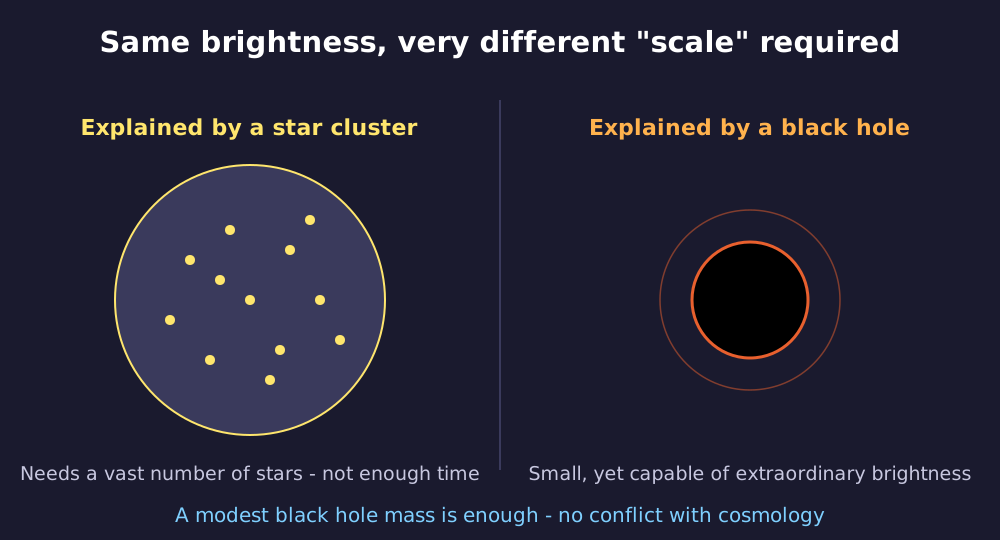
In other words, the supposed contradiction — “galaxies in the early universe grew too fast” — likely rested on a flawed assumption from the start. Astronomers weren’t watching overgrown galaxies. They were watching gas-wrapped black holes and mistaking them for galaxies. So far, GLIMPSE-17775, at 1.8 billion years after the Big Bang, is the one object where this has been confirmed. But if the same misreading applies to even older red dots, the broader “growing too fast” problem could unravel along with it.
Cosmology wasn’t broken after all. We were just reading the picture wrong.
Confirming even one case of this mistaken identity matters a lot, because it suggests the same interpretation might apply to other red dots scattered across the sky. So far it’s just GLIMPSE-17775. But there’s a real sense that more of its kind are about to be unmasked the same way.
The Same Sight Looks Different Once You Know
One last thought, zooming out a bit.
In the end, all a telescope ever gives us is one kind of information: light. What that light actually shows depends entirely on how we choose to interpret it. The same red dot can look like “an overgrown galaxy” one day and “a black hole wrapped in a cocoon” the next.
Something similar happens closer to home. Look at a particularly bright point in the night sky believing it’s a planet, then look again thinking it’s a star — same light, completely different impression. Knowledge rewrites what your eyes actually see.
The light from GLIMPSE-17775, a red dot sitting in a universe roughly 1.8 billion years old, traveled an almost unimaginable distance before landing on JWST’s sensors. Not long ago, humanity called that same light a mystery. Now we call it a growing black hole wrapped in a cocoon of gas.
The light itself never changed at all.