No flour, no sugar, no butter in the kitchen — and yet the cookies came out of the oven anyway. That’s roughly what researchers found when they trained their instruments on a star in a nearby dwarf galaxy.
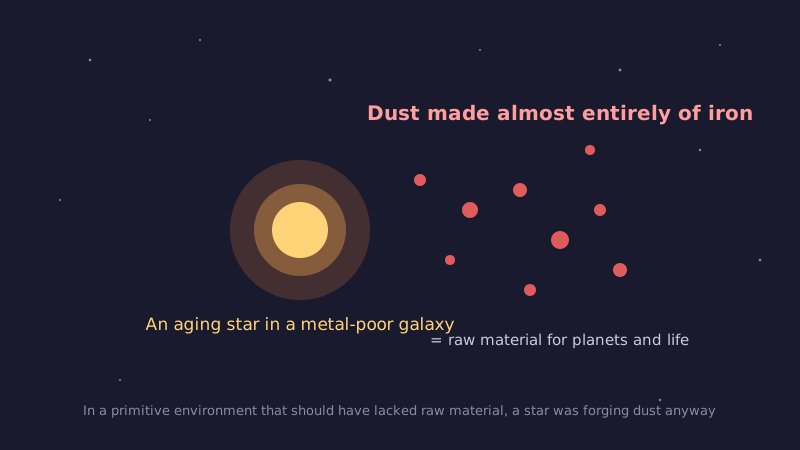
In a primitive galaxy nearly stripped of raw material, a star was making dust. Almost entirely out of iron. Cosmic dust is the tiny solid grains that eventually become planets, and us. Making it is supposed to require a healthy supply of heavy elements. That’s the textbook rule.
That rule just got a little shakier.
We are all, in a sense, made of star dust
Picture the fuzz you pull out of a vacuum cleaner bag — cosmic dust isn’t that. It’s something far smaller: invisible solid grains drifting around stars and through galaxies, more like fine soot or powdered sand than household lint.
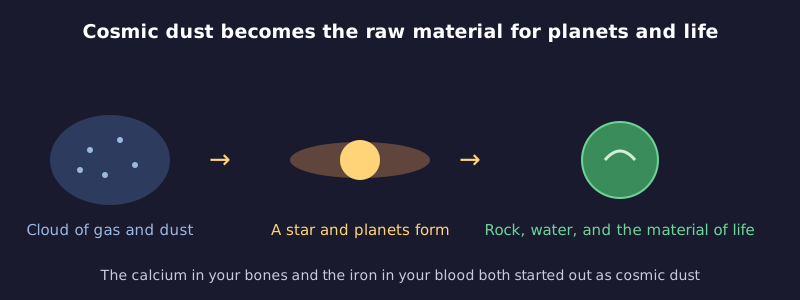
And this dust does surprisingly heavy lifting. Clouds of gas and dust collapse under their own gravity, stars ignite at the center, and planets condense out of whatever’s left over. The rock beneath your feet, the water in the ocean, the calcium in your bones, the iron in your blood — trace it all back far enough, and it started as cosmic dust.
Dust also gives molecules a place to grow in the cold of space. Atoms stick to the surface of a grain, and slowly, piece by piece, water and organic compounds start to assemble. Where dust is scarce, stars and planets struggle to form at all.
In short, dust is the raw flour that the universe uses to bake planets and life. No flour, no bread. No dust, no planets.
Which raises a question astronomers have chased for decades: where, and when, did this raw material first get made? This is where the story gets interesting — and honestly, it’s my favorite part.
Dust factories run on the deathbeds of stars
Dust doesn’t just appear out of nowhere. It comes from actual factories, and there are two main types.
The first is an aging, swollen star. Stars roughly as massive as the Sun balloon outward near the end of their lives and shed dust along with the gas blowing off their surfaces. Astronomers call these AGB stars — short for “asymptotic giant branch,” the bloated late-life stage a star passes through. The second factory is a supernova: the catastrophic final explosion of a much heavier star.
Both factories share one requirement. They need heavy elements — things like silicon and magnesium, anything heavier than hydrogen or helium — as raw material. Ordinary dust is made of silicates, compounds built from these elements. Think of them as chemical cousins of sand and glass.
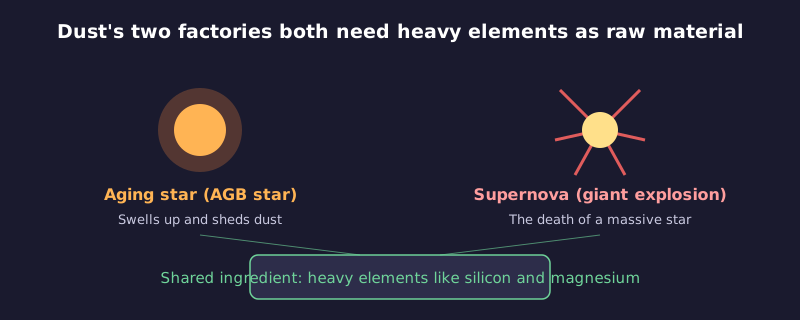
So far, this is standard textbook material. But there was a stretch of cosmic history when almost none of that raw material existed yet. It took generation after generation of stars living and dying before heavy elements built up in any real quantity. Before the factories could run, the universe first had to manufacture the very ingredients needed to build them.
A kitchen with no ingredients shouldn’t be able to bake — or so we thought
In the universe’s earliest moments, there was almost nothing but hydrogen and helium. Silicon, iron, oxygen — none of it existed in any meaningful amount yet. These heavier elements only entered the cosmic inventory gradually, scattered by generation after generation of stars living and dying.
Astronomers lump every element heavier than hydrogen and helium under one label: “metallicity.” The lower a region’s metallicity, the closer it resembles the primitive, early universe.
Here’s the catch. If dust needs heavy elements, then the early universe — starved of those elements — shouldn’t have been able to make much dust at all. Back to the kitchen metaphor: no flour, no sugar, no butter. Mix whatever you want, and it still won’t turn into cookie dough.
And yet, when astronomers point JWST (the James Webb Space Telescope) at distant, early galaxies, the numbers don’t add up. There’s far more dust out there than the models predict — dust that, by the rules, shouldn’t exist yet. Something the theory says can’t be built is sitting right there in the telescope’s images. This mismatch has puzzled astronomers for years.
The answer was hiding in a time capsule four million light-years away
So how do you actually test this? The real early universe is too far away to resolve individual stars — at that distance, whole galaxies blur into faint smudges of light. So a research team looked for the next best thing: a nearby stand-in that looks the part.
They found it in Sextans A, a dwarf galaxy roughly four million light-years away — about 40 Milky Way diameters distant, if you use our galaxy’s 100,000-light-year span as a ruler. On cosmic scales, that’s practically next door. Sextans A has a metallicity of just 3-7% of the Sun’s, meaning it holds roughly a twentieth as many heavy elements. It’s about as primitive an environment as you’ll find nearby.
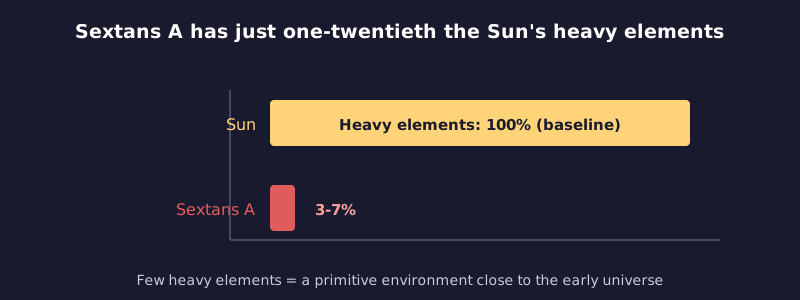
Because it’s close, astronomers can pick out individual stars inside it — something impossible in the true early universe, which only shows up as a blur. Studying this nearby lookalike is like watching a dress rehearsal for conditions we can’t observe directly. It’s a time capsule of the early universe. And since Sextans A sits four million light-years away, the light arriving from it today set out four million years ago.
If you stood on a planet inside this galaxy and looked up, the night sky would probably feel a lot like the sky of a much younger universe: quiet, and nearly empty of heavy elements. Under that sky, the research team pointed JWST’s near-infrared camera (NIRCam) and its mid-infrared instrument (MIRI) at one particular star.
Dust made of iron, and nothing else, that shouldn’t have been possible
What they found was the cookie from our opening scene. A massive AGB star was actively making dust — and that dust turned out to be almost entirely iron.
That’s a genuinely strange result. Silicon and magnesium, the usual ingredients for dust, are barely present in this galaxy. According to team member Martha Boyer, conventional wisdom held that a star in such a metal-poor environment shouldn’t be able to make much dust at all. Even the researchers didn’t expect this particular star to pull it off.
The star simply worked with what it had. When the silicate recipe wasn’t available, it baked with iron instead. The team also spotted other unusual dust types — silicon carbide, and soot-like organic particles called polycyclic aromatic hydrocarbons (PAHs). None of it followed the standard kitchen playbook, but the star found a way to produce flour anyway. No ingredients on hand? Use what you’ve got.
Iron dust might sound like a modest discovery. But every grain of it is a candidate building block for a future planet, or a future living thing. The star may have been working with a limited pantry, but it didn’t waste a single ingredient.
This galaxy offers “a blueprint for what the very first dusty galaxies might have looked like,” according to lead author Elizabeth Tarantino. The findings were published in the peer-reviewed Astrophysical Journal, with related work also presented at the American Astronomical Society meeting in January 2026.
Rethinking what we’re actually seeing in distant galaxies
Here’s where it gets even more interesting. Iron dust has an inconvenient property: it absorbs light readily but leaves behind no clear spectral “fingerprint.” Run a spectroscopic analysis, and iron dust won’t raise its hand to announce itself.
Which means all that dust JWST has been finding in distant, early galaxies might contain a hidden component of iron that’s gone unnoticed until now. Boyer suggests these iron grains could be quietly contributing to the surplus of dust astronomers keep detecting in the distant universe. That long-standing mismatch — too much dust in an era that shouldn’t have had the ingredients for it — is starting to make a little more sense.
The early universe, it turns out, was more resourceful than we gave it credit for. It didn’t wait around for the right ingredients to show up; it started making dust with whatever it had on hand. The research team believes dust formation was far more varied than anyone assumed. The raw material for our own bodies may have started coming together earlier, and in stranger ways, than we thought.
Which makes me want to look down at my own hand. The red in your blood comes from iron ferrying oxygen through your body. Somewhere in a young, ingredient-poor universe, a star clumsily forged grains of iron out of whatever it had lying around. A distant relative of those grains is circulating through you right now.