Earth has a second companion besides the Moon — a rock that has been circling the Sun right alongside us the whole time.
It’s tiny, only a few dozen meters across, and yet it has a name. And here’s the strange part: Earth’s gravity has never actually caught it.
I’ll admit it — for a long time I assumed this thing was some kind of “second moon.” Turns out its situation is nothing like the Moon’s at all. Earth never grabbed hold of it, and yet it never wanders off either. That lopsided, half-committed relationship is somehow a real, stable thing in our solar system.
A rock that tags along with Earth, but isn’t the Moon
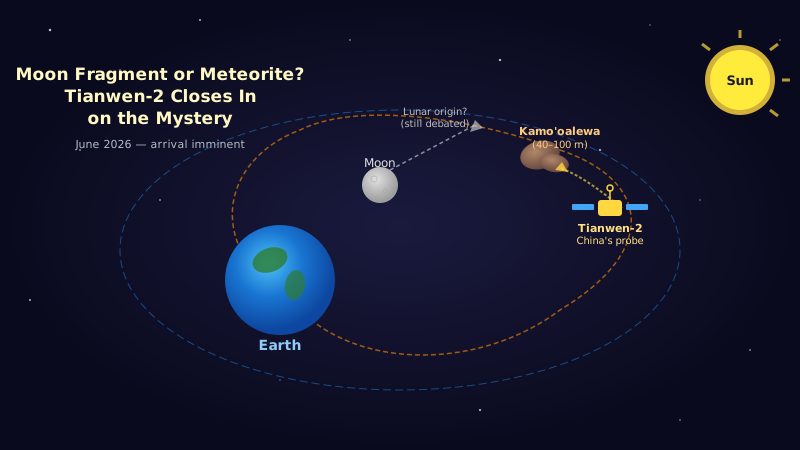
This rock is called Kamo’oalewa. Astronomers with the Pan-STARRS survey at Hawaii’s Haleakala Observatory spotted it in April 2016, and it turned out to be a near-Earth object.
Based on observations, it’s probably somewhere between 40 and 100 meters across — roughly the size of a small office building. On cosmic scales, that’s minuscule.
What makes it interesting is its status as one of Earth’s “quasi-satellites.” A quasi-satellite appears to stick close to a planet, following it around year after year, without actually being gravitationally bound to that planet.
From Earth’s point of view, it’s not family the way the Moon is — more like a neighbor who, for some reason, is always right there.
Which raises an obvious question: if Earth never caught it, why doesn’t it just drift away?
The secret behind “not captured, yet never leaving”
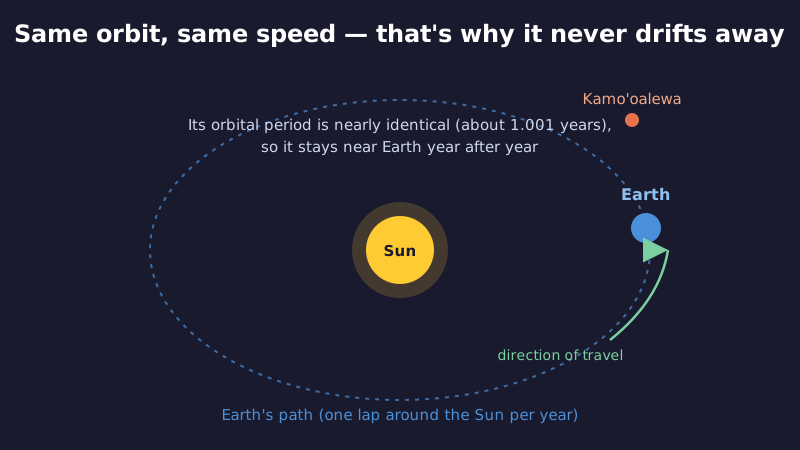
The answer comes down to one simple fact: Earth and Kamo’oalewa travel around the Sun at almost exactly the same speed.
You already know Earth takes about a year to circle the Sun. Kamo’oalewa’s orbital period is roughly 1.001 years — practically identical. Its average distance from the Sun also lines up closely with Earth’s, at close to one astronomical unit (the Earth-Sun distance, about 150 million kilometers).
Picture two cars on the same road, cruising at nearly the same speed — they stay side by side without ever separating. It’s the same feeling as glancing out a highway window and noticing the car in the next lane keeps pace with you, mile after mile. Speed up even slightly and you’d pull ahead; slow down and you’d fall behind. But as long as the pace matches, you stay neighbors.
Here’s the strange part: Earth isn’t pulling Kamo’oalewa toward it. Both objects orbit the Sun completely independently — their gravity has nothing to do with each other. It just so happens their orbital speeds line up.
So in terms of gravity, Kamo’oalewa actually sits outside Earth’s sphere of influence — a region called the Hill sphere, where a planet’s gravity genuinely calls the shots. The Moon lives inside that boundary. Kamo’oalewa lives outside it.
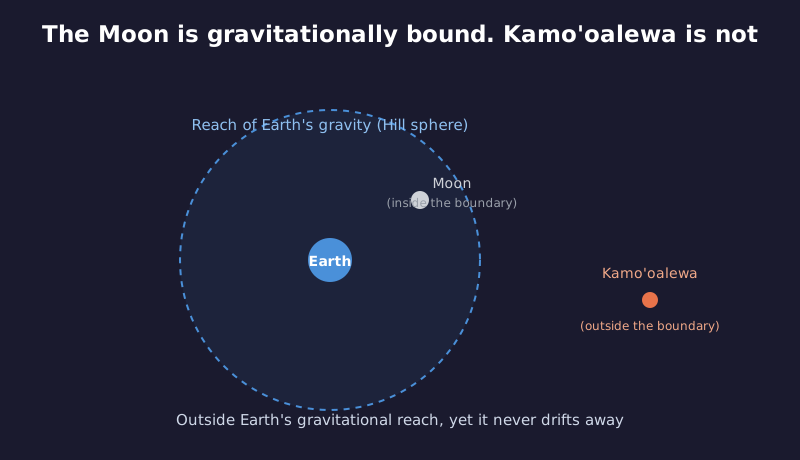
The Moon is firmly gripped by Earth’s gravity, looping around us because of it. Kamo’oalewa isn’t like that at all. It’s held by the Sun’s hand the entire time — it just happens to be walking in step with Earth. Same “staying close,” completely different mechanism underneath.
From Earth’s perspective, it traces a huge loop
Now for the part I find genuinely fascinating.
Earth and Kamo’oalewa travel side by side, but their orbits aren’t perfectly identical. Kamo’oalewa’s path is a bit more elongated and slightly tilted. As a result, when you watch it from Earth over the course of a year, the rock appears to swing ahead and then fall back.
Trace that motion from Earth’s point of view, and Kamo’oalewa seems to draw a huge loop around us — a lopsided ring completed once every year.
That’s exactly why it’s called a “quasi-satellite.” It looks like it’s orbiting us the way a real satellite would, but it isn’t one.
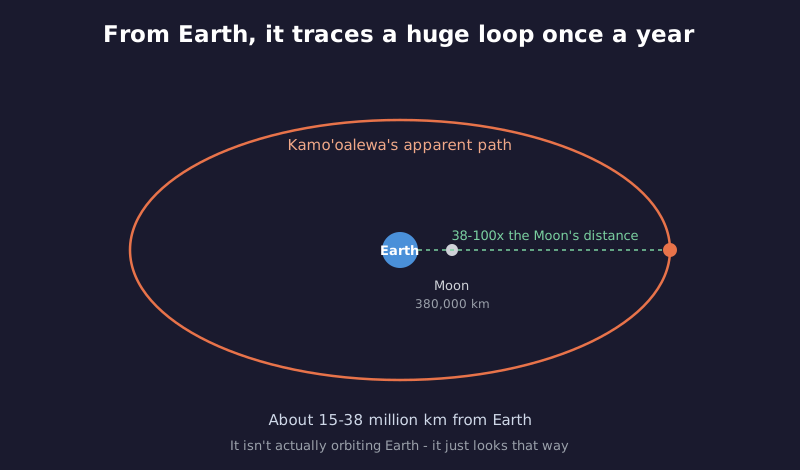
The scale of that loop is the real takeaway. It’s enormous. At its farthest, Kamo’oalewa sits 38 to 100 times more distant than the Moon.
The Moon orbits about 380,000 kilometers from Earth. Multiply that by tens, and Kamo’oalewa turns out to be roughly 15 to 38 million kilometers away.
Numbers like that don’t mean much on their own, but the point is this: “staying close” here means orbiting at a distance far beyond the Moon’s. It’s simply too far for Earth’s gravity to take charge. The Sun remains firmly in control of this rock’s motion. Had it drifted as close as the Moon, Earth’s gravity likely would have snatched it up — but Kamo’oalewa sits just outside that line, still holding the Sun’s hand as it keeps pace with us.
A relationship that shifts over centuries
If you could stand on Kamo’oalewa’s surface and look up, Earth would drift slowly across the sky — approaching, receding, then swinging back again. And this arrangement won’t last forever.
Orbital mechanics tells us that quasi-satellite orbits like this one are fundamentally unstable, gradually morphing into different kinds of motion over time. In Kamo’oalewa’s case, researchers believe it stays a quasi-satellite for a few centuries before transitioning into what’s known as a “horseshoe orbit.”
A horseshoe orbit describes a rock that swings out ahead of Earth, turns back, drifts far behind, and turns back again — tracing a U-shaped, horseshoe-like pattern instead of clinging close the way a quasi-satellite does. Picture it swinging far forward and backward along the orbital path rather than staying tucked in beside us.
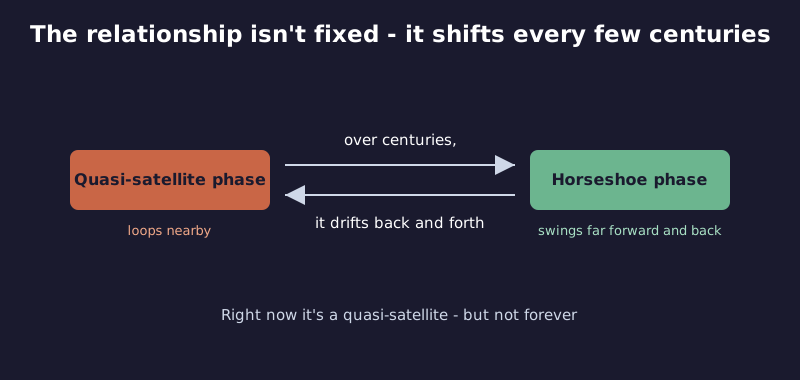
And according to research, this isn’t a one-way transition. It appears Kamo’oalewa has flipped back and forth between these two states repeatedly — drawing close, drifting away, over and over, on a timescale almost too vast to grasp.
Which means the quasi-satellite phase we’re witnessing right now is just one brief scene in a much longer story. Its name only deepens that impression. Kamo’oalewa is Hawaiian, drawn from the Kumulipo — the chant of Hawaiian creation — and is said to mean something like “the oscillating fragment.” Whoever named it seemed to already understand this rock’s restless nature.
This rock might be a piece of the Moon
So where did this thing actually come from?
Here’s where it gets even more interesting. Recent research teams have proposed that Kamo’oalewa may be a fragment blasted off the Moon itself. When scientists examined the light it reflects — its spectral signature — it looked less like an ordinary asteroid and more like weathered lunar rock exposed to space.
The story goes something like this: some ancient impact on the Moon flung a chunk of lunar rock into space, and that fragment ended up orbiting near Earth ever since. If that’s true, this rock carries a double dose of in-between identity — not the Moon, yet born from the Moon.
If it really is a lunar fragment, its surface would preserve a slice of lunar history in physical form. There would be a sample of the Moon’s ancient past floating within reach, right next to Earth.
That said, this remains a hypothesis built from remote observations, not a confirmed fact. The surest way to settle it would be to bring an actual piece back and study it directly. And in fact, sample-return missions targeting this tiny rock are reportedly already underway.
We’ve moved from guessing at its origins through telescopes to a point where we might soon hold the answer in our hands. A rock barely the size of a building is quietly commanding a lot of attention right now.
Just staying close — nothing more
We tend to assume the Moon is family, simply because it’s there — bound by gravity, stirring the tides, the brightest fixture in our night sky.
But just beyond it, there’s been another rock all along — not family, yet never straying far. Never caught by gravity, yet never leaving either. Just traveling the same road, at the same pace, as us.
Turns out connection in space doesn’t always mean holding on tight. Sometimes it just means running alongside something for a while. And in a few centuries, even that quiet companionship will start to come apart.
Next time you look up at the Moon, try picturing the darkness just beyond it. Somewhere out there, a small rock that isn’t the Moon is keeping pace with Earth, matching our stride around the Sun.