I don’t know my neighbor’s name.
For twenty years now, I’ve waved every night to someone whose name I’ve never learned. My name is Mine, and I live alone in this floating house. Ever since my husband died, it’s just been me here. My child settled down on some distant star. A letter comes, now and then.
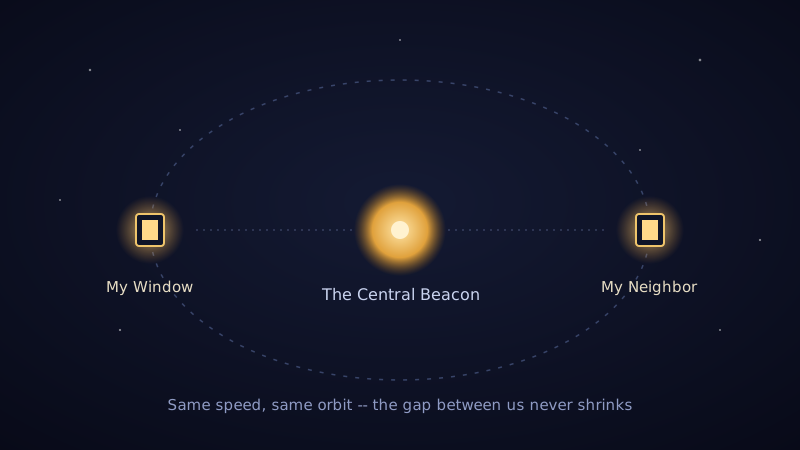
My town has a big beacon at its center, steady as an anchor. The houses drift around it in slow circles — so slow you’d never even feel yourself moving. Once every few years, a young surveyor comes through to check whether the houses have drifted out of place. That’s the kind of town it is.
When evening falls, the beacon dims. We call it the twilight bell. Once the bell rings, everyone lights their evening lamp. I light mine too, topping off the oil in the old lamp my husband used to keep.
Look out the window, and there’s always a light in the same spot — glowing from a window far, far across the dark. I call whoever lives there my neighbor.
When I wave my lamp from the sill, the light across the way sways back. Or seems to. Twenty years, that’s been our greeting. We’ve never met. Even if I wanted to cross over, there’s nothing between us but empty dark. Though lately, I can’t honestly say which of us moves first anymore — them, or me.
They say that as you get older, the waiting stretches longer than the answer ever does. But my neighbor’s light comes, without fail, every single night. That was enough. Maybe they’re alone too, I used to think. Somehow, that thought kept me steady.
Then, the other day, the surveyor came by. A young man, holding some instrument up to my window.
“Ma’am, this house completes an orbit every twenty years or so,” he said. “Nice and steady.”
I pointed at the window across the way. That house and I go way back, I told him. We greet each other with our lights, every night.
“Huh,” he said, glancing outside. Then he hesitated, like he wasn’t sure how to put it.
“That house — it’s orbiting the same beacon too. At exactly the same speed as yours. That’s why you always end up facing each other, in the same spot. Neither one of you is really orbiting the other.”
“I see.”
“Both houses answer to the beacon, in a way. Same clock, so when the twilight bell rings, both lamps come on around the same time. …Probably that’s just their dinner light, over there.”
So it was never a reply. I started to say it, then stopped.
“Is there no way to get closer?” I asked instead.
“If you tried to close the gap,” he said, sliding his hand flat through the air, “you’d just end up sliding away somewhere else instead. This distance, right here — it’s actually the closest the two of you can ever get.”
The surveyor left.
That evening, when the twilight bell rang, I didn’t light my lamp. No oil, no flame — I just set it dark on the sill. I wanted to know: would my neighbor’s light still come, even if I didn’t wave first?
The lamp stayed cold in my hands.
The window across the way lit up anyway. In the usual spot, at the usual distance, with the usual glow. And that light reached straight across the dark, all the way to my window, which stayed unlit.