Textbooks will tell you Earth has one moon. That’s true — but there’s another rock out there quietly tagging along as our planet circles the Sun, and most people have never heard of it.
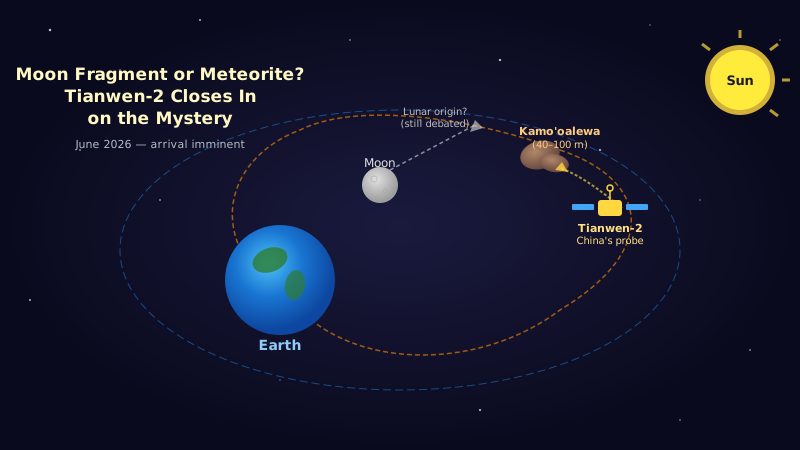
It’s called Kamo’oalewa. At 40–100 meters across, it’s tiny. The Pan-STARRS telescope in Hawaii spotted it in 2016. And right now, China’s Tianwen-2 spacecraft is on its way to pay it a visit — scheduled to arrive in July 2026, which means it’s closing in as you read this.
Why does such a small rock generate so much attention? Simple: nobody actually knows what it is.
A Quasi-Satellite — an Odd Kind of Object
Let’s sort out what Kamo’oalewa actually is, because it doesn’t fit neatly into the usual categories.
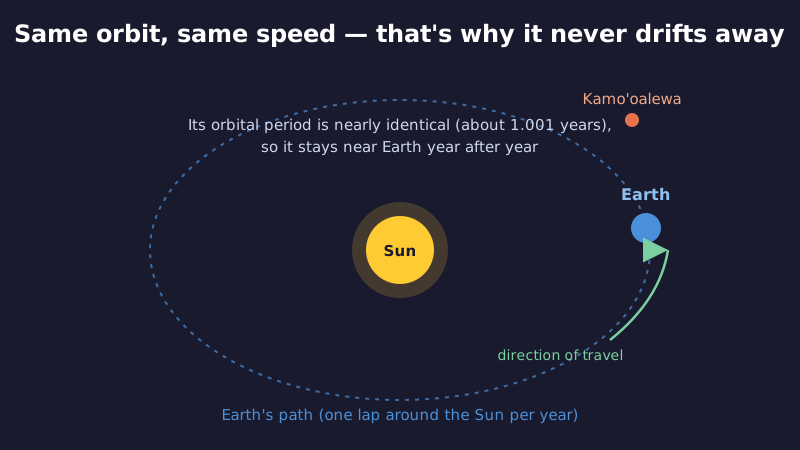
The Moon is a true satellite — held by Earth’s gravity, circling us every 27 days. Kamo’oalewa is different. It orbits the Sun, not Earth, which means it’s technically not our moon at all. But its orbital period is almost identical to Earth’s (366 days), so from our perspective it always seems to be hovering nearby.
Astronomers call objects like this quasi-satellites. They look like they’re orbiting Earth, but they’re actually orbiting the Sun in near-lockstep with us. As seen from Earth, Kamo’oalewa traces a looping, gourd-shaped path that repeats on a roughly 45-year cycle.
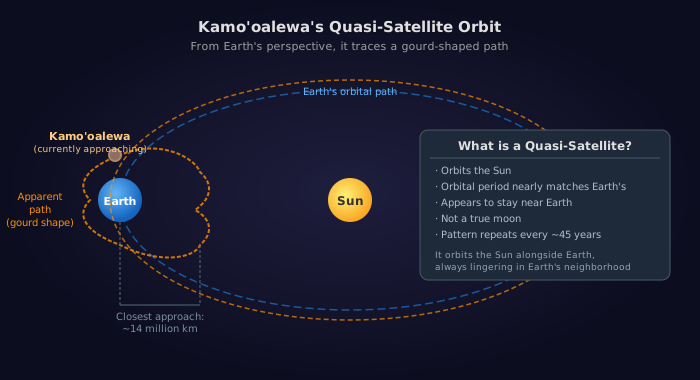
The name “Kamo’oalewa” comes from Hawaiian and roughly translates to “oscillating celestial fragment.” It’s a good name.
Closest Approach: Still 14 Million Kilometers Away
To get a sense of scale: Kamo’oalewa measures about 40–100 meters. A 2024 three-dimensional analysis put its dimensions at roughly 100 × 81 × 46 meters. Despite its small size it spins fast — one full rotation every 28 minutes.
Even at closest approach, it’s about 14 million kilometers from Earth. That’s nearly 37 times the distance to the Moon, which means Earth’s gravity can’t capture it and it keeps its independent solar orbit.
From a mission-planning standpoint, though, this counts as a nearby target. It has no atmosphere, its orbit is reasonably stable, and spacecraft can reach it multiple times over the years. The fuel cost is lower than sending a probe to the main asteroid belt.
The Question Is: Where Did It Come From?
Kamo’oalewa vaulted into the scientific spotlight in 2021, when a University of Arizona research team published a striking finding: the asteroid’s spectrum looks a lot like lunar rock.
Spectrum, in this context, means the pattern of how light is reflected and absorbed by a surface — essentially a light fingerprint. The Moon’s soil has been battered by solar wind and micrometeoroids for billions of years, a process called space weathering that gives it a distinctive reddish tint. Kamo’oalewa’s spectrum matched that altered lunar soil closely enough that researchers floated a bold idea: maybe this rock was blasted off the Moon by an ancient impact.
The Moon is covered in craters, and large impacts can launch material into space. Giordano Bruno Crater — about 22 kilometers across on the lunar far side — became the leading candidate for the launch site.

In May 2026, Researchers Pushed Back
Then the story got more complicated.
While Tianwen-2 was already in flight, a team led by Yang Li of the Chinese Academy of Sciences published a paper in Nature Communications in May 2026. Their argument: the lunar-like spectrum might not mean what we think it does.
The team ground up LL chondrite meteorites — a type of stony meteorite — into powder, then blasted it with lasers at the micrometer scale to simulate millions of years of space weathering in the lab. The result: the powder’s spectral signature shifted dramatically and ended up matching Kamo’oalewa’s spectrum almost exactly.
On top of that, orbital simulations suggested Kamo’oalewa could have originated from the Flora family — a cluster of asteroids in the inner part of the main belt, between the orbits of Mars and Jupiter. Over long timescales, gravitational nudges can gradually push some of these objects into Earth-crossing orbits.
The paper stopped short of dismissing the lunar hypothesis outright, but it argued seriously that a space-weathered ordinary asteroid is a fully plausible explanation.
So right now, both theories carry roughly equal weight: lunar fragment, or asteroid belt refugee.
Tianwen-2 Will Bring Back the Answer
That’s where Tianwen-2 comes in.
China launched the spacecraft on May 29, 2025, from the Xichang Satellite Launch Center in Sichuan province. The plan: enter Kamo’oalewa’s vicinity in July 2026, spend several months observing, collect a surface sample around April 2027, then depart and return to Earth by late 2027.
The sample itself will be small — just a few grains of rock — but analyzed in Earth-based laboratories, it can settle the debate conclusively. If the composition matches lunar material, the lunar origin hypothesis gains strong support. If it resembles LL chondrites, the asteroid belt theory moves to the front.
No simulation, however sophisticated, can substitute for holding the actual rock. That, in the end, is what space exploration is for.

What It Would Mean If It Really Is a Piece of the Moon
If Kamo’oalewa turns out to be genuine lunar ejecta, the implications are quietly wonderful.
Over billions of years, countless objects have slammed into the Moon. Some of the debris from those collisions drifted into space and has been traveling ever since. Maybe Kamo’oalewa isn’t alone — there could be other lunar fragments drifting in similar quasi-satellite orbits, too close to notice until you know to look.
There’s something almost companionable about the idea. The Moon is 380,000 kilometers away, and yet it may have been sending us pieces of itself for millions of years.
On the other hand, if the rock turns out to be a Flora family asteroid, that story is equally interesting in its own way. Gravity — patient, invisible, working over hundreds of millions of years — slowly nudged a small stone from the asteroid belt into this strange, looping orbit next to Earth. As journeys go, that’s a pretty poetic ending.
The Answer Arrives in Late 2027
Tianwen-2 is due back in late 2027. Before then, orbital data from close-up observation — precise measurements of Kamo’oalewa’s rotation and shape — will already help narrow down its origin.
The timing is a strange coincidence. While NASA and its partners are working to send humans back to the Moon through the Artemis program, a small rock that might itself be a lunar castaway is circling nearby, waiting to be understood.
Humanity will spend hundreds of millions of dollars and fly a probe more than 800 million kilometers round-trip to figure out the backstory of one small stone. It’s a little absurd, when you put it that way. But when the answer finally arrives in late 2027, it’ll be clear that it was worth every kilometer.