The image of a “quiet black hole” just got flipped upside down.
Sagittarius A* sits at the center of the Milky Way, with a mass about four million times that of our Sun. Compared to most supermassive black holes in the universe, it has always looked remarkably subdued — nothing like the blazing quasars and active galactic nuclei that light up the cosmos. For decades, the working assumption was that Sgr A* was simply a different beast: dormant, unremarkable, not doing much.
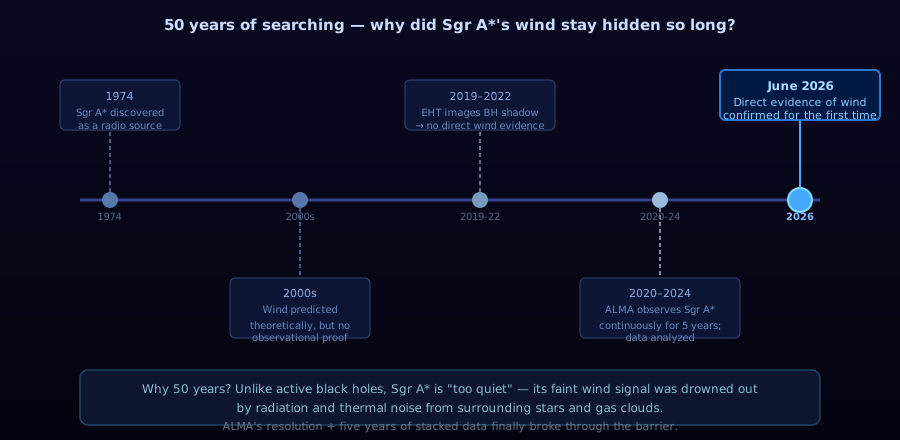
Then, in June 2026, a research team from France’s CNRS and the University of Bordeaux published results from five years of data gathered by the ALMA radio telescope array. They had found unmistakable evidence of a wind. The paper appeared in The Astrophysical Journal Letters, and when the researchers called it “a discovery 50 years in the making,” it was easy to understand why.
What “wind” actually means here
Let’s start with the term itself, because “black hole wind” sounds dramatic in a way that might be misleading.
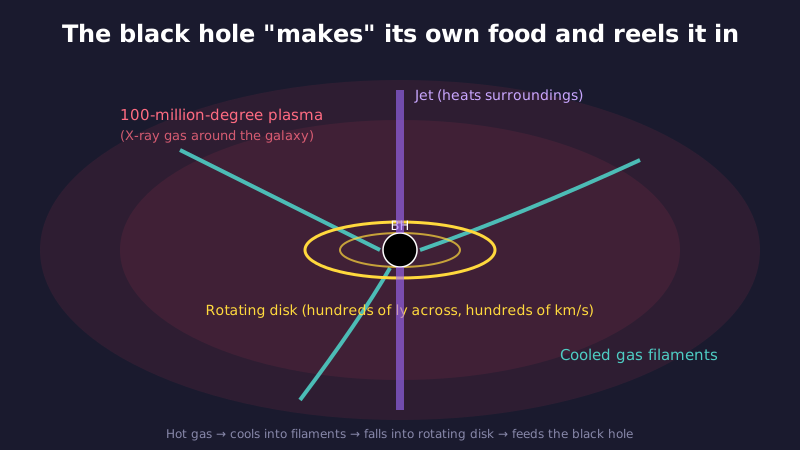
When gas and dust fall toward a black hole, they don’t plunge straight in. Instead, they spiral inward, forming a swirling structure called an accretion disk. The friction within that disk heats the material to extreme temperatures and makes it glow intensely.
Here’s where things get interesting: not all of that heated gas actually falls in. Some of it gets launched outward — away from the black hole — at high speed. That outflow is what astronomers call the wind. It’s a real stream of particles and molecular gas that can sweep through the surrounding space with considerable force.
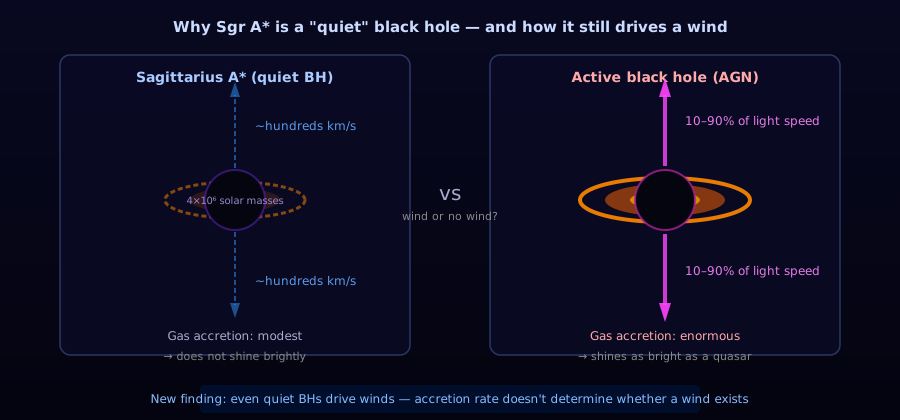
In highly active black holes — what we call active galactic nuclei, or AGN — these winds can reach tens of percent of the speed of light. They carry enough energy to reshape entire galaxies, and that idea has become a cornerstone of modern theories about how galaxies form and evolve.
The problem was Sagittarius A*.
Sagittarius A* was “too quiet”
Sgr A* sits about 26,000 light-years from Earth — close, by cosmic standards. Yet for 50 years, nobody could get solid evidence that it was driving any kind of wind at all.
The reason is simple, if frustrating: Sgr A* is just too faint.
Unlike active black holes, Sgr A* accretes very little gas. That means its accretion disk is weak, the radiation it emits is modest, and any wind it produces would be an extremely faint signal. Layer on top of that the fact that the galactic center is a crowded, noisy place — packed with stars and gas clouds that create an overwhelming amount of background interference — and a subtle outflow becomes nearly impossible to isolate.
This wasn’t really a technology problem. It was more a question of knowing what to look for and how.
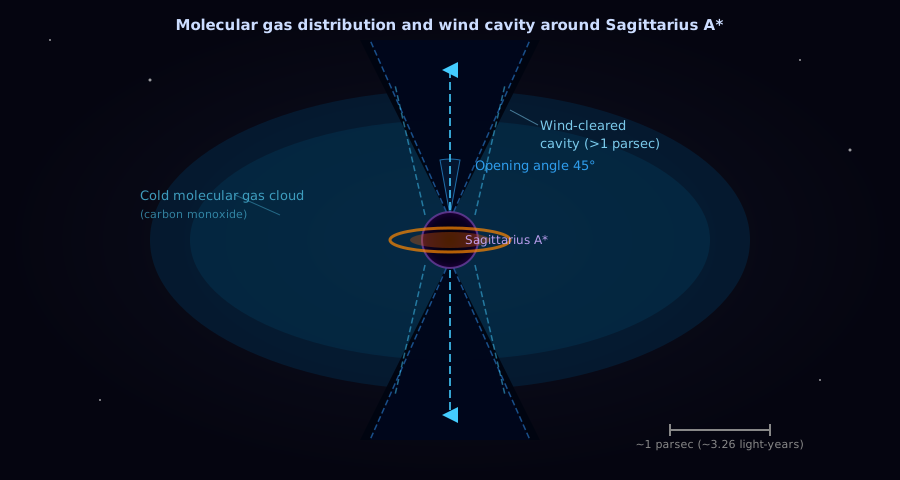
The research team focused on carbon monoxide, or CO — a molecular gas that’s abundant in cold regions of space and relatively easy to detect at radio wavelengths. The logic was straightforward: if a wind exists, it should be pushing the cold CO gas aside, carving out an empty region. Look for where the CO isn’t, and you might find the wind.
The cone-shaped hole ALMA found
ALMA — the Atacama Large Millimeter/submillimeter Array — is a system of 66 antennas spread across the high-altitude Atacama Desert in Chile that work together as a single, enormously powerful radio telescope. Its resolution at radio wavelengths is exceptional, making it well-suited to detecting faint signals buried in distant, complex environments.
The team used ALMA to observe the region around Sgr A* repeatedly over five years, from 2020 to 2024. They then stacked and analyzed all the data to produce a detailed map of CO distribution in the area.
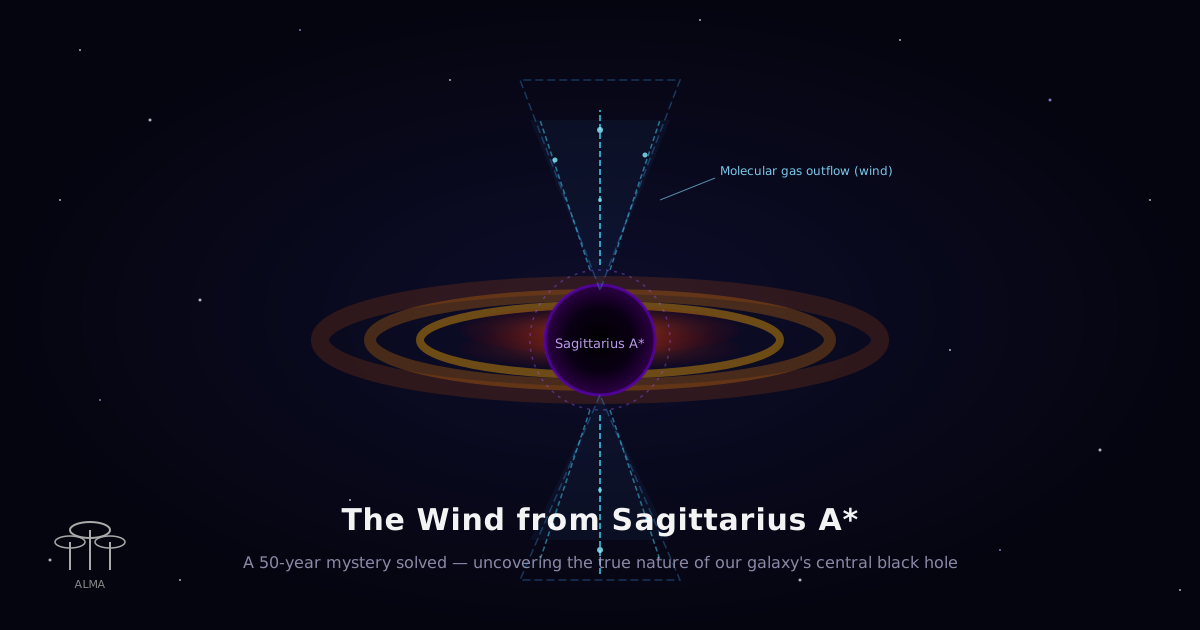
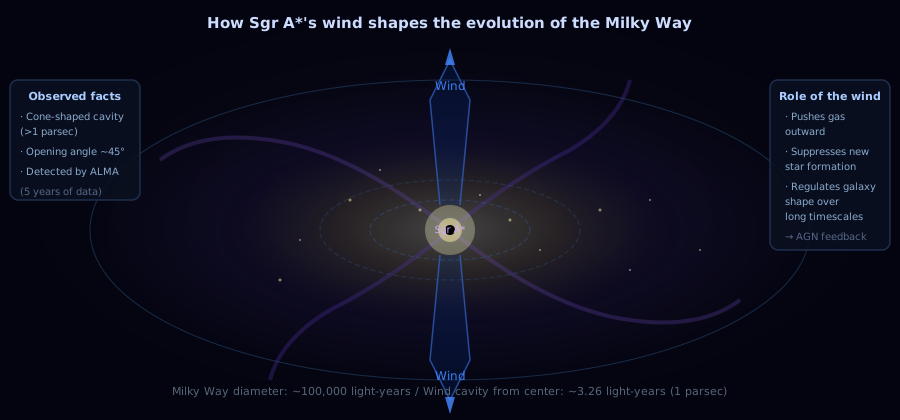
What they found was a cone-shaped void extending above and below the black hole, perpendicular to the galactic plane. The shape is something like two funnels placed end-to-end, pointing in opposite directions. The cavity spans at least one parsec — about 3.26 light-years — with an opening angle of roughly 45 degrees. Inside that cone, cold gas is almost entirely absent.
One of the researchers reportedly described the moment of confirmation as “There it is.” After 50 years of searching, the wind had finally taken visible form.
Why now — and why not sooner?
The timing of this discovery comes down to a combination of accumulated data and patience.
Five years of repeated observations were essential. A signal too faint to distinguish from noise in a single observing run becomes statistically clear when you stack years of data from the same region. That kind of systematic, long-baseline approach takes commitment, and results don’t come quickly.
ALMA’s resolution also proved decisive. Earlier radio telescopes simply couldn’t distinguish the fine spatial detail needed to separate a real cavity from the clutter of nearby stellar emission and tangled gas structures. ALMA cleared that hurdle.
What it means that a “quiet” black hole has a wind
The deeper significance of this discovery is that it challenges a long-standing assumption: that black hole winds are a feature of active, heavily accreting systems.
Sgr A* barely eats. And yet it still blows. That suggests the mechanisms that generate winds are more fundamental than previously thought — rooted in basic physics that doesn’t require extreme accretion rates to operate. If that’s true, then many of the supermassive black holes currently sitting quietly at the centers of other galaxies may be doing the same thing. They look dormant, but they could all be steadily pushing gas around.
For galaxy evolution, that’s a significant reframe. There’s a well-established theory that black hole winds act as a kind of brake on star formation — pushing gas outward, starving the galaxy of the raw material it needs to make new stars. Until now, that braking effect was thought to be the job of active black holes. If quiet ones are doing it too, then the feedback loop between black holes and galaxies could be far more pervasive across cosmic history than our models have assumed.
A quick note on what “now” means here
Just as a reminder of the scales involved: the cavity the team observed reflects the state of Sgr A* some 26,000 years ago. The radio waves that just reached Earth’s telescopes left the galactic center around the time humans were making cave paintings in Europe. What’s happening at Sgr A* right now won’t be visible to us for another 26,000 years.
That’s a genuinely strange thing to sit with. But even without that immediacy, finding a 50-year-old answer is something.
The next questions are already forming: Why does the cone open at exactly 45 degrees? What is the precise energy source driving the wind? The current dataset doesn’t reach that far. But at minimum, the premise that “Sgr A* is quiet, so it doesn’t matter much” has been retired. And that alone is enough to redraw parts of the map.
Key takeaways
- For the first time, a wind from Sagittarius A* — the Milky Way’s central black hole — has been directly confirmed, 50 years after Sgr A* itself was discovered
- Five years of ALMA observations revealed a cone-shaped cavity (more than one parsec long, opening angle ~45°) cleared of cold molecular gas
- The finding that even a “quiet,” low-accretion black hole drives a wind could require revisions to models of galaxy evolution
- The next puzzle: why does the wind take this particular shape and size?