About 700 million years ago, two black holes collided somewhere in the universe. The tremor from that collision has now reached an instrument buried underground in Japan.
And here’s the strange part: one of the two black holes appears to have already been the product of an earlier merger.
Black holes are supposed to be born once, when a star dies. But it looks like some of them keep growing, merger after merger. That’s the discovery researchers just laid out, all at once.
A Batch of “Second-Generation” Black Holes, Found Together
The story starts with GWTC-5.0, a catalog of gravitational-wave detections. Gravitational waves are ripples in spacetime itself, produced when massive objects move violently enough to stretch and squeeze the fabric of the universe. The international LIGO, Virgo, and KAGRA collaboration released this latest catalog in 2026.
It now holds 390 confirmed gravitational-wave signals. Of those, 161 are brand new, detected between April 10, 2024, and January 28, 2025. That single observing run — known as O4 — accounts for roughly 75% of everything in the catalog.
Two of those signals, GW241011 and GW241110, are the focus here. They arrived just a month apart, in October and November of 2024.
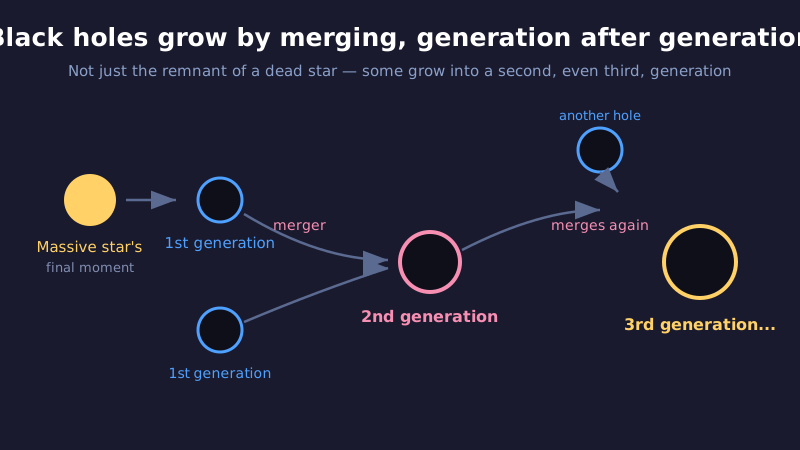
The observing team reports that both events likely involved a “second-generation” black hole — meaning one of the merging objects had itself formed from an earlier merger.
Stop and think about that for a second. Black holes are supposed to be stellar corpses. A star only dies once. So what does “second generation” even mean?
Black Holes Were Supposed to Be Stellar Remains, Full Stop
Under the standard picture, a black hole forms when a star many times heavier than the sun runs out of fuel and collapses under its own weight. The core loses its support and crushes down to a single point. One star, one black hole. End of story — or so it seemed.
I’ll admit I assumed the same thing for a long time. A black hole seemed like a tombstone: once it forms, it just sits there quietly for the rest of eternity.
But there’s a problem. Some black holes are heavier than a single dying star can plausibly produce on its own. In a certain mass range, researchers believe extremely massive stars blow themselves apart completely at the end of their lives, leaving nothing behind. So there’s a gap — a mass range where the usual stellar-death pathway simply doesn’t deliver.
Where do black holes in that gap come from, then? One strong candidate: repeated mergers.
In densely packed environments like globular star clusters, black holes bump into each other far more often than they would in open space. When two merge, the resulting black hole is bigger — and more likely to encounter, and merge with, yet another one. Researchers call this generational buildup hierarchical merging.
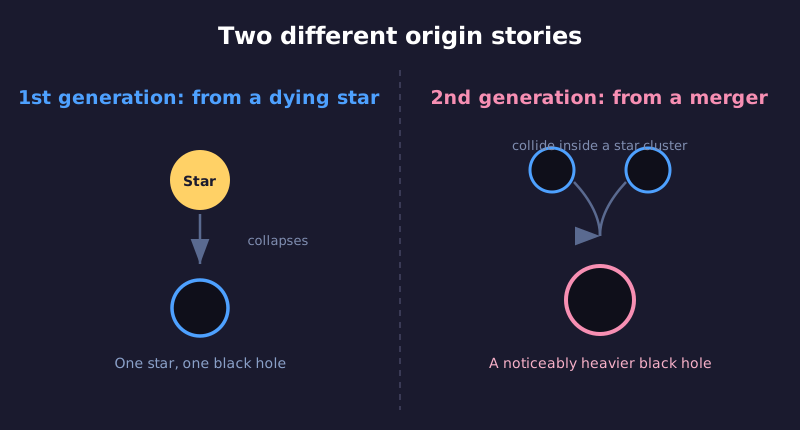
The logic makes sense. But here’s the catch: every black hole looks the same — a black void. All we ever detect is the tremor from the moment of collision itself. So how do you tell whether one of the colliding objects has already lived a full merger history?
The Giveaway: How a Black Hole Spins
This is where it gets interesting. The clue turns out to be spin.
Black holes rotate, and the speed and direction of that rotation leave a subtle fingerprint on the gravitational waveform. The observing team argues that this spin signature is exactly what marks a black hole as second-generation.
There are two reasons for this. First, theory predicts that a black hole formed by merger tends to spin at a particular, telltale rate. Second, inside a star cluster, black holes collide from essentially random directions — so their spins don’t line up neatly the way spins from an isolated binary star system would.
The spins measured for GW241011 and GW241110 matched that prediction closely. That’s the core of the report.
It’s worth being precise here. The measured spin speeds and orientations are hard data. The conclusion — “therefore, second generation” — is the team’s interpretation of that data. It’s presented not as certainty, but as the most natural explanation on the table.
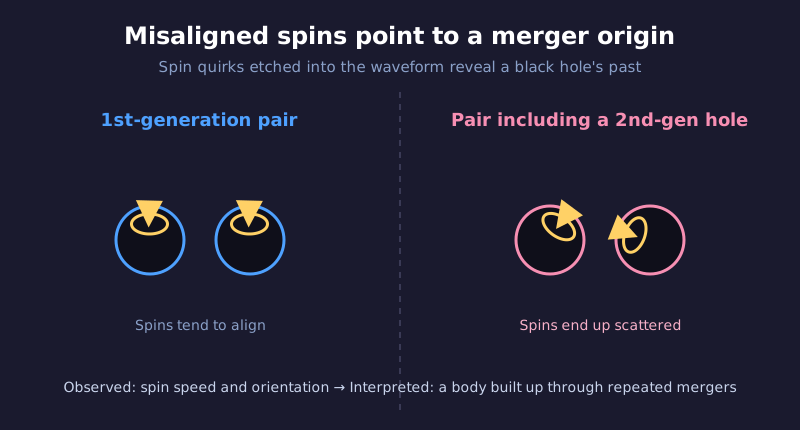
In other words, the quirks baked into an incoming waveform let you trace a black hole’s ancestry. It’s a bit like a detective reading a rap sheet off a single fingerprint — except here, the fingerprint is a ripple in spacetime.
So how far away did this all happen?
700 Million and 2.4 Billion Light-Years — Translating Distance into Time
GW241011 originated roughly 700 million light-years away. GW241110 came from about 2.4 billion light-years out. One light-year is about 5.88 trillion miles (9.46 trillion km) — numbers so large they stop meaning anything as distances.
The trick is to translate distance into time instead. A light-year is the distance light travels in one year, so light arriving from 700 million light-years away shows us that place as it looked 700 million years ago. From 2.4 billion light-years, we’re seeing 2.4 billion years into the past.
700 million years ago, Earth barely had any complex life to speak of. Go back 2.4 billion years, and you’re at roughly the point when oxygen was just beginning to build up in Earth’s atmosphere.
Which means the tremor behind GW241110 set out across the universe when Earth’s skies were still nearly oxygen-free — and spent 2.4 billion years crossing the cosmos to arrive right around the moment humanity finally built instruments sensitive enough to catch it. The timing is almost too perfect to be believed.
Picture yourself floating near that collision site. Two black voids circling closer and closer, then in one final instant, ringing spacetime like a bell as they merge into one. That vibration traveled for 2.4 billion years before anyone was around to catch it — and it just landed in our data.
Why We’re Only Seeing This Now
Worth pausing on one thing: second-generation black holes didn’t suddenly start existing. What changed is our ability to spot them.
The key is precision and sheer numbers. GWTC-5.0 broke several records at once. GW250114, detected on January 14, 2025, delivered the cleanest signal ever recorded, with a signal-to-noise ratio of 76.9. GW240615, detected on June 15, 2024, was pinned down to a sky location just 6 square degrees across — remarkably precise for this kind of measurement.
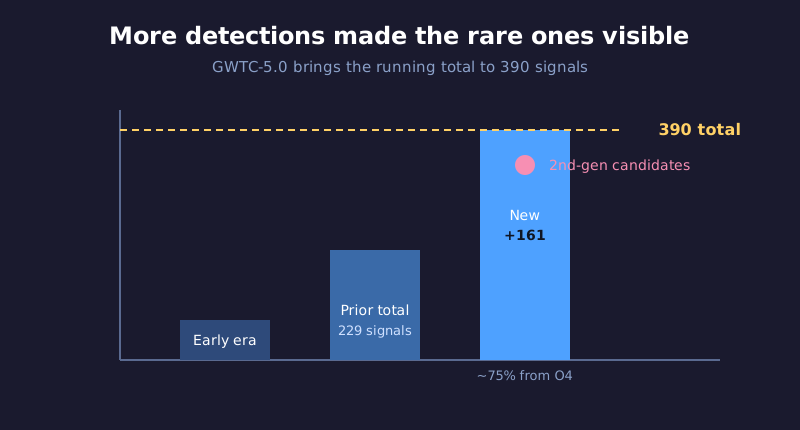
The jump to 390 total detections matters just as much. Rare objects like second-generation black holes only become visible once you have enough of a sample to work with. One or two events could easily be coincidence. Line up hundreds, though, and the “misalignment” in spin orientation starts to stand out as a real pattern.
Accumulating raw numbers is what makes it possible to read individual origin stories. It sounds unglamorous, but I’d argue it’s doing the most work here.
Black Holes Have Family Trees
A star dies and becomes a black hole. That black hole merges and becomes second-generation. The second-generation hole merges again and becomes third-generation. Climb that ladder, and you reach masses that stellar death alone could never produce.
What genuinely gives me chills is the idea that black holes have something like a family tree. Not a single, solitary tombstone, but an object that meets others, merges, and builds up across generations. They might be far more “social” than we ever gave them credit for.
The instruments reading that family tree — including KAGRA, buried deep in the mountains of Gifu, Japan — span the globe. Right now, somewhere out there, the tremor from another black-hole merger is racing toward Earth at the speed of light.
A message that left home 2.4 billion years ago just became a single line in this morning’s data log. That’s the world we’re living in now.