The closest photo of a lander lying face-down on the Moon was taken by a silver sphere about the size of a baseball.
And the mechanism that lets that sphere transform? It comes from a toy company. Its name is SORA-Q. It weighs just 250 grams — about as much as a single orange.
In June 2026, a JAXA-led research team reported the results in the peer-reviewed journal Science Robotics. It’s the record of a tiny robot that actually deployed on the Moon, transformed, drove, and photographed a fallen lander.
Who photographed the lander lying face-down?
The story starts on January 20, 2024 (Japan time), the day JAXA’s SLIM lander touched down on the Moon.
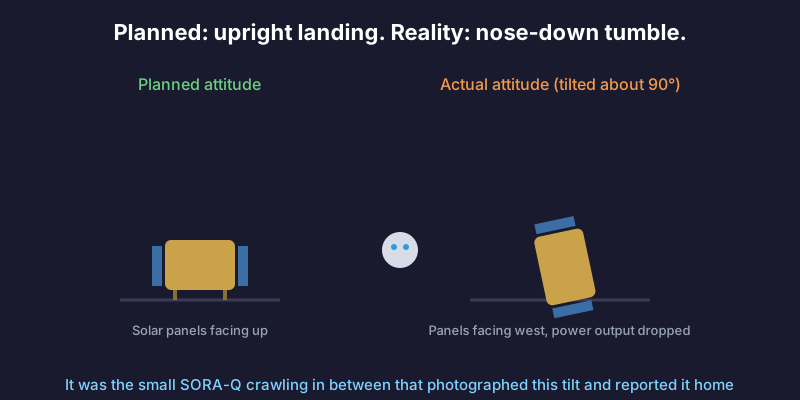
SLIM had one big goal: a “pinpoint landing” within 100 meters of its target site. It nailed that. Previous Moon landings counted a miss of several kilometers as a success. Squeezing the margin down to 100 meters was precision on a whole different level. But once it touched down, the lander’s posture wasn’t what anyone expected.
The spacecraft came to rest nose-down, tipped almost onto its front. Its solar panels, which were supposed to face upward, ended up lying sideways and pointing west instead. Power generation suffered, and mission control on the ground was left wondering exactly what state SLIM was in.
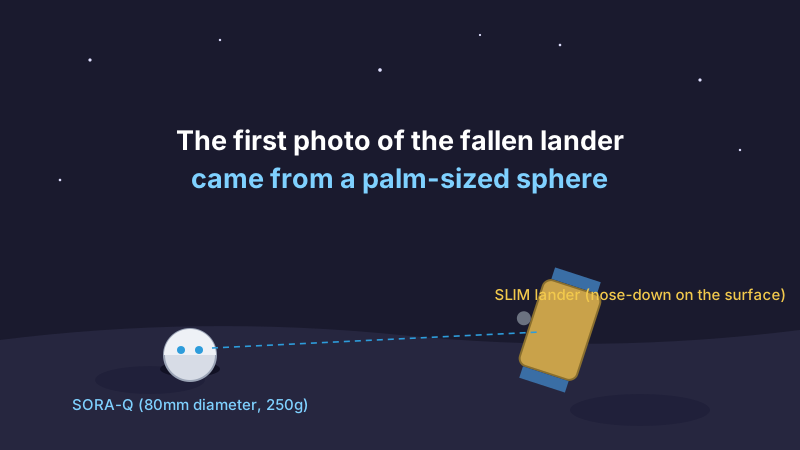
That’s where SORA-Q came in — one of two small robots SLIM had ejected just before touchdown. The sphere reshaped itself on the lunar surface and photographed the fallen lander. That image was what told the ground team the spacecraft had landed nose-down.
The second robot handled radio communication. Both were released from SLIM in the final moments before landing. In a tense window when no one on Earth even knew whether the lander had survived, these two small companions delivered the first picture.
A palm-sized sphere reported back on the condition of a much larger spacecraft. It feels backward somehow — and I find that a little odd, in a good way.
Baseball-sized, 250 grams — an almost absurd number
SORA-Q measures 80 millimeters across, just a bit bigger than a baseball, and weighs 250 grams.
Just how small that is becomes obvious the moment you set it next to other planetary rovers.

Take Perseverance, NASA’s rover currently working on Mars. Its dry mass is about 1,025 kilograms — nearly a ton, roughly the size of a small car. Compared to SORA-Q’s 250 grams, that’s a difference of about 4,000 times.
Honestly, the first time I saw this comparison, I double-checked the zeros. One is a car. The other is an orange. It’s almost strange to lump them both under the label “planetary robot.”
Why does small matter so much? In spaceflight, shaving off even a single gram eases the burden on a launch vehicle. For a mission like SLIM, which was already built to be small and light, every gram its companion robots saved mattered too.
The idea: split the sphere open and walk
So how does a 250-gram sphere actually get around on the Moon? This is my favorite part of the whole story.
SORA-Q gets dropped onto the lunar surface still in its spherical shape. On landing, the sphere pops open, splitting left and right. The two halves become wheels, and the robot crawls across the ground.
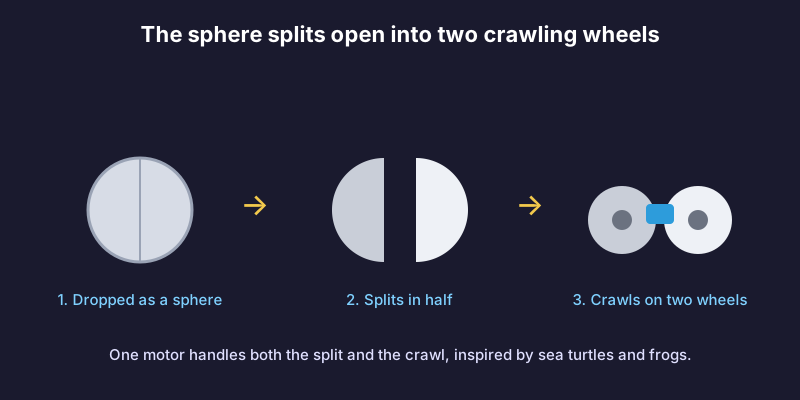
The team modeled its motion on sea turtles and frogs. Two small cameras, front and back, capture footage as it moves — and those same cameras are what caught SLIM’s tipped-over silhouette.
The photo that caught SLIM showed the main engine nozzle pointing skyward. A rocket exhaust nozzle is supposed to face the ground. Seeing it aimed at the sky was clear evidence the spacecraft had pitched forward onto its nose. That single image was enough for the research team to work out SLIM’s exact posture.
SORA-Q itself, though, has no way to beam images back to Earth on its own. That’s where the second robot, LEV-1, comes in. This hopping little machine communicated directly with Earth. SORA-Q handed its photos to LEV-1, and LEV-1 relayed them to mission control. It took two tiny robots splitting the workload to get that first picture home.
And no one was steering SORA-Q by remote control from Earth. The Moon sits roughly 380,000 kilometers away, and radio signals take real time to travel that distance. So SORA-Q was built to act autonomously — once released, it had to transform and shoot its footage entirely on its own, within a tight operating window.
Takara Tomy, a toy manufacturer, contributed the transformation mechanism. The company has spent decades building transforming toys, Transformers among them, and its know-how in making things fold, shrink, and hold up to abuse without breaking translated directly into hardware for the Moon.
Sony Group and Doshisha University also took part in the development. A space agency, an electronics maker, a university, and a toy company — just picturing that lineup building a lunar robot together is a little delightful.
Simplicity as a strength when things go wrong
Here’s the real point. Why bring something this small and simple to the Moon in the first place?
A large rover packs in more functions and higher performance, but that also means more parts and more wiring. Complexity is fragile — a single snag anywhere in the system can bring the whole thing to a halt.
SORA-Q’s design philosophy runs the opposite direction. Strip away extra functions, use as few motors as possible. All it does is split open and become wheels. Fewer moving parts mean fewer things that can break.
Remember, SLIM landed nose-down, nothing like the plan called for. It was a textbook case of a mission not going according to plan.
And in that exact moment when nothing was going as expected, SORA-Q still separated, transformed, drove, and shot its photo. A small sphere with no flashy features ended up being the thing that handled the unexpected. The research team’s conclusion: this kind of small, simple design works precisely because the lunar surface is such a harsh, unpredictable place.
We tend to assume that strength means more features. This little sphere showed, on the Moon itself, that isn’t always true.
2026: a peer-reviewed paper for the “build it small” philosophy
I’ll admit it — I first learned about SORA-Q’s exploits from the landing-day news, and then forgot about it. Turns out the story wasn’t over.
In June 2026, the research team compiled the full results in Science Robotics. Rather than just a headline from landing day, this is now a peer-reviewed academic record of a small robot that actually worked on the lunar surface.
That matters more than it might seem. “Build it small and simple” has long been dismissed as a budget compromise, a cheaper option rather than a real design choice. Now there’s peer-reviewed evidence that it’s a genuine strategy that holds up in one of the harshest environments we know.
It opens up a new option for future missions to the Moon and other worlds: instead of sending a single one-ton rover, scatter a swarm of palm-sized robots. If one stops working, the rest keep going.
That said, plenty of jobs still call for a large rover, and small robots aren’t about to replace them. What this adds is simply another tool for the right situation.
Palm-sized technology, standing on the Moon
Imagine standing on the Moon and watching this sphere at your feet pop open, turn into wheels, and start moving. I suspect it would feel less like watching a machine and more like watching something alive.
Behind that motion is technology from a transforming toy you might have played with as a kid. A toy store shelf and a lunar surface 380,000 kilometers away — two places that should have nothing to do with each other, connected by a 250-gram sphere.
Next time you spot a transforming robot toy, remember this: somewhere up on the Moon, a close relative of that same mechanism is rolling around right next to a fallen lander.