Some 858 light-years away, a giant planet is spilling its own atmosphere into space. And the trail it leaves behind isn’t behind at all — it’s on both sides.
That’s what the James Webb Space Telescope found after tracking the escape uninterrupted for one full orbit. According to the research team, this is the first time anyone has caught an exoplanet’s atmosphere leaking away across an entire orbital cycle, start to finish.
Two tails, one trailing and one leading. Right away, something doesn’t add up. Comet tails always point away from the sun — that’s the rule. But this planet was dragging a tail out in front of it too, in the direction it was actually moving.
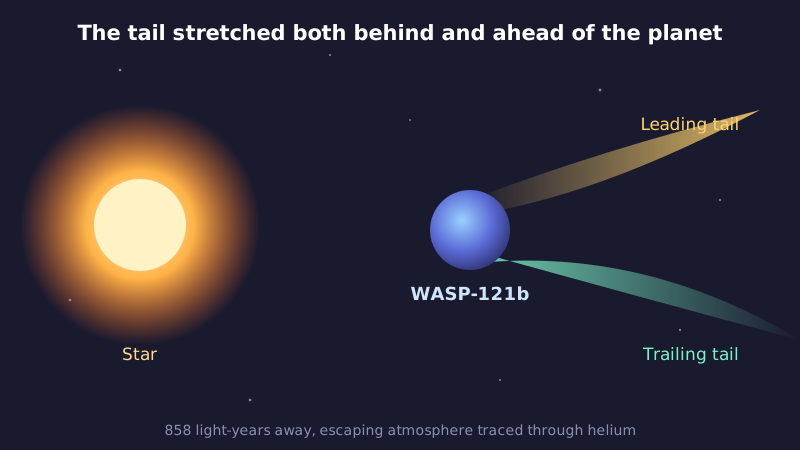
Two tails, front and back
Let’s start with what was actually observed.
The planet in question is WASP-121b, roughly 858 light-years from Earth in the constellation Puppis. Discovered in 2015, it’s a gas giant slightly larger than Jupiter — about 1.16 times Jupiter’s mass and 1.75 times its radius.
Astronomers already knew this planet was losing its atmosphere. But every previous observation had captured just one moment of the orbit — a single frozen frame. You’d get a fragment, never knowing quite where the planet was in its cycle when the picture was taken.
This time, the team used JWST to follow the entire orbit continuously. What emerged was a double-tail structure: escaping gas stretching not just behind the planet, but ahead of it too. The team published the findings in Nature Communications in 2025.
Two tails. So why does the gas behave this way? To answer that, it helps to understand just how brutal a place this planet actually is.
A year that lasts 30 hours, and a sky where iron melts
WASP-121b belongs to a class known as ultra-hot Jupiters — the most punishing subset of hot Jupiters, the giant gas planets that orbit dangerously close to their stars.
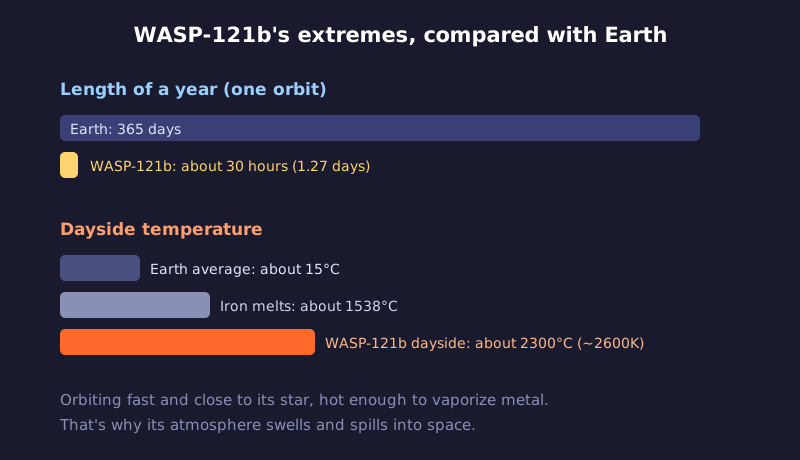
How close? Its orbital period is about 1.27 days — roughly 30 hours. Earth takes 365 days to circle the sun. This planet finishes a full year in a little over a single day.
Being that close means being that hot. Dayside temperatures reach around 2,300°C (about 2,600 Kelvin). Iron melts at roughly 1,538°C, so this is a world where even metal can turn liquid and boil away. In fact, astronomers have already detected vaporized metal in the planet’s atmosphere.
The first time I saw that number, I assumed it was a typo. This isn’t really a planet so much as a fireball that happens to be getting continuously roasted next to a star.
If you could somehow stand on this planet’s surface, its sun would loom over most of the sky — inescapable heat and light, all the time. In an environment like that, an atmosphere simply can’t sit still and cling to the planet.
Why the atmosphere is leaking away
Hot gas expands. Just like steam bursting out of a boiling kettle, an atmosphere baked by extreme heat keeps pushing outward and upward.
The trouble is that this planet sits practically on top of its star, and proximity means the star’s gravity pulls hard. As the outer atmosphere swells and loosens its grip on the planet’s own gravity, the star’s pull rips it away. There’s a boundary — called the Roche lobe — marking the limit of atmosphere a planet can still hold onto. WASP-121b’s atmosphere appears to be spilling right past that boundary.
Think of the Roche lobe as the amount of atmosphere a planet can hug in its own arms. Whatever spills past those arms, the planet can no longer support. WASP-121b sits so close to its star that this huggable zone has already shrunk down small. So once the atmosphere puffs up even a little, it slides right off the edge — and the star’s gravity yanks the escaping gas away even harder.
Pause here for a second. When you hear that a planet is “losing its atmosphere,” you might picture a slow fade over billions of years. But what’s happening on this planet is fast enough, and forceful enough, to carve out a visible structure in real time.
So how did researchers actually see that escaping gas? The answer is helium.
How helium reveals the escape route
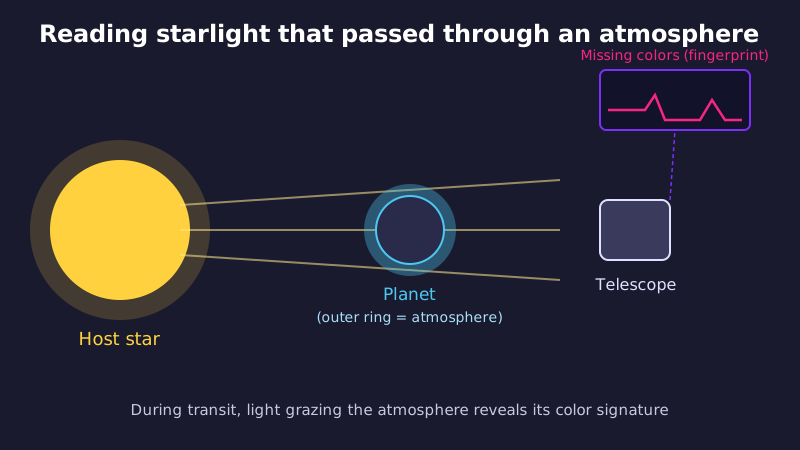
When researchers want to observe an atmosphere in the act of escaping, helium is one of the most useful signals available — specifically, near-infrared light around 1,083 nanometers, where fleeing helium gas shows up almost like a silhouette.
Why is helium so convenient? Escaping gas spreads out far wider and thinner than the planet itself. As that spread-out gas passes in front of the star’s light, it absorbs a small sliver of specific wavelengths. From the shape and depth of that absorption, researchers can work out where the gas is, how much there is, and how fast it’s moving.
But why does 1,083 nanometers work so well? In simple terms, hot and thin escaping helium happens to absorb light at exactly this wavelength unusually strongly. Picture standing on a train platform, catching only the glow of a passing train’s interior lights leaking through the windows as a kind of shadow. That’s roughly the effect: this technique picks out only the thin, far-flung escaping gas, ignoring the dense atmosphere still clinging close to the planet. That’s how you get a clear outline of exactly how far the gas traveled, and in which direction.
JWST ran this measurement continuously through an entire orbit — as the planet passed in front of its star, swung around the side, and slipped behind it. Every angle, stitched together without a gap.

I’ll admit it: I always assumed atmospheric-escape observations meant catching one precise instant — the planet crossing in front of its star, nothing more. Watching a full orbit changes that picture entirely. It confirms the tail isn’t some coincidence visible only from one particular angle — it’s a structure that exists no matter how you look at it. That’s the real significance of this observation.
And it’s exactly because the team watched the whole orbit that they could confirm there wasn’t just one tail. There were two.
The strangeness of a tail pointing forward
Normally, escaping gas trails behind a planet the way a comet’s tail streams away from the sun. A trailing tail, sure, that makes sense. What’s strange is that a tail also stretched out ahead of the planet, in the direction it was traveling.
Why would that happen? Boiled down, the research team’s explanation goes something like this: gas doesn’t escape from just one spot on the planet. It leaks out from both the side facing the star and the side facing away.
Gas that escapes toward the star falls into an orbit slightly closer in than the planet’s own. Inner orbits move faster, so that gas outpaces the planet and swings around to lead it from the front. Gas that escapes on the far side, meanwhile, drifts into a slightly wider orbit, moves slower, and gets left behind. The front and back tails, in this picture, come down to a simple difference in orbital speed.
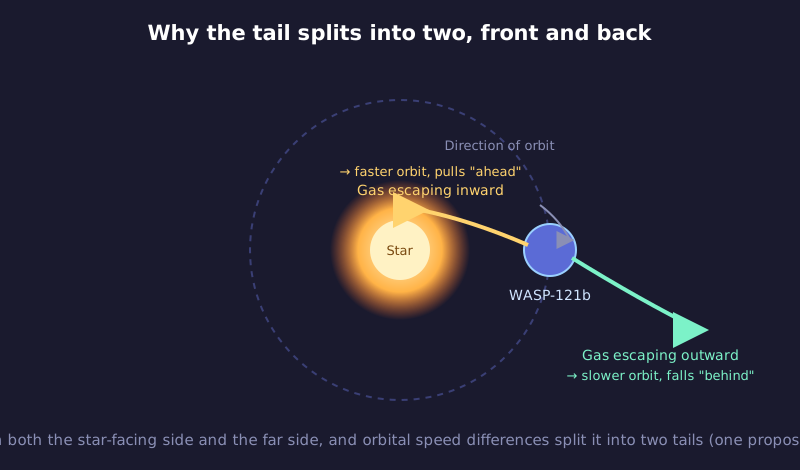
Here’s the part I find most interesting: according to the research team, current models of atmospheric escape can’t fully reproduce this double-tail structure. In other words, the observation has outrun the explanation. The exact mechanics of why the gas settles into this particular shape are still an open question.
Watching a planet waste away, in real time
For most of exoplanet science’s history, the goal has simply been confirming that a planet exists at all. Of the more than 5,000 exoplanets discovered so far, most were inferred from tiny dips in starlight — indirect evidence, nothing more.
What this observation shows, I think, is that we’ve entered an era where a distant planet can be followed not as a still image but as an unfolding process — tracked continuously across a full orbit. You can watch, step by step, how a planet loses its atmosphere and what shape the resulting tail takes.
Right now, at this very moment, WASP-121b’s atmosphere is still spilling into space. But the light JWST is capturing left the planet roughly 858 years ago. In Japanese historical terms, that’s light emitted around the end of the Heian period — arriving at our telescopes only now.
Somewhere inside that ancient light, a scorching planet is dragging two tails, one ahead and one behind, as it races around its star in just 30 hours.