A few milliseconds. Shorter than a blink, a fraction of one. Somewhere out in the cosmos, a burst of radio waves flares and vanishes.
For a long time, nobody knew what caused it — and stranger still, some of these flashes repeat from the same spot, over and over, with no discernible rhythm. Recently, researchers discovered that one of these radio sources wasn’t alone after all. It had a companion.
A Flash Lasting Milliseconds, Origin Unknown
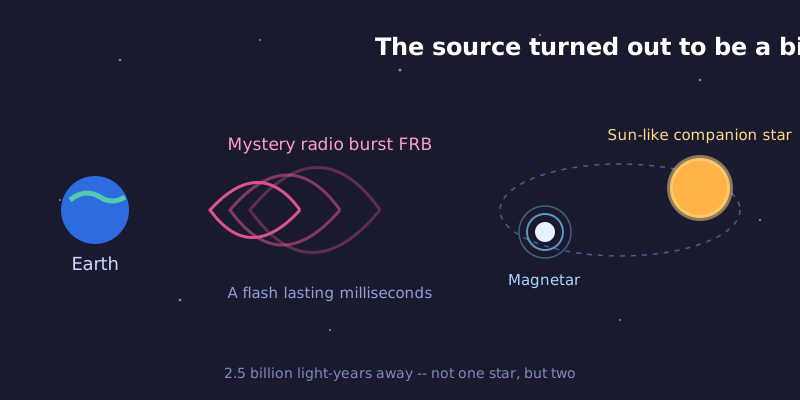
Let’s start with the star of this story: the fast radio burst, or FRB.
As the name suggests, it’s an intense flash of radio waves that lasts only an instant — typically a few milliseconds. So brief, in fact, that when astronomers first spotted one, they suspected their equipment had glitched.
But the energy packed into that instant is staggering. A single burst can release as much energy as the Sun puts out over several days — all of it crammed into less time than it takes to blink.
The distance to today’s subject, FRB 220529A, makes your head spin even more. It’s roughly 2.5 billion light-years from Earth. Light itself takes 2.5 billion years to make that trip.
When this light began its journey, Earth didn’t even have multicellular life yet. Microbes were still drifting through the oceans. The radio waves reaching us now set out in that era. Somehow, that makes a few milliseconds of flickering light feel a lot heavier.
Here’s the tricky part: some of these FRBs repeat from the same location, but irregularly. No steady cycle, just occasional flashes whenever they feel like it. Where do they come from, and why do they repeat? For years, this was one of astronomy’s stubborn puzzles.
The Suspected Source: Magnetars, Magnets the Size of a City
So what’s actually producing these bursts? The leading suspect is a magnetar.
A magnetar is a type of neutron star — the extraordinarily dense, compact remnant left behind after a massive star explodes as a supernova — carrying a magnetic field of almost unimaginable strength. It’s essentially the leftover ash of a star that collapsed under its own weight at the very end of its life.
That collapse is extreme. A mass comparable to the Sun’s gets compressed into a sphere only about 20 kilometers across — roughly the size of a mid-sized city.
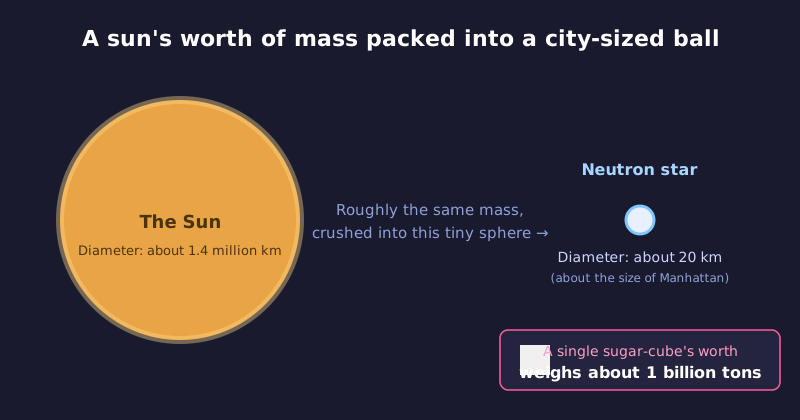
To grasp just how absurd that density is, picture a sugar cube. Scoop up a sugar-cube-sized chunk of neutron star material, and it would weigh about a billion tons. A cube that fits in your palm, containing the mass of an entire mountain.
Magnetars wrap all that in an even more extreme magnetic field — about a quadrillion times stronger than Earth’s. Forget deflecting a compass needle; get close enough, and this field would bend the very atoms in your body.
But the real surprise in this new research isn’t just confirming that magnetars are likely the source. It’s something else — a discovery that changes how we picture the whole scene.
Seventeen Quiet Months, Then Late 2023
Researchers had been watching FRB 220529A for a long stretch using FAST, the giant radio telescope in China. FAST’s single dish spans 500 meters across, making it one of the largest radio telescopes on Earth.
Five hundred meters might not mean much on its own, so picture this: a reflective surface equivalent to roughly 30 soccer fields, nestled into a natural depression in the mountains. That sheer size is what lets it pick up faint radio signals from 2.5 billion light-years away.
The team patiently monitored FRB 220529A with this telescope. For a long while, nothing particularly interesting happened.
The observation campaign ran for about 20 months. For roughly 17 of those months, the radio bursts behaved exactly as expected — flickering on, then off, without any unusual quirks.
Then, near the end of 2023, everything changed. A signal that had stayed calm for so long suddenly showed a bizarre shift. One particular value spiked to more than 100 times its usual level.
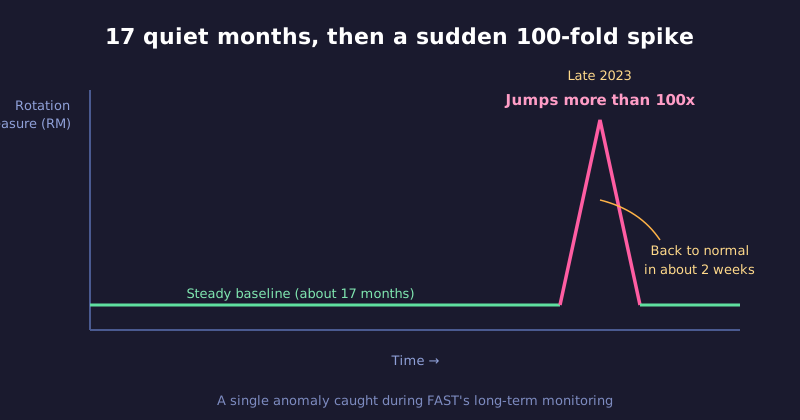
And just as quickly, it faded. Over roughly two weeks, the spiked value settled back down to its baseline. A long stretch of calm, punctuated by one brief storm. Those two weeks turned out to hold the key to the whole mystery.
The Radio Waves Got “Twisted” — A Clue Called Rotation Measure
What was that mysterious value that jumped a hundredfold? It’s called rotation measure (RM). Bear with a short detour here — once you understand this, the rest of the puzzle snaps into focus.
Radio waves and light both oscillate in a specific direction relative to the direction they’re traveling. That direction of oscillation is called polarization. You’ve likely experienced this already: polarized sunglasses cut glare off water by blocking light oscillating in certain directions while letting the rest through.
When a radio wave passes through gas threaded with a magnetic field, its polarization angle rotates — it gets twisted. Rotation measure quantifies exactly how much twisting occurred. It’s essentially a record-keeper, logging what kind of gas the wave passed through along its journey.
And in late 2023, that record-keeper reported something unusual: this time, the twist was off the charts — a hundred times the normal amount. That means dense, strongly magnetized gas — something that normally isn’t anywhere near the radio wave’s path — had suddenly appeared right in its way.
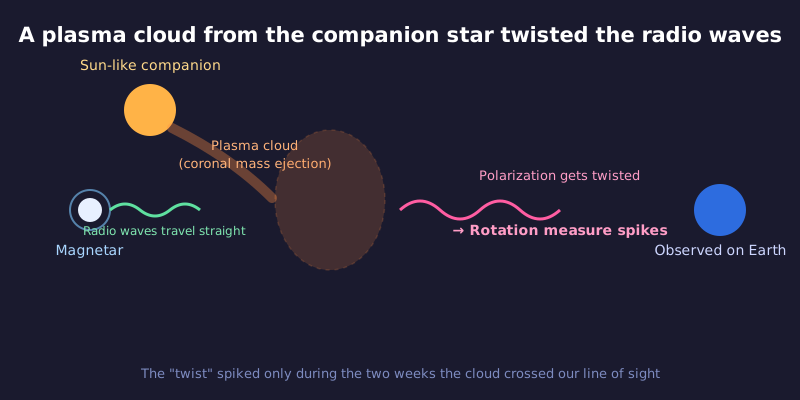
And then, just two weeks later, it was gone. Fixed structures like stars or nebulae simply can’t appear and disappear that fast. Something had to have swept quickly across the radio wave’s path. So what was it?
A Storm from the Companion Star
Here’s where the research team landed on their answer — the “companion” that gives this story its name.
Our own Sun occasionally produces something called a coronal mass ejection, or CME: a massive burst of plasma (electrically charged gas) hurled violently into space. It’s essentially a solar eruption. When one of these reaches Earth, it lights up auroras and sometimes scrambles communications and GPS systems.
The research team believes the same mechanism explains FRB 220529A’s brief anomaly. A star much like our Sun orbits near the magnetar, and that star produced a CME. The magnetized plasma cloud it ejected happened to sweep directly across the radio wave’s path toward Earth. That’s why, for exactly two weeks, the polarization got so violently twisted.
In other words, this radio source was never a lone object. The team strongly favors the interpretation that it’s a binary system — a magnetar paired with a sun-like star.
Picture it: if you were floating near that star system 2.5 billion light-years away, you’d see a star just like our Sun erupting in a fireball right in front of you, while behind it, a city-sized magnet flashes blue-white every few milliseconds. Quite the flashy duo.
Honestly, when I first read this explanation, it had the satisfaction of a detective novel. The smoking gun wasn’t the culprit itself — it was a shadow that flickered past for a moment.
Rethinking What “Repeating” Means
One caveat is worth flagging here. The binary-system conclusion is an interpretation the research team drew from the observed spike in the twist, not direct proof. Not every FRB necessarily comes from a binary system.
Still, this single case reshapes the picture. The team argues it’s decisive evidence that at least some repeating FRBs originate from binary systems. A companion’s presence, it seems, can leave its mark on how the radio bursts behave.
That raises a bigger question: maybe the long-standing puzzle of why these bursts repeat so erratically was never solvable by studying the source alone. There was another player on stage the whole time. Just knowing that changes how the entire signal reads — turning the same data into a completely different story.
Next time you put on polarized sunglasses and watch the glare vanish off a lake, remember what’s happening: light getting sorted by direction. That same property of light is what let a radio wave, twisted just once, 2.5 billion light-years away, quietly give away the presence of a distant star’s companion.