About 530 light-years away, a planet is being born right now — and for the first time ever, we have footage of it happening.
That sentence stopped me when I first read it. We’ve had plenty of images of planet-forming regions before, but nobody had ever actually watched the disk rotate. The difference between a photo and a video might sound minor, but it turns out to be crucial for understanding how planets come together.
On June 1, 2026, a team from the French National Centre for Scientific Research (CNRS) and the University of Bordeaux published a paper documenting something new: the disk surrounding the young star AB Aurigae, caught in motion. The result came from four years of patient, repeated observations — an astronomical time-lapse.
What a Protoplanetary Disk Actually Is
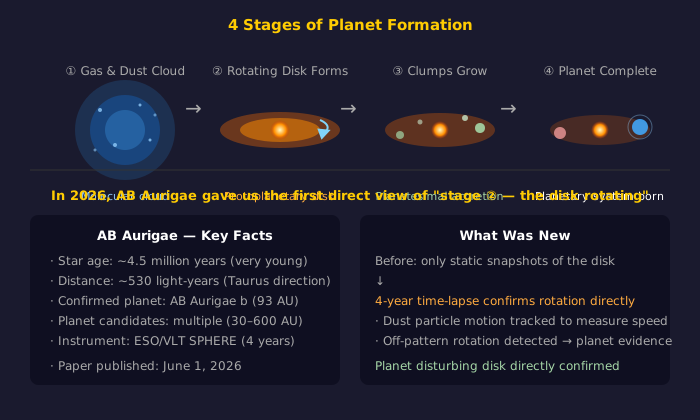
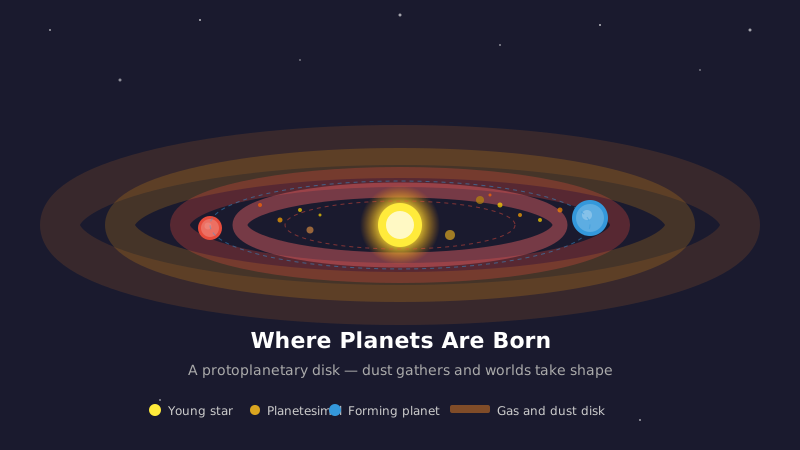
Planets form from the leftover gas and dust when a star is born. As a molecular cloud collapses under its own gravity, a protostar ignites at the center while the surrounding material flattens into a rotating disk. That disk — called a protoplanetary disk — is the raw material depot for future planets.
Inside, dust grains collide and stick, gradually building up into rocky clumps called planetesimals. Those clumps keep growing until, eventually, you have a planet. It’s the standard textbook story, but watching it actually unfold in real time is another matter entirely.
AB Aurigae is one of the rare cases where we can try. It’s a young star — about 4.5 million years old — with roughly twice the mass of the Sun. For context, our own Sun formed 4.6 billion years ago, so AB Aurigae is barely out of the cosmic cradle. It lies in the direction of Taurus, close enough at 530 light-years to study in detail.
From Still Images to Motion Pictures
Earlier observations had already revealed the shape of AB Aurigae’s disk. VLT’s SPHERE instrument — built for high-resolution infrared imaging — had mapped its spiral arms and other structures. But seeing that the disk was rotating? That required something different.
The new study collected data over four years, observing the same system repeatedly and tracking how individual dust particles shifted position. Think of it like photographing a clock face: a single shot shows where the hands are, but only a sequence of images proves they’re actually moving. The team did exactly that — just on a timescale of years rather than minutes.
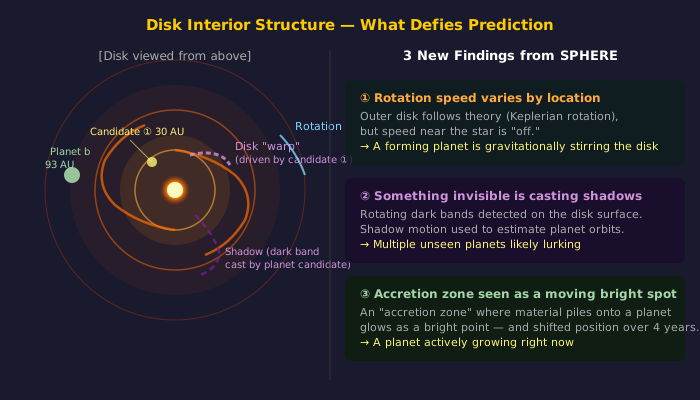
On the whole, the disk rotates cleanly, following the physics we expect (Kepler’s laws). But close to the central star, the motion doesn’t match the prediction.
When the Disk Doesn’t Behave
Here’s where it gets interesting.
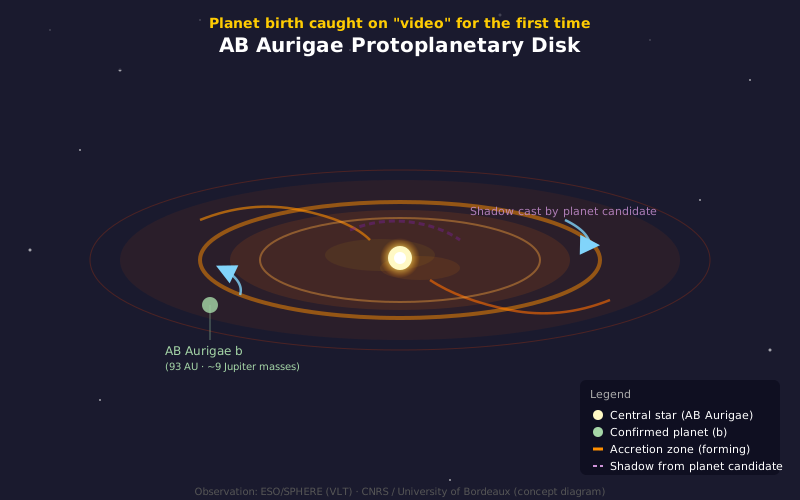
In theory, material in a protoplanetary disk should orbit at speeds set purely by the star’s gravity — what astronomers call Keplerian rotation. In the inner disk around AB Aurigae, that relationship breaks down. The team’s leading explanation is that a massive planet-in-formation is gravitationally stirring the disk, pulling material out of its expected path.
They also found shadows. Dark bands sweeping across the disk surface suggest that something is orbiting fast in the inner region, projecting its shadow outward like a rotating lighthouse beam. Whatever’s causing it isn’t visible directly, but the shadow’s motion points to either a planet candidate or a dense clump of dust concentrated near one.
Then there’s the accretion zone — a bright structure that appears where material is actively raining down onto a forming body. The fact that this bright spot moved over the four-year baseline is strong evidence that a planet is orbiting through the disk, sweeping up material as it goes.
The known planet candidate, AB Aurigae b, sits about 93 AU from the star (93 times the Earth–Sun distance) and weighs in at roughly 9 Jupiter masses. The new data strongly suggest a second candidate lurking closer in, around 30 AU.
Reality Is Messier Than the Textbook
Planetary formation theory has grown impressively sophisticated over the decades. And yet the research team’s conclusion is straightforward: the actual disk behaves in ways that are considerably more complex than any model predicted.
That’s good news, not bad. Nature tends to run ahead of our theories, and every time observations catch up, we learn something new. The unexpected complexity here means our picture of how planets form still has genuine gaps — and now we have a concrete place to look.
Time-series observations like this one may become the standard approach for planet formation research going forward. Motion that a single image can’t reveal becomes suddenly visible when you stack years of data. It’s a familiar story — better instruments changing the questions scientists can ask — but watching it happen in a specific case never gets old.
A Snapshot of Our Own Past
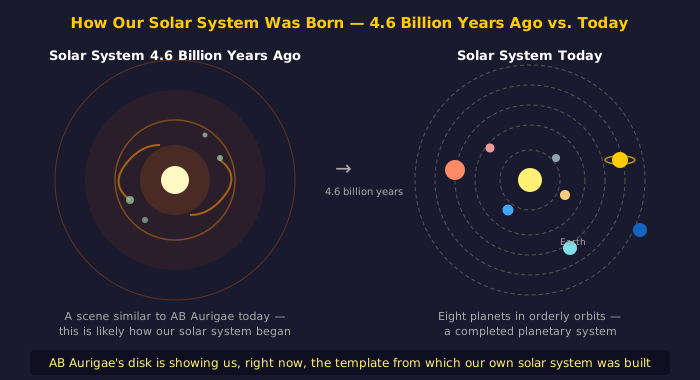
Four and a half billion years ago, our Sun was a young star wrapped in its own disk of gas and dust. Jupiter and Saturn were forming right about where AB Aurigae b sits today, pulling in material from the disk around them.
What makes AB Aurigae special is that we’re watching this process happen right now, in a system that looks like a plausible ancestor of our own. Everything we’re learning there is, in a sense, a letter from our own origins — just 530 light-years away.
Of course, AB Aurigae’s planetary system won’t end up looking like ours. The star is more massive, the disk composition differs, and countless small contingencies will steer things in their own direction. But the underlying mechanics of planet birth should be universal, and that’s what we’re actually seeing in motion.
The team plans to keep watching. ALMA, which maps disks in radio wavelengths, and the future ELT — the Extremely Large Telescope — will add far sharper views. The planet candidates lurking in those shadows might finally show their faces.
We’ve Only Ever Seen Finished Planets
More than 5,000 exoplanets have been confirmed so far. Nearly all of them were spotted as a shadow crossing their host star — the transit method. We learn the planet’s size and orbit, but nothing about how it got there. In that sense, the exoplanet catalog is a museum of finished products, with no assembly instructions.
AB Aurigae is the assembly floor.
We’re watching a planet build itself from raw material, in real time, as a motion picture rather than a snapshot. That shift — from still image to time-lapse, from finished planet to planet-in-progress — is happening now, and it’s changing what planetary science can actually ask.
Understanding how planets form is, ultimately, understanding how Earth became Earth. The fact that a piece of that answer is playing out live, 530 light-years away, is exactly the kind of thing that makes space science feel genuinely surprising.