On a planet 690 light-years away, rock melts every morning, drifts into the sky, and disappears by dusk.
This isn’t a metaphor. It’s what the James Webb Space Telescope (JWST) found and published in May 2026 in the journal Science. When you think of “planetary weather,” water clouds probably come to mind — but on this planet, the sky fills with clouds made from vaporized rock, day after day.
What Kind of Place Is This Planet?
Meet WASP-94Ab. It orbits one of two stars in a binary system about 690 light-years from Earth, completing a full orbit in just four days.
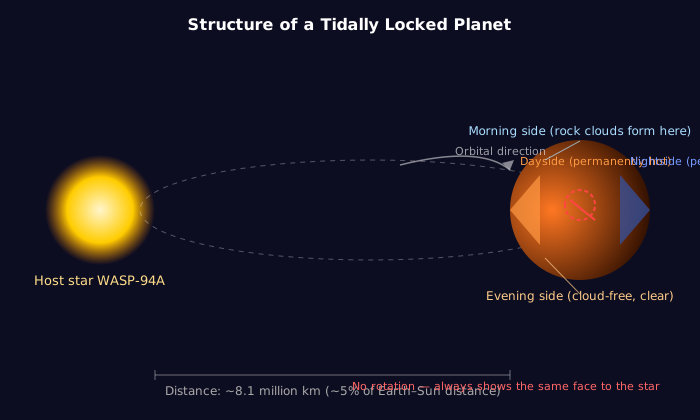
The planet is roughly 1.7 times the size of Jupiter, yet it sits only about 8.1 million kilometers from its host star. For comparison, Earth is about 150 million kilometers from the Sun — meaning WASP-94Ab is a mere 5% of that distance away. At such close range, the surface temperature climbs above 1,200°C. This is exactly what astronomers call a “hot Jupiter.”
And like our Moon relative to Earth, WASP-94Ab is tidally locked — it keeps the same face permanently pointed toward its star. That means there’s a permanent dayside and a permanent nightside. No rotation, which means no sunrise, no sunset. No morning or evening — or so scientists thought.
The “Morning Side” and “Evening Side” Explained
JWST found something unexpected: two distinct regions along the boundary between day and night. Astronomers call them the morning terminator and the evening terminator.
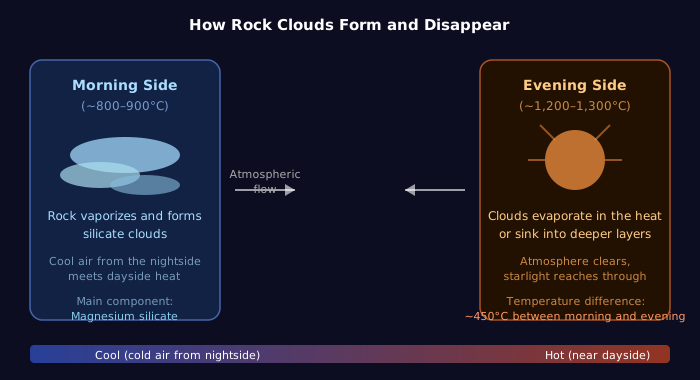
On a hot Jupiter, the atmosphere is never still. Gas heated on the dayside rises, flows toward the nightside, cools, and circulates back. Within this loop, the region where cool nightside air first pushes into the hot dayside becomes the morning side; the region where heated air flows back away from the dayside becomes the evening side.
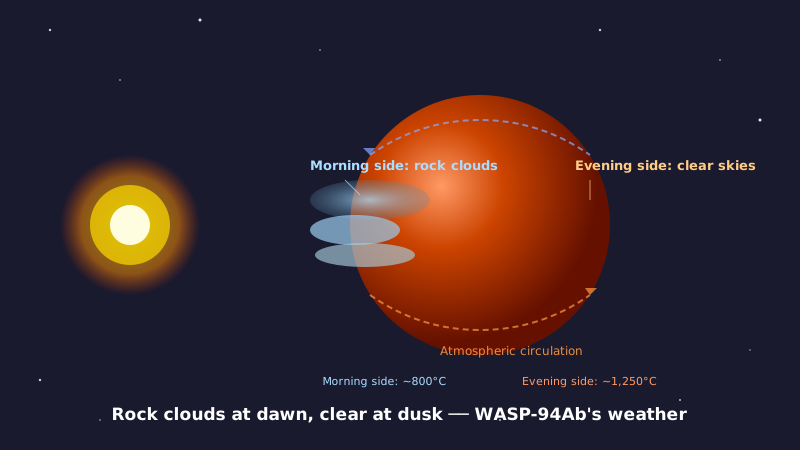
On the morning side, relatively cool nightside air first encounters the dayside’s intense heat — temperatures land around 800–900°C. By the time air reaches the evening side, it has absorbed a full dose of dayside heat, pushing temperatures up toward 1,200–1,300°C.
That’s a temperature swing of roughly 450°C. For context, Earth’s most extreme temperature range — from Antarctica’s record low of -89°C to a desert high of 56°C — spans about 145°C. WASP-94Ab exceeds that by more than three times, all along a fixed line on the same planet.
The takeaway: even a tidally locked planet has a steep temperature gradient. That gradient is the key to everything discovered here.
How Rock Becomes a Cloud
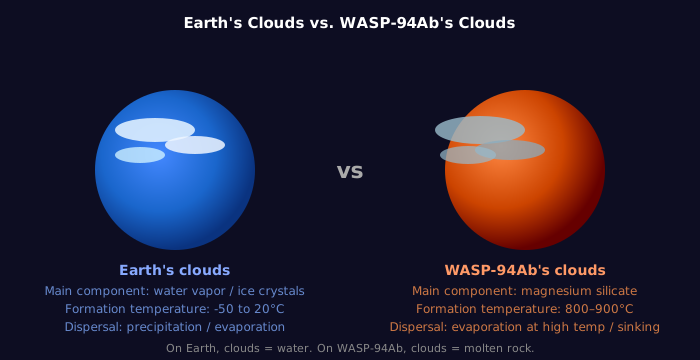
On Earth, clouds are made of water vapor — water evaporates, rises into the atmosphere, cools, and falls back as rain or snow. On WASP-94Ab, rock plays that same role.
The main ingredient is magnesium silicate — an ordinary mineral found in Earth’s rocks, sand, glass, and ceramics. On Earth, you’d need to heat it above 1,700°C to vaporize it. At 800–900°C on WASP-94Ab’s morning side, the material exists as fine liquid droplets drifting through the atmosphere. As this vapor rises into cooler upper layers, it condenses into tiny crystals and assembles into cloud-like haze.
That’s what’s happening on the morning side. Air streaming in from the nightside hits intense heat for the first time, rock begins to vaporize, and the resulting vapor cools enough in the upper atmosphere to crystallize into silicate clouds.
On the evening side, temperatures above 1,200°C are simply too high for the particles to hold together. They keep evaporating — or strong thermal convection drives them into the deep atmosphere. Either way, the clouds vanish.
The parallel to Earth’s water cycle is striking. On Earth: water evaporates from the ocean, cools into clouds, falls as rain. On WASP-94Ab: rock vaporizes, drifts and cools, crystallizes, sinks back down. Different ingredients, same basic pattern — evaporation, transport, condensation, descent.
Earth’s clouds are water. WASP-94Ab’s clouds are rock. The principle is similar; the scale and the materials are worlds apart.
Not Quite Like Any Cloud You Know
It’s worth pausing on just how different these clouds really are from the word “cloud” suggests.
Earth’s clouds form at temperatures between roughly -50°C and 20°C. They consist of water ice crystals or liquid droplets, and they scatter light efficiently — that fluffy white mass in the sky is light and highly reflective.
WASP-94Ab’s clouds float in an atmosphere above 800°C, made of silicate particles. In earthly terms, it’s closer to rock dissolving into gas and recongealing in suspension — less like a sandstorm, more like “stone smoke.”
There’s another key difference: Earth’s clouds move around, appearing and disappearing across the globe. WASP-94Ab’s clouds exist only on the morning side. Half the planet is perpetually shrouded in haze; the other half is perpetually clear. If you were somehow orbiting this planet in a spacecraft, you’d see one hemisphere dusted in a pale brownish murk and the other half sharp and open — a permanent, frozen asymmetry.
Why JWST Was the Only Tool for the Job
WASP-94Ab is not a new discovery. Multiple telescopes, including Hubble, had been accumulating data on it for over a decade. But those observations had a fundamental blind spot.
When earlier telescopes observed a transit — the planet crossing in front of its star — the light filtered through the whole atmospheric limb at once. The morning and evening sides blended into a single averaged signal. A cloudy side and a clear side would cancel each other out.
The analogy: trying to understand Earth’s climate by averaging observations from both poles together. Mixing two drastically different environments destroys the signal from either. Researchers sensed something was off, but for ten years they may have been working with partially incorrect assumptions baked into every analysis.
JWST’s exceptional sensitivity allowed it to apply transit spectroscopy in a new way: analyzing the leading limb (morning side) and trailing limb (evening side) of the planet separately for the first time. The result was unambiguous — the two sides have dramatically different atmospheric compositions.
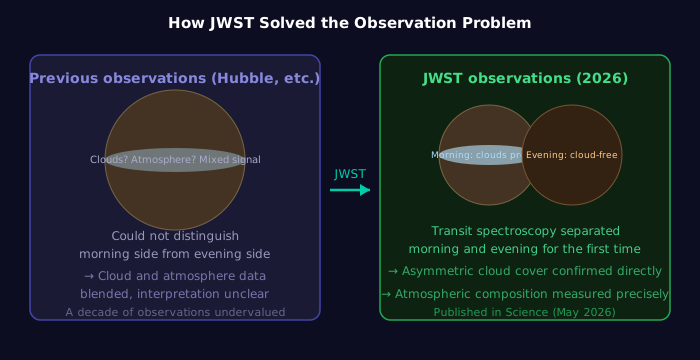
That mismatch in previous data may now have an explanation. And this isn’t just a WASP-94Ab story — other hot Jupiters observed the same way may need a fresh look.
Reading a Planet’s Weather
What makes this discovery particularly compelling is that it captures, for the first time, a complete atmospheric cycle on another world.
“Planetary weather” sounds vague, but it encodes real information: circulation patterns, cloud formation and dissipation, temperature distribution. Being able to observe these directly is enormously valuable for testing atmospheric models.
One point researchers find especially interesting is the comparison to Earth-scale atmospheric physics. WASP-94Ab’s atmosphere looks nothing like ours — but the underlying rules are the same: warm air meets cold air, clouds migrate along temperature gradients, matter cycles between gas and solid phases. The equations that describe it are related to the ones meteorologists use every day.
As JWST applies this approach to more hot Jupiters, a catalog of atmospheric conditions will take shape: what clouds form under what conditions, how temperature drives circulation, what signatures to look for. That catalog will eventually become a toolkit for reading the atmospheres of smaller, more Earth-like planets.
Studying a world where rock melts and floats as clouds — one of the most alien environments imaginable — turns out to be part of the path toward understanding atmospheres closer to our own. Planetary science has always moved forward in roundabout ways like this.
SORABUMI is a space media site delivering knowledge and stories from the universe.