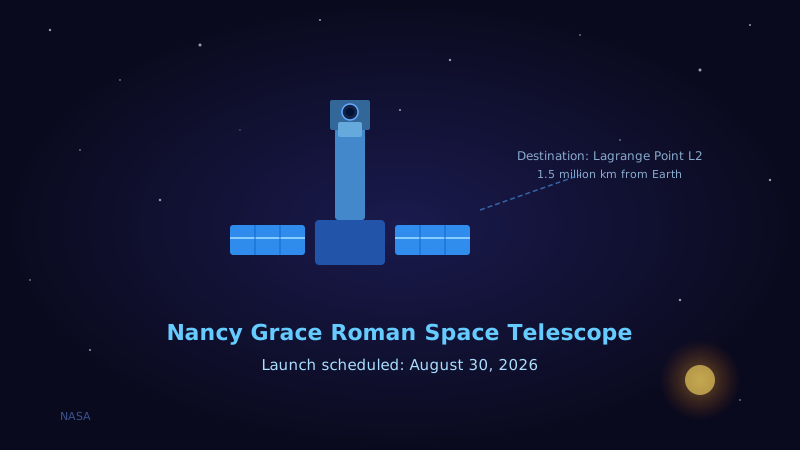
In just over two months — on August 30 — a telescope will leave Earth.
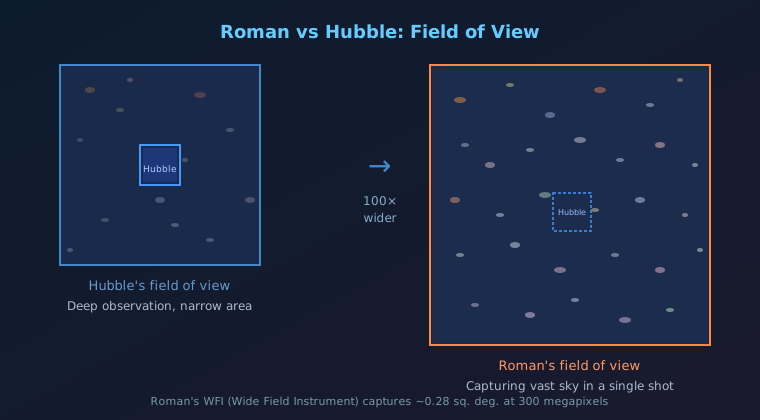
NASA’s Nancy Grace Roman Space Telescope. It weighs more than 2,200 kilograms, its primary mirror measures 2.4 meters across, and its imaging camera packs roughly 300 megapixels. Every one of those numbers is extraordinary, but the most interesting thing about Roman isn’t any single spec. It’s the field of view. Roman can photograph 100 times more sky in a single exposure than Hubble, at the same sharp resolution.
The original target date was May 2027. That’s now been moved up to August 30 of this year — eight months early.
A Finished Telescope, Currently in a Box
In November 2025, Roman was declared complete at NASA’s Goddard Space Flight Center in Maryland. For the six months since, engineers have been preparing it for the trip to Kennedy Space Center in Florida.
Sometime this month — June 2026 — the telescope gets packed and loaded onto a truck. When it arrives, it faces a thorough inspection. Did anything crack in transit? Did a bolt come loose? Is any sensor reading off? Nothing can be repaired once Roman is in orbit, so every check that can be done on the ground, will be done.
After that: launch rehearsals, fueling the hydrazine tank (roughly 1,100 liters), and mating to the rocket. Roman will ride a SpaceX Falcon Heavy to the pad and wait for launch day.
If that sounds anticlimactic — “still talking about pre-launch stuff?” — here’s the thing. With space telescopes, the ground campaign isn’t just logistics. The care taken here directly determines how well the science holds up once the telescope is in space, where no one can touch it.
Why Does a 100x Wider Field Matter?
Hubble transformed astronomy. Distant galaxies, supernova brightness, the age of the universe — over more than thirty years, what Hubble showed us rewrote our picture of the cosmos.
But Hubble has a fundamental limitation. It’s narrow.
The patch of sky Hubble can capture in a single image is roughly 1/50th the area of the full moon. To map a large region, engineers steer the telescope in small steps and stitch the results together like a mosaic — slow, labor-intensive work that makes full-sky surveys nearly impossible.
Roman solves this. Its Wide Field Instrument (WFI) captures about 0.28 square degrees in a single frame — more than 100 times the area of a Hubble image. It does this with a 300-megapixel camera doing infrared observations, while maintaining Hubble-class resolution throughout.
What does that actually unlock? The ability to track hundreds of millions of galaxies at once.
Rather than studying one galaxy deeply, tracking hundreds of millions of galaxies statistically — their distribution, brightness, and distance — reveals patterns across the entire universe. How fast has the universe been expanding, and has that rate changed? Where does mass concentrate? Questions like these demand breadth over depth.
Three Mysteries, Attacked at the Same Time
Roman’s science program has three main pillars.
Dark energy: The universe is expanding, and the expansion is accelerating. Astronomers call the driver of that acceleration “dark energy,” but no one knows what it actually is. It’s calculated to make up about 68% of the total energy in the universe, yet it has never been directly detected. Roman will precisely measure the distribution and redshift of hundreds of millions of galaxies — mapping the history of cosmic expansion across time — to pin down whether dark energy has been constant or has varied. Each survey will tighten the constraints a bit more.
Exoplanets: Planet-hunting has advanced dramatically over the past two decades. Roman will use a technique called gravitational microlensing to statistically catalog more than 100,000 planets within our galaxy. It will also attempt direct imaging of planets around sun-like stars using a specialized coronagraph that blocks a star’s light to reveal the faint worlds orbiting around it. As more direct images of Earth-like planets accumulate, we’ll be able to talk about potentially habitable environments in statistical terms rather than one-off examples.
Infrared astrophysics: This is the broadest category. Galaxy formation and evolution, the large-scale structure of the universe, stellar birth and death, gas dynamics around black holes. Over Roman’s five-year primary mission, the telescope is expected to transmit roughly 20,000 terabytes of data back to Earth — more than most operating space telescopes will collect in their entire lifetimes.

The Best Seat in the Solar System
Roman is heading to a place called Lagrange Point L2, about 1.5 million kilometers from Earth, along the Sun-Earth line extended out the other side — directly “behind” us from the Sun’s perspective.
L2 has a useful property: the Sun, Earth, and Moon all sit in roughly the same direction at all times. Point Roman’s sunshield that way, and a single structure blocks all three bright sources at once. Infrared sensors are sensitive to heat, and L2 provides the stable, cold environment they need.
There’s another benefit. L2 is far enough that the Earth’s glow doesn’t interfere, but close enough that sending large amounts of data home is practical.
The James Webb Space Telescope is already there. When Roman joins it, you’ll have one telescope that surveys wide and shallow, and one that stares narrow and deep, both operating from the same vantage point. Two major space telescopes observing simultaneously from L2 will be an astronomical first.
The Person Behind the Name
Nancy Grace Roman joined NASA in 1958, the same year the agency was founded, and became its first Chief of Astronomy — one of the first women to hold a senior management role at NASA.
She played a central role in developing the concept for the Hubble Space Telescope, earning the informal title “Mother of Hubble.” By the time Hubble launched in 1990, Roman had already retired, but the foundation she built — from concept through organizational structure — was her work. She died in 2018 at the age of 99, and the following year this telescope was named after her.
A telescope bearing the name of the person who helped create Hubble is now set to see a hundred times more of the sky than Hubble can. That continuity is worth sitting with for a moment.

What Happens at the End of August
Launch is August 30. Roman lifts off from Kennedy Space Center on a Falcon Heavy, heading east. A few tens of minutes after launch, the telescope separates from the rocket and begins a roughly 30-day transit to its L2 orbit.
Once there, it won’t immediately start doing science. The sensors need months to cool down and stabilize. The optics require final alignment. Test observations have to verify performance. Space telescopes can’t just be switched on. The first real science data from Roman isn’t expected to be released until at least six months after launch.
By the time Roman sends its first images, billions of years of cosmic history will already be waiting out there for it to collect.
A couple of months from now, a Falcon Heavy will light up its engines and a 300-megapixel camera will leave Earth behind. It’s headed toward the things we know least about — the dark energy and dark matter that make up 95% of the universe. Call it, without too much exaggeration, humanity’s attempt at an answer sheet.
Space telescope launches are always the first step. Everything before that moment is the best preparation that can be done on the ground.
Sources: