A dim, lightweight red star — less than half the mass of the Sun. Orbiting right next to it: a gas giant almost exactly the size of Jupiter, completing one lap every 39 hours. In theory, this combination shouldn’t be possible.
When I first came across this system, my honest reaction was something like, “Wait, that can’t be right.” Apparently the scientists who discovered it had much the same response. The team named it “the forbidden planet.” Why forbidden? And why does it exist anyway? Let’s dig in.
Meet the “Red Dwarf” 285 Light-Years Away
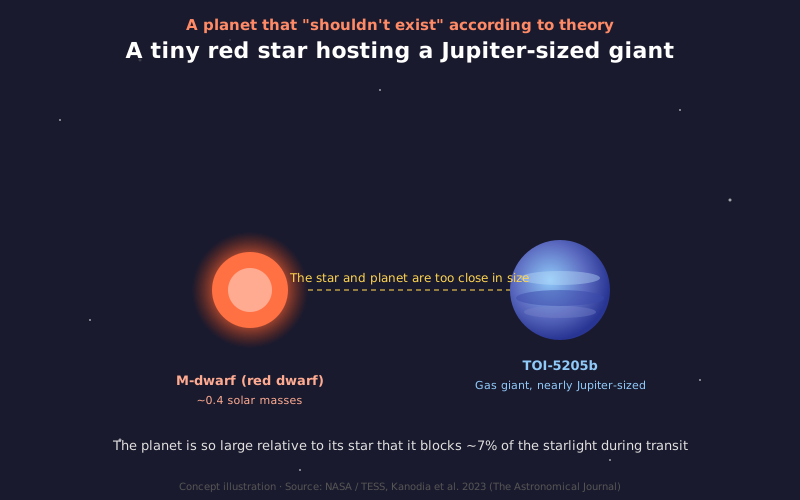
TOI-5205 sits about 285 light-years from Earth. It’s an M-dwarf — also called a red dwarf — a class of star that is far smaller and dimmer than the Sun. Its mass is roughly 0.4 solar masses, its surface temperature is low, and the light it emits skews reddish. M-dwarfs are actually the most common type of star in the galaxy, the unassuming “little red workers” that make up the bulk of stellar populations.
In 2023, an unexpected discovery arrived at this ordinary star. A massive gas planet — TOI-5205b — was found orbiting in close proximity. The discovery came from NASA’s planet-hunting satellite TESS, led by Shubham Kanodia and colleagues at the Carnegie Institution for Science (at the time).
The planet’s mass is nearly identical to Jupiter’s (about 1.08 Jupiter masses), and so is its size. Picture Jupiter transplanted wholesale into the neighborhood of a star barely half the Sun’s size. To appreciate just how strange that is, we need to walk through a bit of planet science.
The Star’s Light Drops 7% — Enter the Transit Method
First, the practical question: how do you find a planet 285 light-years away? The technique is called the transit method, and it’s the workhorse of exoplanet discovery.
When a planet crosses in front of its star, it blocks a tiny fraction of the starlight, causing a brief, measurable dip in brightness. By measuring how deep the dip is and how long it lasts, astronomers can infer the planet’s size and orbital period.
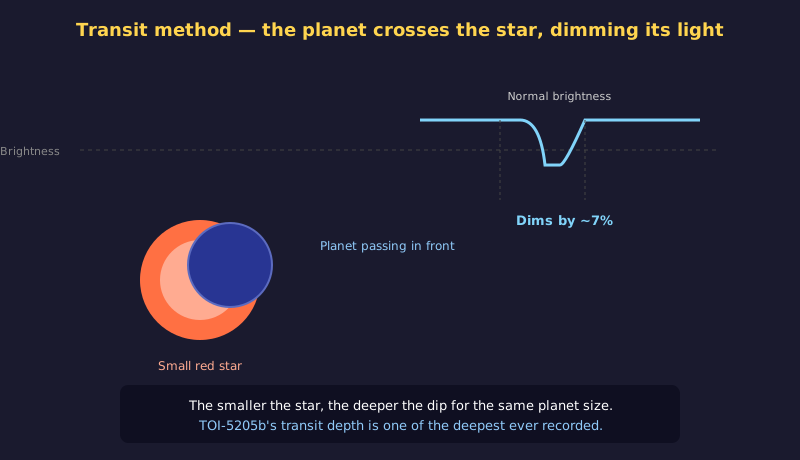
The key variable is the size ratio between star and planet. A small planet crossing a large star barely registers. But when the star is small and the planet is large, the dip is dramatic. In the case of TOI-5205b, the star dims by about 7% during each transit — one of the deepest transit depths ever recorded. It’s a bit like a child wearing an adult’s baseball glove: the sizes are obviously mismatched.
The orbital period is about 1.63 days. While Earth takes a year to circle the Sun, this giant completes its lap in under two days, racing around in an uncomfortably tight orbit.
Why “Forbidden”? There Wasn’t Enough Material to Build It
Now for the real puzzle. Why was this planet considered theoretically impossible?
The leading explanation for how gas giants form is called core accretion. The process works in stages: first, pebbles and icy chunks slowly aggregate into a solid core. Once that core reaches roughly ten times Earth’s mass, its gravity becomes strong enough to pull in huge amounts of hydrogen gas from the surrounding disk — and the result is a Jupiter-like giant.
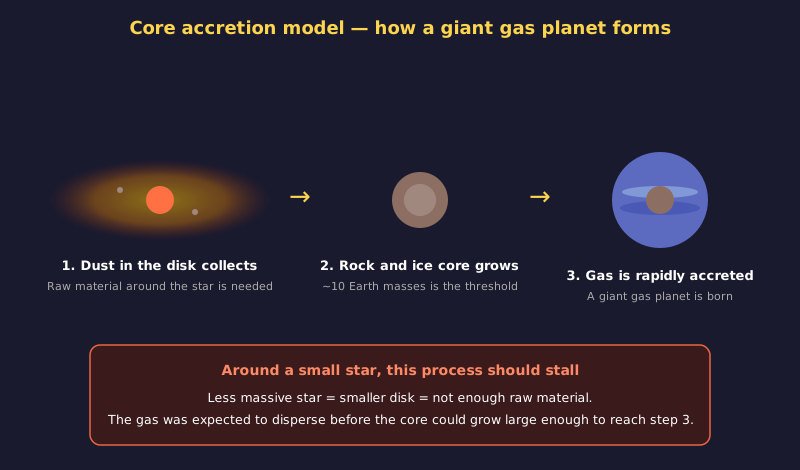
The catch is material. A newborn star is surrounded by a protoplanetary disk — a swirling reservoir of gas and dust from which planets draw their building blocks. But the disk’s mass scales roughly with the star’s mass. A lightweight star has a lightweight disk, meaning less stuff to work with.
Worse, the gas in that disk dissipates within a few million years. Around a small star with a thin, depleted disk, the expectation was that the core would never grow large enough before the gas disappeared — so no Jupiter-scale planet could form. That was the consensus prediction for decades.
And yet TOI-5205b is right there, doing exactly what the theory said it couldn’t. Researchers were understandably puzzled: how did a thin disk around a small star produce something this massive?
Then JWST Made It More Complicated
“Inexplicable existence” would be enough of a story. But it didn’t end there — the atmosphere threw researchers another curveball.
Enter the James Webb Space Telescope. JWST excels at reading planetary atmospheres in infrared light using a technique called transmission spectroscopy.
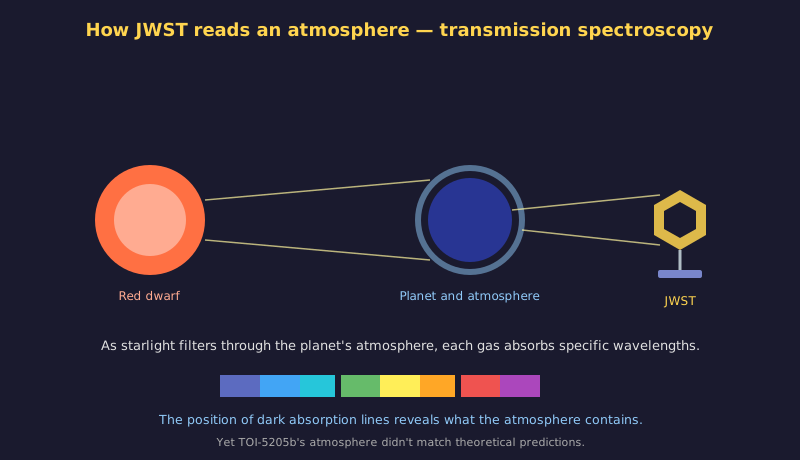
During a transit, a sliver of starlight passes through the outermost layers of the planet’s atmosphere. Different gases absorb different wavelengths of that light, leaving characteristic “missing colors” in the spectrum. By analyzing those gaps, astronomers can identify what the atmosphere is made of.
How a planet formed leaves fingerprints in its atmospheric composition — the abundances of various elements shift depending on where and how the planet assembled. Researchers hoped that reading TOI-5205b’s atmosphere might finally reveal how this forbidden world came to be.
Instead, the data refused to line up cleanly with any single formation scenario. The atmospheric signature didn’t match what the leading models predicted. Rather than solving the mystery, JWST added new layers to it.
It Exists. We Just Don’t Know How.
So where does that leave us? Researchers are exploring several possibilities.
One option is to stretch the core accretion model. Perhaps under certain conditions, even a small star’s disk can accumulate more material than expected, allowing a massive core to form quickly enough. The standard assumptions may be too conservative.
Another possibility is a completely different formation mechanism: gravitational instability, where a portion of the disk collapses directly under its own weight to form a planet in a single step. The trouble is that this process is also considered unlikely around low-mass stars, so it hasn’t emerged as a definitive answer.
The honest summary is that no one has cracked it yet. TOI-5205b is a living counterexample — a planet that forces theorists to confront the gap between their models and reality. In astronomy, objects that refuse to follow the rules tend to be the most productive: they show us exactly where our understanding falls short.
One Exception That Shakes the Textbook
A tiny red star, barely half the Sun’s mass. A gas giant almost the size of Jupiter locked in a 39-hour orbit around it. A combination that theory says shouldn’t form — yet there it is, 285 light-years away, going about its business.
The transit dims the star’s light by 7%. JWST’s look at the atmosphere only deepened the puzzle. Why this planet exists remains an open question.
Every so often, the universe produces one of these textbook-busting cases. Each time it does, we’re reminded that our picture of how planets form is still a work in progress. What answer will someone eventually find for the homework TOI-5205b has handed us? The next round of observations can’t come soon enough.